
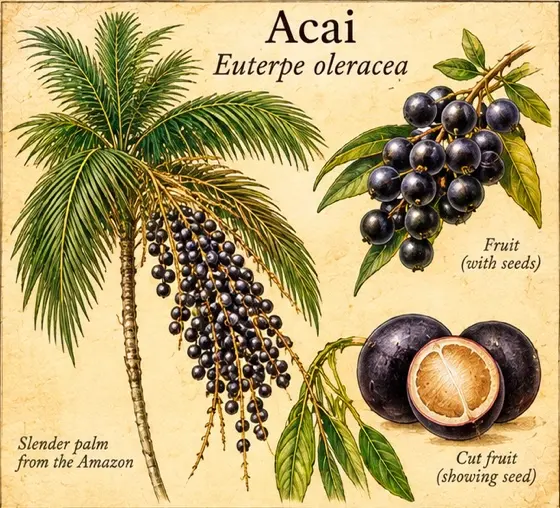
Açaí
Euterpe oleracea
The dark purple fruit of an Amazon palm, a staple food now sold worldwide as a superfruit. It didn't change cholesterol in trials, and contaminated açaí has caused outbreaks of Chagas disease in Brazil.
Safety at a glance
- PregnancyNothing recorded
- BreastfeedingNothing recorded
- MedicinesNothing recorded
- Who should avoid itNothing recorded
- AllergiesNothing recorded
- ToxicityNothing recorded
Tap a box to read the safety notes below. “Nothing recorded” means our sources don't cover it, not that it's safe.
What is Açaí?
- Plant family
- Arecaceae, the palm family
- Parts used
- The fruit pulp (as juice, frozen pulp or powder)
- Where it grows
- The Amazon basin
- Genus
- Euterpe
- Species
- oleracea
Also called
Acai, Açaí Berry, Açaí Palm
Traditionally used for
- Food and juice
- Antioxidant (lab research)
- Cholesterol (studied
- no effect)
Traditionally described as
- Rich in anthocyanins
- healthy fats and fiber
Health topics
Where Açaí appears in symptom search, and why. Being listed doesn't mean it's a proven treatment.
- High Cholesterol
A review of 8 studies found açaí didn't change cholesterol or triglycerides.
Natural compounds
Safety
Contamination
Açaí pulp or juice can be contaminated with the parasite that causes Chagas disease, a serious infection. Açaí was the food most often linked to outbreaks of Chagas disease caught from food in Brazil (32 of 64 outbreaks). Across Latin America, these outbreaks have killed about 6 in 100 people affected.[1]Review or trial
Technical detail: Trypanosoma cruzi; 114 outbreaks, 1,293 cases and 77 deaths (case fatality 5.95%) from 1965 to 2024; mainly sylvatic TcI/TcIV lineages and Rhodnius vectors.
In Pará, Brazil, 87% of acute Chagas disease cases from 2013 to 2023 were caught by mouth, and cases rose and fell with the açaí harvest. The authors call for food safety measures across the whole açaí production chain.[2]Study
What does the research say?
Traditional use
These are traditional uses, not proven treatments.
Açaí is the small dark purple fruit of a palm native to the Amazon basin. Long a staple food in the Amazon, it's now sold worldwide as a "superfruit". The pulp is rich in anthocyanins (dark plant pigments), polyphenols, healthy fats and fiber.[3]Study
Technical detail: main anthocyanin cyanidin-3-glucoside; fats include oleic and linoleic acids.
Laboratory & animal research
Lab and animal results show what might be worth studying in people. They don't show that the herb has these effects in humans.
In lab and animal studies, açaí has acted as an antioxidant and reduced inflammation, and has been studied for protecting the heart and liver and against weight gain. Evidence in people is still limited.[3]Study
Research in people
A 2025 review of 8 studies with 411 adults found that açaí didn't change LDL cholesterol, HDL cholesterol, total cholesterol or triglycerides.[4]Review or trial
Technical detail: LDL-C MD 6.06 mg/dL (95% CI −0.03 to 12.48; p = 0.06); HDL-C 0.30; total cholesterol 2.94; triglycerides 2.05 (all non-significant).
In short
Contaminated açaí pulp or juice can carry the Chagas disease parasite.
Sources
- [1] Orally transmitted Chagas disease outbreaks in Latin America: a comprehensive systematic review and public health implications · DOI: 10.3389/fpubh.2026.1911186Review or clinical trial
- [2] Epidemiology of Acute Chagas Disease in the Amazon: Association between the açaí production chain and case reports in Pará state, Brazil · DOI: 10.1590/0037-8682-0360-2025Peer-reviewed study
- [3] Bibliometric Insights and Recent Advances in the Science, Technology, and Sustainability of Açaí (Euterpe oleracea) from Amazonian Staple to Global Superfruit · DOI: 10.3390/foods15122203Peer-reviewed study
- [4] Investigating the Impact of Açai (Euterpe oleracea) on Lipid Profile: A Comprehensive Systematic Review and Meta-Analysis · DOI: 10.1111/nbu.12735Review or clinical trial
This information is educational and traditional in nature, and is not a substitute for professional medical advice. Unfamiliar word? See what these words mean.