
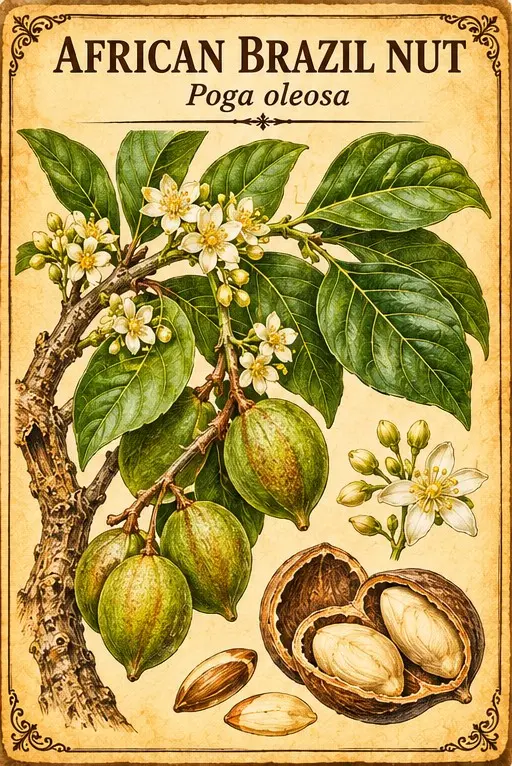
African Brazil Nut
Poga oleosa
A Central African rainforest tree whose oily seeds are a main wild food and source of fat for Baka people in Cameroon. Not related to the South American Brazil nut.
Safety at a glance
- PregnancyNothing recorded
- BreastfeedingNothing recorded
- MedicinesNothing recorded
- Who should avoid itNothing recorded
- AllergiesNothing recorded
- ToxicityNothing recorded
Tap a box to read the safety notes below. “Nothing recorded” means our sources don't cover it, not that it's safe.
What is African Brazil Nut?
- Plant family
- Anisophylleaceae, the anisophyllea family
- Parts used
- The seeds (nuts) and fruit
- Where it grows
- Central and West African rainforest
- Genus
- Poga
- Species
- oleosa
Regional names
Po'o
Traditionally used for
- Food
- Cooking oil (traditional)
Traditionally described as
- Oily
- edible seeds
Safety
Depends on how it's prepared
No human medical or safety studies were found.[1]Study
What does the research say?
Traditional use
These are traditional uses, not proven treatments.
A rainforest tree whose oily seeds are one of the most used wild foods of Baka people in Cameroon, eaten as a main food and used as a cooking ingredient in several recipes.[2]Study
The Baka rely heavily on its large fruits and seeds, and those of the related Panda oleosa, for their daily fat.[3]Study
Laboratory & animal research
Lab and animal results show what might be worth studying in people. They don't show that the herb has these effects in humans.
In rats, a fruit extract reduced swelling. It had a weak effect against bacteria in lab tests and none against yeast.[1]Study
In short
No human medical or safety studies were found.
Sources
- [1] Anti-inflammatory and antimicrobial activities of Hippocratea indica root bark and Poga oleosa fruitsPeer-reviewed study
- [2] Ethnobotanical survey of wild edible plants used by Baka people in southeastern Cameroon · DOI: 10.1186/s13002-020-00413-0Peer-reviewed study
- [3] The importance of choosing appropriate methods for assessing wild food plant knowledge and use: A case study among the Baka in Cameroon · DOI: 10.1371/journal.pone.0247108Peer-reviewed study
This information is educational and traditional in nature, and is not a substitute for professional medical advice. Unfamiliar word? See what these words mean.