
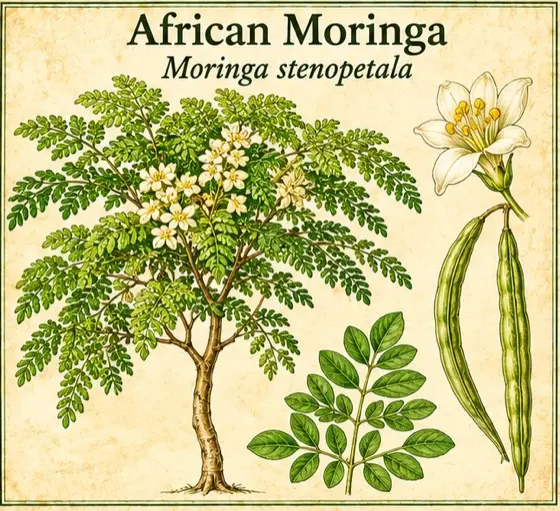
African Moringa
Moringa stenopetala
An Ethiopian relative of moringa whose leaves are a staple vegetable. People who ate it regularly had better vitamin A levels, and lower blood pressure and cholesterol, in Ethiopian studies.
Safety at a glance
- PregnancyNothing recorded
- BreastfeedingNothing recorded
- MedicinesNothing recorded
- Who should avoid itNothing recorded
- AllergiesNothing recorded
- ToxicityNothing recorded
Tap a box to read the safety notes below. “Nothing recorded” means our sources don't cover it, not that it's safe.
What is African Moringa?
- Plant family
- Moringaceae, the moringa family
- Parts used
- The leaves (also the seeds)
- Where it grows
- Southern Ethiopia and northern Kenya
- Genus
- Moringa
- Species
- stenopetala
Also called
Cabbage Tree, Ethiopian Moringa
Traditional names
Shiferaw
Traditionally used for
- Leaf vegetable
- Vitamin A (studied)
- High blood pressure and cholesterol (studied)
Traditionally described as
- Leaves eaten like cabbage; seeds used in folk medicine
Health topics
Where African Moringa appears in symptom search, and why. Being listed doesn't mean it's a proven treatment.
- High Blood Pressure
People who ate it alongside standard treatment had lower blood pressure in an Ethiopian study.
- High Blood Sugar
Studied in people with diabetes in southern Ethiopia.
- High Cholesterol
Linked to lower cholesterol and triglycerides in people with diabetes and hypertension.
Traditions that use it
- African Traditional Medicine
A staple leaf vegetable and traditional medicine in southern Ethiopia; crushed seeds in coffee are a folk remedy for high blood pressure.
How it's prepared
Common ways African Moringa is prepared or sold. This isn't advice on how to take it; see Safety below.
- Culinary Preparation
Leaves are cooked like cabbage and mixed with cereal flours.[1]Study
Safety
Side effects
African moringa leaves are eaten regularly as food in southern Ethiopia. There are no randomized trials of it as a medicine, so its effects alongside diabetes and blood pressure medicines haven't been properly tested.[2]Study
What does the research say?
Traditional use
These are traditional uses, not proven treatments.
African moringa is a tree related to the more familiar moringa (Moringa oleifera). It has long been used as food and traditional medicine in southern and southwestern Ethiopia. Its dark green leaves are cooked like cabbage and mixed with cereal flours in traditional dishes.[1]Study
In Ethiopian folk medicine, the seeds are crushed, mixed with a cup of coffee and drunk three times a day for high blood pressure.[3]Review or trial
Research in people
In a study at two hospitals in southern Ethiopia, people with diabetes and high blood pressure who regularly ate African moringa had lower cholesterol, LDL ("bad") cholesterol, triglycerides and blood pressure than those who didn't. Both groups were also on standard treatment. The groups came from different areas and weren't randomly assigned, so this doesn't prove moringa caused the difference.[2]Study
Technical detail: facility-based prospective cohort (Gidolie vs Chencha District Hospitals); mean systolic BP 127.83 vs 133.71 mmHg, diastolic 78.26 vs 81.24 (p < 0.001); total cholesterol 126.03 mg/dL in the moringa group.
Adults in southern Ethiopia who ate African moringa had higher vitamin A levels and less vitamin A deficiency than those who didn't. The more often they ate it, the higher their levels. This was a one-time comparison of two groups, not a trial.[1]Study
Technical detail: mean serum retinol 1.62 vs 1.24; daily consumers 1.88; vitamin A deficiency 19.85% in non-consumers (p < 0.005).
In short
No randomized trials; effects with diabetes and blood pressure medicines untested.
Sources
- [1] Impact of Moringa stenopetala dietary consumption on vitamin A deficiency and serum retinol levels among adults in Southern Ethiopia: a multicenter comparative cross-sectional study · DOI: 10.1186/s40795-026-01313-4Peer-reviewed study
- [2] Facility-based prospective cohort study to evaluate Moringa stenopetala based diet consumption in management of diabetes and hypertension in South Ethiopia · DOI: 10.1038/s41598-026-38009-5Peer-reviewed study
- [3] Medicinal Plants Traditionally Utilized in Ethiopia for the Treatment of Hypertension: A Systematic Review · DOI: 10.1002/hsr2.71586Review or clinical trial
This information is educational and traditional in nature, and is not a substitute for professional medical advice. Unfamiliar word? See what these words mean.