
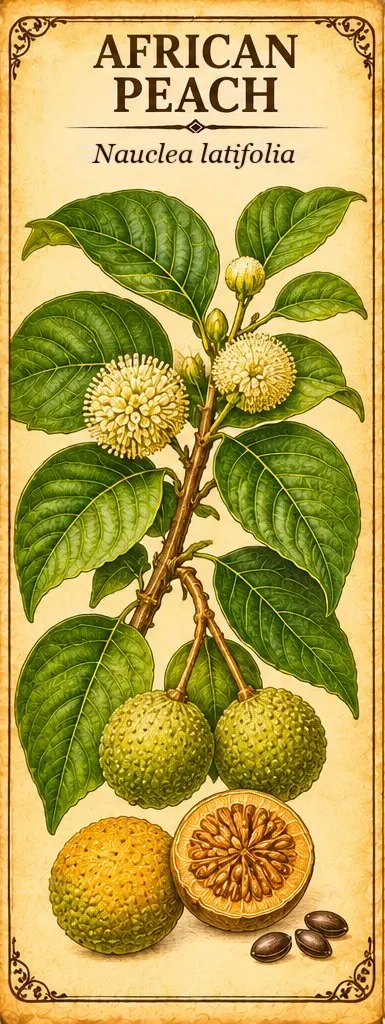
African Peach
Nauclea latifolia
A tropical African tree used for malaria, fever, pain and epilepsy. A root decoction eased fever and pain in mice, and leaf extracts lowered blood sugar in rats.
Safety at a glance
- PregnancyNothing recorded
- BreastfeedingNothing recorded
- MedicinesNothing recorded
- Who should avoid itNothing recorded
- AllergiesNothing recorded
- ToxicityNothing recorded
Tap a box to read the safety notes below. “Nothing recorded” means our sources don't cover it, not that it's safe.
What is African Peach?
- Plant family
- Rubiaceae, the coffee family
- Parts used
- The roots, leaves and fruit
- Where it grows
- Tropical Africa
- Genus
- Nauclea
- Species
- latifolia
Traditionally used for
- Malaria
- Fever
- Pain
- Epilepsy (traditional)
Traditionally described as
- Root
- leaf and fruit studied
Health topics
Where African Peach appears in symptom search, and why. Being listed doesn't mean it's a proven treatment.
- Fever
A traditional fever and malaria remedy; a root decoction reduced fever in mice. Not tested in people.
- High Blood Sugar
Leaf extracts lowered blood sugar in diabetic rats. Not tested in people.
Safety
Depends on how it's prepared
No human medical or safety studies were found.[1]Study
What does the research say?
Traditional use
These are traditional uses, not proven treatments.
A small tropical African tree used in traditional medicine for malaria, epilepsy, anxiety, pain and fever.[1]Study
In Benin it's among the plants used for snakebite, though few studies have looked at that use.[2]Review or trial
Laboratory & animal research
Lab and animal results show what might be worth studying in people. They don't show that the herb has these effects in humans.
In short
No human medical or safety studies were found.
Sources
- [1] Antipyretic and antinociceptive effects of Nauclea latifolia root decoction and possible mechanisms of action · DOI: 10.3109/13880209.2010.492479Peer-reviewed study
- [2] Traditional medicinal knowledge and diversity of medicinal plants in Benin: a systematic review (2014-2023) · DOI: 10.1186/s12906-026-05440-0Review or clinical trial
- [3] Hypoglycaemic activity of Nauclea latifolia Sm. (Rubiaceae) in experimental animals · DOI: 10.4314/ajtcam.v5i2.31274Peer-reviewed study
- [4] Anthelmintic efficacy of Nauclea latifolia extract against gastrointestinal nematodes of sheep: in vitro and in vivo studiesPeer-reviewed study
This information is educational and traditional in nature, and is not a substitute for professional medical advice. Unfamiliar word? See what these words mean.