
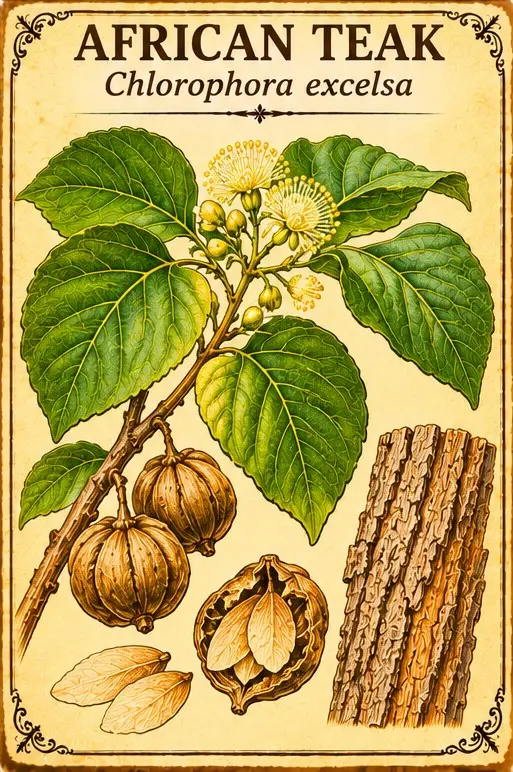
African Teak
Milicia excelsa
Iroko, a large African timber tree whose root is a traditional remedy for missed periods and diarrhea. A root extract acted like estrogen in rats.
Safety at a glance
- PregnancyNothing recorded
- BreastfeedingNothing recorded
- MedicinesNothing recorded
- Who should avoid itNothing recorded
- Allergies1 note →
- ToxicityNothing recorded
Tap a box to read the safety notes below. “Nothing recorded” means our sources don't cover it, not that it's safe.
What is African Teak?
- Plant family
- Moraceae, the fig and mulberry family
- Parts used
- The roots, root bark and stem bark
- Where it grows
- Tropical Africa
- Genus
- Milicia
- Species
- excelsa
Also called
Iroko
Older scientific names
Chlorophora excelsa
Traditionally used for
- Missed periods
- Diarrhea (traditional)
Traditionally described as
- Root contains flavonoids and tannins
Health topics
Where African Teak appears in symptom search, and why. Being listed doesn't mean it's a proven treatment.
- Diarrhea
A traditional diarrhea remedy; reduced diarrhea in rats. Not tested in people.
Safety
Allergies
Dust from iroko wood can cause allergic skin rashes, even through the air.[1]Study
Depends on how it's prepared
The root acts like estrogen in animal studies. It hasn't been studied in people.[2]Study
What does the research say?
Traditional use
These are traditional uses, not proven treatments.
A large tropical African timber tree, also called iroko. Its root is a traditional remedy for missed periods (amenorrhea), and its root bark for diarrhea.[2]Study
Laboratory & animal research
Lab and animal results show what might be worth studying in people. They don't show that the herb has these effects in humans.
In young female rats, a root extract raised estrogen-related hormones and sped sexual maturity, behaving somewhat like the plant estrogen genistein.[2]Study
In rats with a model of polycystic ovary syndrome (PCOS), a root extract reversed hormone and ovary changes.[3]Study
In rats, a root bark extract reduced diarrhea and slowed the gut.[4]Study
In short
Wood dust can cause allergic skin rashes.
Sources
- [1] Airborne allergic contact dermatitis from iroko (Chlorophora excelsa) · DOI: 10.1111/j.1600-0536.1998.tb05750.xPeer-reviewed study
- [2] Emmenagogue properties of Milicia excelsa (Welw.) C.C. Berg (Moraceae) based, at least in part, on its ability to correlate the activity of the hypothalamic-pituitary axis to that of the ovaries · DOI: 10.1016/j.jep.2017.06.005Peer-reviewed study
- [3] Milicia excelsa (Moraceae) reversed the effects of letrozole-induced aromatase inhibition in rats with polycystic ovary syndrome · DOI: 10.1515/jcim-2022-0352Peer-reviewed study
- [4] Evaluation of Anti-Diarrheal Activity of Methanol Root Bark Extract of Milicia Excelsa (Welw) C. C Berg (Moraceae) in Rats · DOI: 10.1055/a-0825-6337Peer-reviewed study
This information is educational and traditional in nature, and is not a substitute for professional medical advice. Unfamiliar word? See what these words mean.