
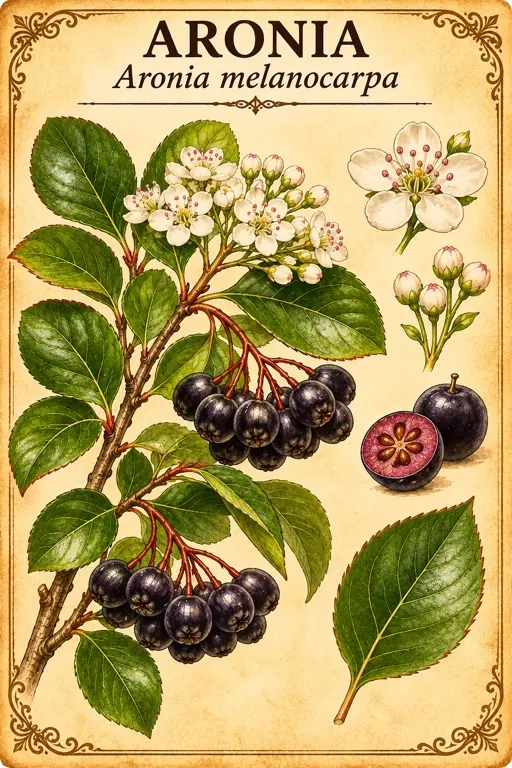
Aronia
Aronia melanocarpa
A shrub from eastern North America with very tart black berries rich in anthocyanins. Drunk as juice or taken as powder, it has been tested in many small trials, but reviews found no clear effect on weight, blood sugar, cholesterol or blood pressure.
Safety at a glance
- PregnancyNothing recorded
- BreastfeedingNothing recorded
- MedicinesNothing recorded
- Who should avoid itNothing recorded
- AllergiesNothing recorded
- ToxicityNothing recorded
Tap a box to read the safety notes below. “Nothing recorded” means our sources don't cover it, not that it's safe.
What is Aronia?
- Plant family
- Rosaceae, the rose family
- Parts used
- The berries (as juice, powder or extract)
- Where it grows
- Eastern North America
- Genus
- Aronia
- Species
- melanocarpa
Also called
Black Chokeberry, Chokeberry, Aronia Berry
Older scientific names
Photinia melanocarpa
Traditionally used for
- Juice and food coloring
- Antioxidant supplement
- Cholesterol and blood pressure (studied)
- Urinary tract infections (early research)
Traditionally described as
- Rich in anthocyanins
- proanthocyanidins and chlorogenic acid; very tart and astringent
Health topics
Where Aronia appears in symptom search, and why. Being listed doesn't mean it's a proven treatment.
- Bladder and Urinary Tract Infections (UTIs)
One study in nursing home residents found fewer infections with aronia juice; lab studies show antibacterial effects.
- High Blood Pressure
No overall effect in pooled trials; blood pressure fell only with higher-anthocyanin products, in a subgroup analysis.
- High Blood Sugar
Two reviews of trials found aronia didn't lower fasting blood sugar.
- High Cholesterol
Pooled trials found no overall effect on cholesterol; small subgroups suggested a possible drop. Evidence is very low certainty.
Natural compounds
Safety
How much to use
Trials have used between 90 mg a day of extract in capsules and 300 mL (about 10 fl oz) a day of juice. There's no established dose.[1]Review or trial
Technical detail: supplementation lasted at least 2 weeks; forms were extracts, powders and juices with widely varying anthocyanin content.
What does the research say?
Traditional use
These are traditional uses, not proven treatments.
Black chokeberry is a shrub from eastern North America. It has long been valued as both a food and a medicinal plant.
Today the berries are used in juices, sports drinks, natural food colorings and preservatives.[2]Study
Technical detail: applications include sports nutrition products, natural antioxidant additives, natural pigments and food preservation.
The fresh berries taste very sour and drying in the mouth, which is likely why trials have used juice, powder or capsules instead.[1]Review or trial
Technical detail: none of the included trials used fresh chokeberry, likely because of its astringent, tart taste.
Laboratory & animal research
Lab and animal results show what might be worth studying in people. They don't show that the herb has these effects in humans.
The berries are rich in polyphenols (antioxidant plant compounds), especially the dark pigments called anthocyanins. In lab and animal studies they've been tested for protecting the liver, nerves and blood vessels, reducing inflammation, and acting against tumors.
The review notes that studies in people are still limited.[2]Study
Technical detail: main anthocyanin cyanidin-3-O-galactoside (19–1282 mg/100 g). Reported activities: antioxidant, anti-inflammatory, hepatoprotective, neuroprotective, cardiometabolic-regulating and antitumor, via Nrf2/KEAP1, NF-κB/MAPK and PI3K/Akt signaling and inhibition of ferroptosis.
In lab tests, compounds from aronia slowed the growth of several kinds of bacteria and stopped them forming sticky films (biofilms). In mice, aronia juice eased a gut infection.
One study in nursing home residents found fewer urinary tract infections among those given aronia juice. The authors say clinical trials are needed.[3]Study
Technical detail: stronger against Gram-positive than Gram-negative bacteria; prophylactic juice alleviated Listeria monocytogenes enteritis in mice and reduced growth of caries-causing streptococci.
Research in people
A 2025 review pooled 10 trials with 666 adults who took aronia juice, powder or extract for at least 2 weeks. Overall, it didn't improve weight, blood sugar, cholesterol or blood pressure.
In smaller subgroups, cholesterol fell in people whose cholesterol was already normal, and blood pressure fell with higher-anthocyanin products. In people aged 50 or under, fasting blood sugar rose slightly. The certainty of all these results was rated very low.[1]Review or trial
Technical detail: random-effects meta-analysis with trial sequential analysis and GRADE. Subgroups: total cholesterol and LDL-C fell when baseline total cholesterol was under 200 mg/dL; systolic BP fell with more than 50 mg/day anthocyanins. Doses ranged from 90 mg/day (capsules) to 300 mL/day (juice).
A 2026 review of 7 trials found that aronia didn't lower fasting blood sugar, body weight, body mass index or waist size.[4]Review or trial
Technical detail: FBS WMD 0.05 mmol/L (95% CI −0.05 to 0.16); body weight WMD −0.66 kg (95% CI −2.54 to 1.22); no subgroup effects on weight or BMI. Most trials used 300 mL/day of chokeberry juice.
In short
There's no established dose; trials used up to 300 mL of juice a day.
Sources
- [1] Impact of a Chokeberry (Aronia melanocarpa (Michx.) Elliott) Supplementation on Cardiometabolic Outcomes: A Critical Systematic Review and Meta-Analysis of Randomized Controlled Trials · DOI: 10.3390/nu17091488Review or clinical trial
- [2] A Review of Aronia melanocarpa's Phytochemical Profile, Health Benefits, and Applications in Agri-Food Systems · DOI: 10.3390/foods15101627Peer-reviewed study
- [3] A review of the anti-bacterial effects exerted by Aronia melanocarpa · DOI: 10.1556/1886.2024.00139Peer-reviewed study
- [4] The Effect of Aronia melanocarpa (Chokeberry) on Body Weight and Fasting Blood Sugar: A Systematic Review and Meta-Analysis of Randomised Controlled Trials · DOI: 10.1002/edm2.70139Review or clinical trial
This information is educational and traditional in nature, and is not a substitute for professional medical advice. Unfamiliar word? See what these words mean.