
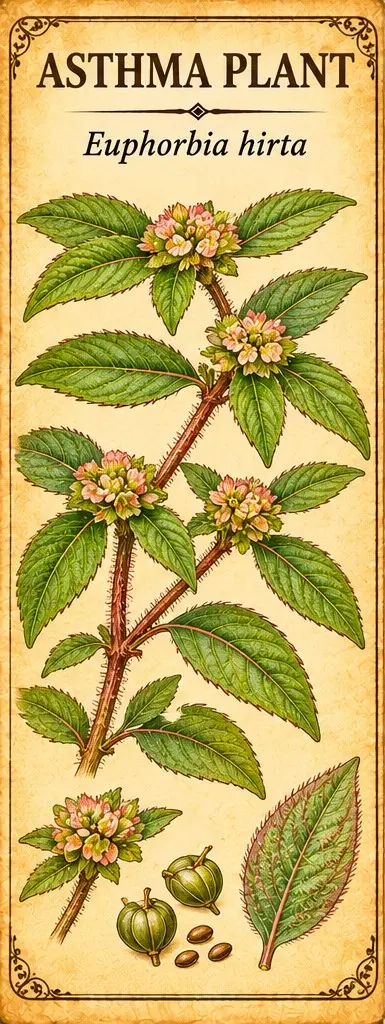
Asthma Plant
Euphorbia hirta
A tropical plant used in folk medicine for asthma, coughs, diarrhea and skin problems, and to increase breast milk. Its white sap irritates skin and eyes.
Safety at a glance
- PregnancyNothing recorded
- Breastfeeding1 note →
- MedicinesNothing recorded
- Who should avoid itNothing recorded
- AllergiesNothing recorded
- ToxicityNothing recorded
Tap a box to read the safety notes below. “Nothing recorded” means our sources don't cover it, not that it's safe.
What is Asthma Plant?
- Plant family
- Euphorbiaceae, the spurge family
- Parts used
- The whole plant and leaves
- Where it grows
- Tropical regions worldwide
- Genus
- Euphorbia
- Species
- hirta
Regional names
Amman Pacharisi
Traditionally used for
- Asthma
- Coughs
- Diarrhea
- Breast milk (traditional)
Traditionally described as
- Extracts kill bacteria in lab tests
Health topics
Where Asthma Plant appears in symptom search, and why. Being listed doesn't mean it's a proven treatment.
- Asthma and Wheezing
Traditionally used for asthma and bronchitis, which gives it its name. Not tested for asthma in people.
- Breast Milk Supply
Used in India, Indonesia and Angola to increase milk, but no valid trials support it.
- Cancer Research
Animal studies only: a leaf extract shrank tumors in mice. Not tested against cancer in people.
- Diarrhea
A traditional remedy for diarrhea and worms. Not studied in people.
Traditions that use it
- Ayurveda
Used in Siddha and other Indian traditional medicine as Amman Pacharisi.
Safety
Side effects
The white sap can cause skin allergy and can damage the eyes if it gets in them. Taken by mouth, Euphorbia can cause nausea and vomiting.[1]Health agency
Breastfeeding
There's no information on whether its compounds pass into breast milk, and no valid trials show it increases milk.[1]Health agency
What does the research say?
Traditional use
These are traditional uses, not proven treatments.
Asthma plant is used for asthma, bronchitis, hay fever, coughs and colds; for diarrhea, worms, stomach ulcers, heartburn and vomiting; and on the skin for warts, scabies, ringworm and thrush.[2]Study
In India, Indonesia and Angola it's used to increase breast milk, but no valid clinical trials support this. Some animal evidence found a Euphorbia extract raised prolactin, the milk-making hormone.[1]Health agency
Laboratory & animal research
Lab and animal results show what might be worth studying in people. They don't show that the herb has these effects in humans.
A 2026 review of 27 lab studies found its extracts slowed the growth of several drug-resistant bacteria, including Staphylococcus aureus, E. coli and Pseudomonas.[3]Review or trial
In mice, a leaf extract caused no deaths, organ damage or DNA damage at a high single dose, and shrank tumors.[4]Study
In short
The sap irritates skin and eyes; by mouth it can cause nausea and vomiting.
Sources
- [1] Euphorbia. In: Drugs and Lactation Database (LactMed) — National Library of Medicine (US), National Institutes of HealthGovernment health agency
- [2] Determination of Phytochemical Properties "Amman Pacharisi"-Euphorbia hirta Linn. · DOI: 10.4103/jpbs.jpbs_822_24Peer-reviewed study
- [3] Euphorbia hirta L. as a potential resistance-modifying agent against ESKAPE pathogens: a systematic review · DOI: 10.3389/fphar.2026.1862731Review or clinical trial
- [4] Phytochemical Profile, Toxicological Screening, Antitumor Activity, and Immunomodulatory Response of Saline Extract from Euphorbia hirta L. Leaves · DOI: 10.3390/molecules30153105Peer-reviewed study
This information is educational and traditional in nature, and is not a substitute for professional medical advice. Unfamiliar word? See what these words mean.