
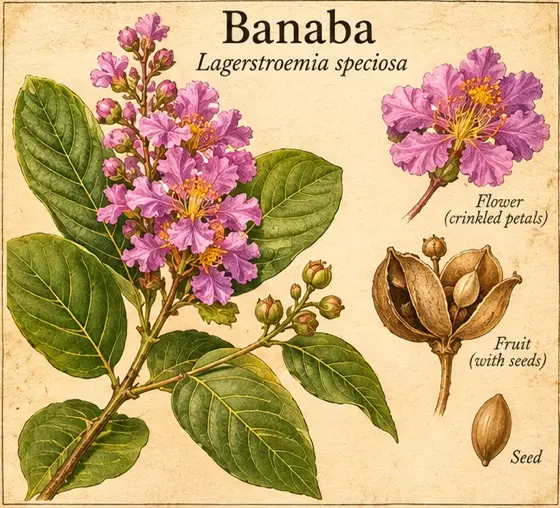
Banaba
Lagerstroemia speciosa
A flowering tree from tropical Asia whose leaves are a folk remedy for diabetes. Its compound corosolic acid, nicknamed plant insulin, lowered blood sugar in small trials.
Safety at a glance
- PregnancyNothing recorded
- BreastfeedingNothing recorded
- MedicinesNothing recorded
- Who should avoid itNothing recorded
- AllergiesNothing recorded
- ToxicityNothing recorded
Tap a box to read the safety notes below. “Nothing recorded” means our sources don't cover it, not that it's safe.
What is Banaba?
- Plant family
- Lythraceae, the loosestrife family, which includes pomegranate
- Parts used
- The leaves
- Where it grows
- Tropical Asia, including India, Southeast Asia and the Philippines
- Genus
- Lagerstroemia
- Species
- speciosa
Also called
Queen's Crape Myrtle, Pride of India
Regional names
Jarul
Traditionally used for
- Blood sugar (traditional and studied)
- Metabolic syndrome (studied)
Traditionally described as
- Leaves rich in corosolic acid and ellagitannins
Health topics
Where Banaba appears in symptom search, and why. Being listed doesn't mean it's a proven treatment.
- High Blood Pressure
Systolic blood pressure fell in a small 12-week trial in people with metabolic syndrome.
- High Blood Sugar
A traditional diabetes remedy; small trials found banaba and corosolic acid lowered blood sugar.
Natural compounds
Safety
Side effects
Corosolic acid, the main active compound in banaba supplements, was linked to sudden kidney damage and lactic acidosis (a dangerous build-up of acid in the blood) in a person who already had poor kidney function.[1]Study
A 2012 review found no side effects reported in animal studies or controlled human trials of banaba.[2]Study
What does the research say?
Traditional use
These are traditional uses, not proven treatments.
Banaba is a flowering tree. Its leaf extracts have been used for many years in folk medicine to treat diabetes. The first research study on it was published in 1940.[2]Study
Laboratory & animal research
Lab and animal results show what might be worth studying in people. They don't show that the herb has these effects in humans.
The leaves' blood-sugar-lowering effect is linked to corosolic acid and to tannins called ellagitannins. In lab and animal studies, corosolic acid has also been studied for effects on blood fats, inflammation, germs and cancer. It seems to work in several ways, such as helping cells take up sugar and slowing the breakdown of starches.[2]Study
Technical detail: proposed mechanisms include enhanced cellular glucose uptake, impaired hydrolysis of sucrose and starch, decreased gluconeogenesis and lipid regulation via PPAR, MAPK and NF-κB.
Corosolic acid is sometimes called "plant insulin". A 2026 review found promising lab and animal results, but a big gap remains between these findings and solid proof in people.[3]Study
Technical detail: reported preclinical activities are hypoglycemic, anticancer, anti-inflammatory, antioxidant and cardiovascular-protective, via pathways including AMPK, NF-κB and YAP.
Research in people
Pure corosolic acid has been reported to lower blood sugar within 60 minutes in people.[2]Study
In a 12-week trial with 24 people with metabolic syndrome, banaba (500 mg twice a day) lowered fasting blood sugar, systolic blood pressure and triglycerides compared with the start. 8 of the 12 people taking banaba no longer met the criteria for metabolic syndrome. The trial was very small.[4]Study
Technical detail: randomized, double-blind, placebo-controlled (NCT02767869). Systolic BP 121.5 → 116.3 mmHg; fasting glucose 5.9 → 5.7 mmol/L; triglycerides 2.3 → 1.7 mmol/L; insulin AUC and total insulin secretion also fell.
In short
Corosolic acid was linked to kidney damage in a person with poor kidney function.
Sources
- [1] Corosolic acid-induced acute kidney injury and lactic acidosis in a patient with impaired kidney function · DOI: 10.1053/j.ajkd.2010.06.002Peer-reviewed study
- [2] A review of the efficacy and safety of banaba (Lagerstroemia speciosa L.) and corosolic acid · DOI: 10.1002/ptr.3664Peer-reviewed study
- [3] A review of the pharmacological mechanism of corosolic acid · DOI: 10.3389/fphar.2026.1723882Peer-reviewed study
- [4] Effect of Banaba (Lagerstroemia speciosa) on Metabolic Syndrome, Insulin Sensitivity, and Insulin Secretion · DOI: 10.1089/jmf.2021.0039Peer-reviewed study
This information is educational and traditional in nature, and is not a substitute for professional medical advice. Unfamiliar word? See what these words mean.