
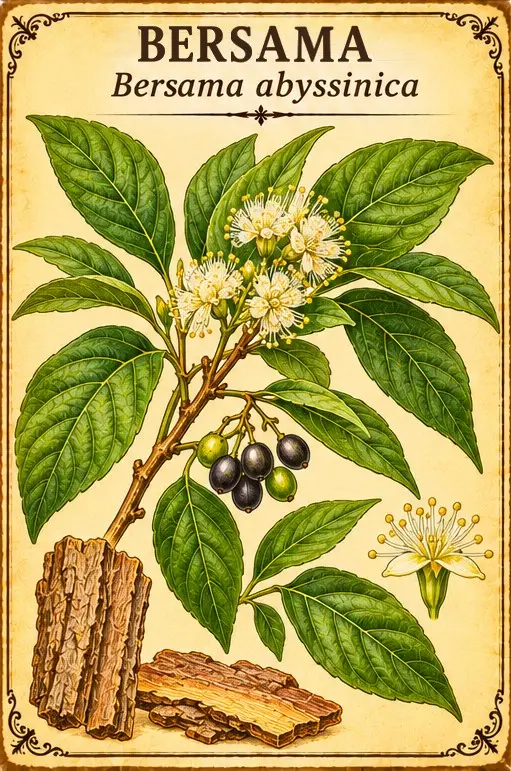
Bersama
Bersama abyssinica
An African shrub whose bark and leaves are used for colic, diarrhea, worms and liver ailments. It contains heart-active compounds and has poisoned livestock.
Safety at a glance
- PregnancyNothing recorded
- BreastfeedingNothing recorded
- MedicinesNothing recorded
- Who should avoid itNothing recorded
- AllergiesNothing recorded
- Toxicity1 note →
Tap a box to read the safety notes below. “Nothing recorded” means our sources don't cover it, not that it's safe.
What is Bersama?
- Plant family
- Melianthaceae, the honey-flower family
- Parts used
- The bark, leaves and roots
- Where it grows
- Tropical Africa, from Ethiopia to Angola
- Genus
- Bersama
- Species
- abyssinica
Traditionally used for
- Diarrhea
- Worms
- Liver ailments
- Diabetes (traditional)
Traditionally described as
- Contains cardiac glycosides and mangiferin
Health topics
Where Bersama appears in symptom search, and why. Being listed doesn't mean it's a proven treatment.
- Diarrhea
A traditional remedy for diarrhea and dysentery. Not tested in people.
- High Blood Sugar
Lowered blood sugar in diabetic mice. Not tested in people.
Safety
Toxicity testing
It contains cardiac glycosides, compounds that act on the heart and can affect the gut, nerves and breathing. Its leaves have been linked to deaths of cattle and other animals, so the dose matters.[1]Study
Depends on how it's prepared
No human medical or safety studies were found.[1]Study
What does the research say?
Traditional use
These are traditional uses, not proven treatments.
A shrub or small tree whose bark, leaves and roots are boiled for colic, diarrhea, dysentery and worms, and used for rheumatism, diabetes, malaria, hemorrhoids, epilepsy and sexually transmitted infections. In southern Ethiopia the bark is used for liver ailments and snakebite.[1]Study
Laboratory & animal research
Lab and animal results show what might be worth studying in people. They don't show that the herb has these effects in humans.
In short
Contains heart-active cardiac glycosides; has poisoned animals.
Sources
- [1] The ethnomedicine, phytochemistry, and pharmacological properties of the genus Bersama: current review and future perspectives · DOI: 10.3389/fphar.2024.1366427Peer-reviewed study
- [2] Effect of Crude Leaves Extract of Bersama abyssinica on Blood Glucose Level and Serum Lipid Level of Streptozotocin-Induced Diabetic Mice: Evidence for in vivo Antidiabetic Activity · DOI: 10.2174/1871525719666210726114802Peer-reviewed study
- [3] Hepatoprotective Effect of Bersama abyssinica Fresen Leaf Methanolic Extract on Paracetamol-Induced Hepatotoxicity in Swiss Albino Mice · DOI: 10.1177/27536130251405227Peer-reviewed study
This information is educational and traditional in nature, and is not a substitute for professional medical advice. Unfamiliar word? See what these words mean.