
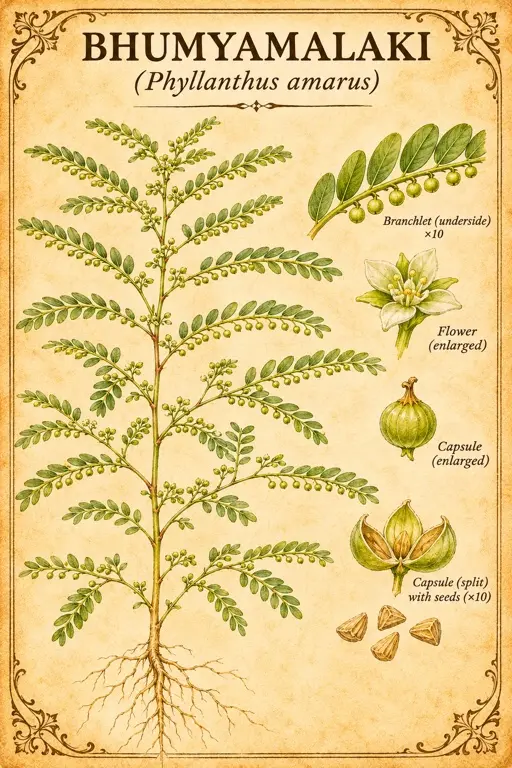
Bhumyamalaki
Phyllanthus amarus
A small, bitter Ayurvedic herb used for the liver, kidneys and digestion. It has been studied for hepatitis B, but Cochrane reviews found no convincing benefit when it's used on its own.
Safety at a glance
- PregnancyNothing recorded
- BreastfeedingNothing recorded
- MedicinesNothing recorded
- Who should avoid itNothing recorded
- AllergiesNothing recorded
- ToxicityNothing recorded
Tap a box to read the safety notes below. “Nothing recorded” means our sources don't cover it, not that it's safe.
What is Bhumyamalaki?
- Plant family
- Phyllanthaceae, the leafflower family
- Parts used
- The whole plant
- Genus
- Phyllanthus
- Species
- amarus
Also called
Stonebreaker, Carry Me Seed
Regional names
Bhumi Amla, Keezhanelli
Traditionally used for
- Liver problems
- Hepatitis B
- Urinary problems
- Diarrhea (traditional)
Traditionally described as
- Bitter; rich in lignans
- flavonoids and tannins
Health topics
Where Bhumyamalaki appears in symptom search, and why. Being listed doesn't mean it's a proven treatment.
- Diarrhea
Traditionally used for diarrhea and dysentery.
- Fever
Traditionally used for fevers that come and go.
- High Blood Pressure
Blood pressure fell in some people in a small 10-day study with no comparison group.
- High Blood Sugar
Blood sugar fell in a small 10-day study of 9 people with no comparison group.
- Joint Discomfort
A gel made from the plant, applied with ultrasound, eased knee arthritis pain in a 40-person trial.
- Liver Disease (Hepatitis, Cirrhosis)
Traditionally used for the liver. Cochrane reviews of hepatitis B trials found no convincing benefit when it's used on its own.
Traditions that use it
- Ayurveda
An important Ayurvedic plant for the stomach, liver, kidneys, spleen and urinary system.
Safety
Side effects
In hepatitis B trials, no serious side effects were reported. Only 2 of 16 trials gave numbers for side effects.[1]Review or trial
In the hangover trial, side effects were no more common than with the placebo.[2]Study
What does the research say?
Traditional use
These are traditional uses, not proven treatments.
An important plant in Ayurveda, used for problems of the stomach, liver, kidneys and spleen, and of the urinary and genital organs. It's described as bitter.[3]Study
The whole plant has also been used for:
- diarrhea and dysentery
- fevers that come and go
- gonorrhea, heavy periods and other genital problems
- eye problems, scabies, ulcers and wounds
Laboratory & animal research
Lab and animal results show what might be worth studying in people. They don't show that the herb has these effects in humans.
In lab and animal studies, extracts and compounds from the plant showed many effects, including against viruses, bacteria and malaria parasites, lowering blood sugar and cholesterol, and protecting the liver and kidneys. Most of these haven't been tested in people.[3]Study
Technical detail: reported constituents include lignans, flavonoids, hydrolysable tannins (ellagitannins), polyphenols, triterpenes, sterols and alkaloids; reported activities include antiviral, antibacterial, antiplasmodial, anti-inflammatory, anticancer, antidiabetic, hypolipidemic, antioxidant, hepatoprotective, nephroprotective and diuretic effects.
Research in people
In an early study of people carrying hepatitis B, 22 of 37 (59%) who took the plant for 30 days lost a key sign of the virus in their blood, compared with 1 of 23 (4%) who took a placebo. Few or no side effects were seen. Later trials didn't confirm this result (see below).[4]Study
Technical detail: loss of hepatitis B surface antigen (HBsAg) 15–20 days after treatment; some people were followed for up to 9 months.
A Cochrane review of 16 trials (1,326 people) found no convincing evidence that phyllanthus plants, the group that includes bhumyamalaki, help chronic hepatitis B compared with a placebo.
Adding phyllanthus to antiviral medicines may have worked better than the medicines alone, but the trials had serious weaknesses, so this isn't reliable. No serious side effects were reported.[1]Review or trial
Technical detail: only 1 trial (42 people) used a placebo, with no difference in HBeAg seroconversion (RR 0.9; 95% CI 0.73 to 1.25). In 15 add-on trials, phyllanthus plus antivirals affected serum HBV DNA (RR 0.69), HBeAg (RR 0.70) and HBeAg seroconversion (RR 0.77), with substantial heterogeneity; the HBV DNA result wasn't supported by trial sequential analysis. Most trials didn't report which species was used.
A second Cochrane review compared phyllanthus with antiviral medicines in 5 trials (290 people). All the trials had a high risk of bias, and the review found too little evidence to support or rule out phyllanthus for chronic hepatitis B.[5]Review or trial
Technical detail: "compound phyllanthus" for 3–12 months versus lamivudine, interferon alpha or thymosin. HBeAg clearance favoured phyllanthus in conventional meta-analysis (RR 0.76) but not after trial sequential analysis; no difference in HBsAg (RR 1.00) or HBV DNA clearance (RR 0.83). No adverse event data were reported.
In a small study without a comparison group, 9 people with mild high blood pressure (4 of whom also had diabetes) took the whole plant for 10 days. They passed more urine, and their blood sugar fell. Blood pressure fell in those without diabetes and in the women. No harmful side effects were seen.[6]Study
Technical detail: significant increases in 24-hour urine volume and in urine and serum sodium; significant fall in systolic blood pressure in non-diabetic and female participants.
In a trial with 15 adults, a leaf extract (750 mg a day for 10 days) was taken before drinking alcohol. Compared with a placebo, people had milder hangover symptoms, such as less nausea, headache and dizziness, and alcohol cleared from their blood faster. Some of the researchers worked for the company that makes the extract.[2]Study
Technical detail: randomized, double-blind, placebo-controlled crossover study of PHYLLPRO, a standardized ethanol extract; the placebo group still had 0.05% blood alcohol 12 hours after drinking (p < 0.0001). Hangover Severity Score differences at hour 10 (p < 0.05). First author affiliated with Biotropics Malaysia Berhad.
In a trial with 40 people with knee arthritis, both groups had 10 sessions of ultrasound therapy. Those treated with a gel made from the plant had less knee pain and walked further in 6 minutes than those treated with a plain gel.[7]Study
Technical detail: randomized, double-blind trial of phonophoresis with P. amarus nanoparticle gel versus ultrasound with a non-drug coupling gel (1.0 W/cm², 10 minutes per session); VAS pain and 6-minute walk test both improved more in the phonophoresis group (p < 0.05).
In short
Hepatitis B needs medical care; don't use it in place of treatment.
Sources
- [1] Phyllanthus species for chronic hepatitis B virus infection — Cochrane Database of Systematic Reviews · DOI: 10.1002/14651858.CD008960.pub2Review or clinical trial
- [2] Effects of Phyllanthus amarus PHYLLPRO leaves on hangover symptoms: a randomized, double-blind, placebo-controlled crossover study · DOI: 10.1080/13880209.2019.1585460Peer-reviewed study
- [3] Phyllanthus amarus: ethnomedicinal uses, phytochemistry and pharmacology: a review · DOI: 10.1016/j.jep.2011.09.040Peer-reviewed study
- [4] Effect of Phyllanthus amarus on chronic carriers of hepatitis B virus · DOI: 10.1016/s0140-6736(88)92416-6Peer-reviewed study
- [5] Phyllanthus species versus antiviral drugs for chronic hepatitis B virus infection · DOI: 10.1002/14651858.CD009004.pub2Review or clinical trial
- [6] Diuretic, hypotensive and hypoglycaemic effect of Phyllanthus amarusPeer-reviewed study
- [7] Phonophoresis of Phyllanthus amarus nanoparticle gel improves functional capacity in individuals with knee osteoarthritis: A randomized controlled trial · DOI: 10.1016/j.jbmt.2019.04.013Peer-reviewed study
This information is educational and traditional in nature, and is not a substitute for professional medical advice. Unfamiliar word? See what these words mean.