
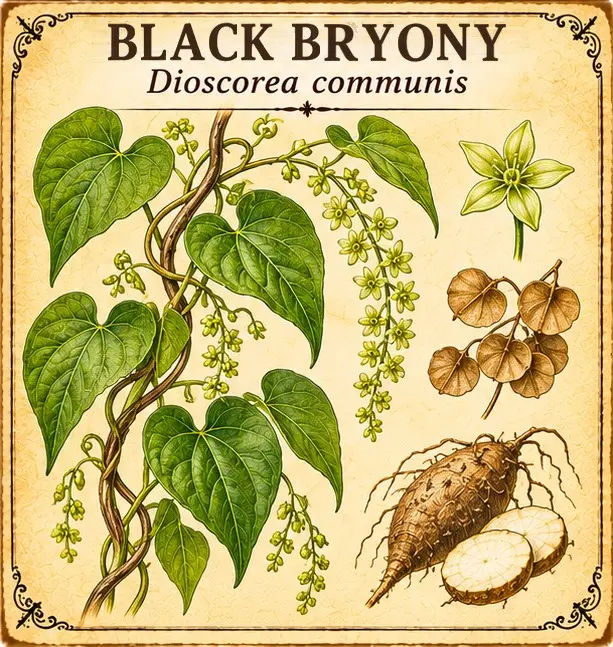
Black Bryony
Dioscorea communis
A climbing wild yam whose root is rubbed on bruises, rheumatism and muscle pain in Bulgarian and Turkish folk medicine. Its berries and root sap irritate the skin.
Safety at a glance
- PregnancyNothing recorded
- BreastfeedingNothing recorded
- MedicinesNothing recorded
- Who should avoid itNothing recorded
- AllergiesNothing recorded
- ToxicityNothing recorded
Tap a box to read the safety notes below. “Nothing recorded” means our sources don't cover it, not that it's safe.
What is Black Bryony?
- Plant family
- Dioscoreaceae, the yam family
- Parts used
- The rhizome (root), used externally
- Where it grows
- Europe, North Africa and western Asia
- Genus
- Dioscorea
- Species
- communis
Older scientific names
Tamus communis
Traditionally used for
- Bruises
- Rheumatism
- Muscle pain (traditional
- external)
Traditionally described as
- Root contains phenanthrenes
- calcium oxalate and histamine
Health topics
Where Black Bryony appears in symptom search, and why. Being listed doesn't mean it's a proven treatment.
- Cancer Research
Lab studies only: compounds from the root killed cervical cancer cells. Not tested against cancer in people.
- Joint Discomfort
The root is rubbed on for rheumatic and muscle pain in Bulgarian and Turkish folk medicine. Not tested in people.
Safety
Side effects
Juice from the berries and the slimy root sap cause skin rashes, from tiny needle-like calcium oxalate crystals that pierce the skin and from histamine.[1]Study
What does the research say?
Traditional use
These are traditional uses, not proven treatments.
A climbing wild yam with heart-shaped leaves, red berries and a large root. In Bulgarian folk medicine the root juice is rubbed on for injuries, bruises, rheumatic and muscle pain and sciatica; in Turkey the pounded root is used for rheumatism.[2]Study
Laboratory & animal research
Lab and animal results show what might be worth studying in people. They don't show that the herb has these effects in humans.
The root irritates the skin, which increases blood flow to the area, likely why it's used as a rub. Compounds from the root killed cervical cancer cells in lab tests.[2]Study
In short
Berries and root sap cause skin rashes.
Sources
- [1] The dermatitic properties of black bryony (Tamus communis L.) · DOI: 10.1111/j.1600-0536.1983.tb04435.xPeer-reviewed study
- [2] Phytochemical Constituents and Pharmacological Potential of Tamus communis Rhizomes · DOI: 10.3390/molecules27061851Peer-reviewed study
This information is educational and traditional in nature, and is not a substitute for professional medical advice. Unfamiliar word? See what these words mean.