
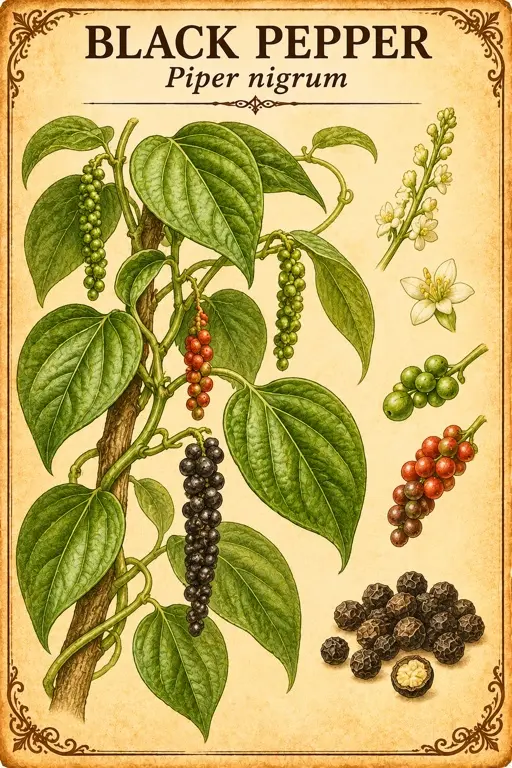
Black Pepper
Piper nigrum
The world's best-known spice, made from the dried berries of a tropical climbing vine. Its compound piperine greatly boosts how much curcumin the body absorbs, and breathing in black pepper oil improved swallowing in older stroke survivors.
Safety at a glance
- PregnancyNothing recorded
- BreastfeedingNothing recorded
- Medicines2 notes →
- Who should avoid itNothing recorded
- AllergiesNothing recorded
- ToxicityNothing recorded
Tap a box to read the safety notes below. “Nothing recorded” means our sources don't cover it, not that it's safe.
Black Pepper may interact with some medicines. If you take any medicine, read Interactions with medicines below and talk to your doctor or pharmacist before using it.
What is Black Pepper?
- Plant family
- Piperaceae, the pepper family
- Parts used
- The dried unripe berries (peppercorns); the essential oil
- Where it grows
- South India (Western Ghats)
- Genus
- Piper
- Species
- nigrum
Also called
Peppercorn
Regional names
Kali Mirch
Traditional names
Maricha
Traditionally used for
- Spice
- Boosting curcumin absorption
- Swallowing problems after stroke (oil inhalation
- studied)
Traditionally described as
- Pungent; contains the alkaloid piperine
Natural compounds
Safety
Interactions with medicines
Piperine, the main compound in black pepper, can change how the body absorbs and breaks down some medicines. In the lab, it blocks enzymes and pumps that process many drugs, so its effect depends on the medicine.[1]Study
Technical detail: piperine inhibits CYP3A4 and P-glycoprotein in vitro; PBPK models predict different effects across CYP3A4 substrates, so interaction risk is substrate-specific.
Small studies suggest piperine may raise blood levels of the epilepsy medicine phenytoin. If you take phenytoin, the review recommends checking your medicine levels when also taking piperine.[2]Review or trial
Technical detail: two very low-quality and one moderate-quality quasi-experimental studies; piperine increased phenytoin absorption and may delay its elimination by inhibiting microsomal metabolism.
What does the research say?
Traditional use
These are traditional uses, not proven treatments.
Black pepper, the dried fruit of a climbing vine, is one of the world's most important spices. It has long been used in traditional medicine to treat a variety of diseases.[3]Study
Laboratory & animal research
Lab and animal results show what might be worth studying in people. They don't show that the herb has these effects in humans.
In lab and animal studies, black pepper and its main compound, piperine, acted as antioxidants and were tested for effects on blood sugar, weight, blood pressure, inflammation, cancer, and liver protection. Piperine has also shown promise in animal models of age-related brain diseases.[3]Study
Technical detail: reported activities include antioxidant, antidiabetic, anti-obesity, antihypertensive, anti-inflammatory, anticancer, hepatoprotective and neuroprotective effects.
Research in people
Piperine helps the body absorb some other substances. In healthy volunteers, taking 20 mg of piperine with 2 g of curcumin (from turmeric) raised the amount of curcumin absorbed about 20-fold. No side effects were seen.[4]Study
Technical detail: curcumin bioavailability increased by 2000% in humans and 154% in rats; piperine inhibits hepatic and intestinal glucuronidation.
In a 1-month trial with 105 nursing home residents who had trouble swallowing after a stroke, breathing in black pepper oil for 1 minute sped up their swallowing reflex. It worked better than lavender oil or water. A slow swallowing reflex raises the risk of pneumonia, and the authors suggest the oil might help older stroke survivors with swallowing problems.[5]Study
Technical detail: randomized, controlled; nasal inhalation shortened the latency of the swallowing reflex and increased swallowing movements and serum substance P, with changes in insular and orbitofrontal cortex blood flow.
In short
Piperine supplements may change how some medicines are absorbed, including the epilepsy drug phenytoin.
Sources
- [1] Piperine: From Green Extraction to Clinical Translation-A Review · DOI: 10.2147/DDDT.S639169Peer-reviewed study
- [2] Optimizing phenytoin therapy: a systematic review of clinically relevant food and herb interactions · DOI: 10.3389/fphar.2025.1676685Review or clinical trial
- [3] Neuroprotective Effects of Black Pepper and Its Bioactive Compounds in Age-Related Neurological Disorders · DOI: 10.14336/AD.2022.1022Peer-reviewed study
- [4] Influence of piperine on the pharmacokinetics of curcumin in animals and human volunteers · DOI: 10.1055/s-2006-957450Peer-reviewed study
- [5] A randomized trial of olfactory stimulation using black pepper oil in older people with swallowing dysfunction · DOI: 10.1111/j.1532-5415.2006.00840.xPeer-reviewed study
This information is educational and traditional in nature, and is not a substitute for professional medical advice. Unfamiliar word? See what these words mean.