
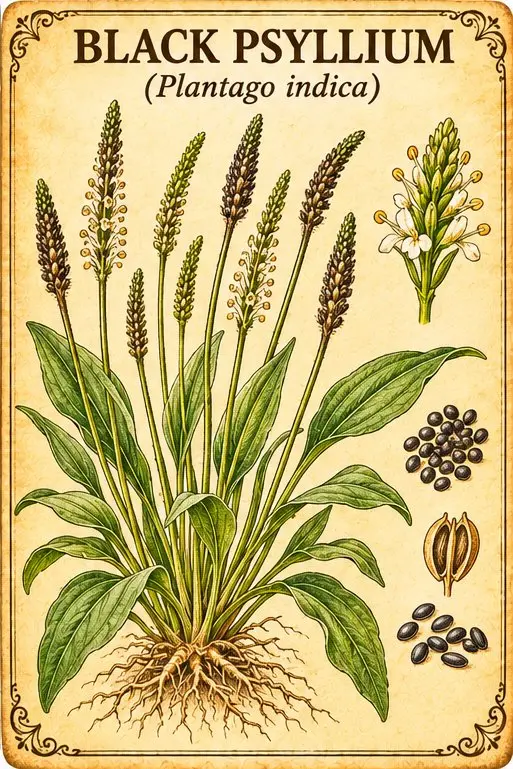
Black Psyllium
Plantago indica
Psyllium seed recognized in Europe as an established fiber treatment for constipation and to soften stools.
Safety at a glance
- Pregnancy1 note →
- BreastfeedingNothing recorded
- Medicines1 note →
- Who should avoid it1 note →
- Allergies1 note →
- ToxicityNothing recorded
Tap a box to read the safety notes below. “Nothing recorded” means our sources don't cover it, not that it's safe.
Black Psyllium may interact with some medicines. If you take any medicine, read Interactions with medicines below and talk to your doctor or pharmacist before using it.
What is Black Psyllium?
- Plant family
- Plantaginaceae, the plantain family
- Parts used
- The ripe seeds, whole or powdered
- Genus
- Plantago
- Species
- indica
Also called
Psyllium Seed
Older scientific names
Plantago arenaria
Traditionally used for
- Constipation
- Softening stools
Traditionally described as
- Fiber-rich seeds
Health topics
Where Black Psyllium appears in symptom search, and why. Being listed doesn't mean it's a proven treatment.
- Constipation
Recognized in Europe as an established treatment for long-term constipation and to soften stools. Take with plenty of water.
Safety
Interactions with medicines
It can slow the absorption of other medicines and supplements, including minerals, vitamin B12, heart medicines like digoxin, blood thinners like warfarin, carbamazepine and lithium. Take it at least 30 to 60 minutes before or after other medicines. People with diabetes, or who take thyroid medicine, should only use it under a doctor's supervision, because their doses may need changing.[1]Health agency
Technical detail: cardiac glycosides and coumarin derivatives.
Who should avoid it
Don't use it if you have a sudden change in bowel habit lasting more than 2 weeks, unexplained bleeding from the bottom, no bowel movement after using a laxative, a narrowing or blockage in the gut, or trouble swallowing or other throat problems. Stop and see a doctor if you get stomach pain. Older or frail people should use it under medical supervision. Take it with opioids or other drugs that slow the gut only under medical supervision.[1]Health agency
Allergies
Allergic reactions can occur, including a runny nose, red eyes, tightening of the airways and severe allergic reactions (anaphylaxis). Avoid breathing in the powder, because this can cause allergies, especially in people who handle it often.[2]Health agency
Side effects
It can cause gas and a swollen belly.[2]Health agency
Pregnancy
It may be considered during pregnancy and breastfeeding if needed and if changing your diet hasn't worked.[1]Health agency
How much to use
Ages 12 and up: 25 to 40 g a day, split into 3 doses. Children 6 to 12: 12 to 25 g a day in 3 doses. Not for children under 6. It starts working in 12 to 24 hours. See a doctor or pharmacist if constipation doesn't improve within 3 days.[1]Health agency
Depends on how it's prepared
Always take it with plenty of liquid (about 30 ml of water for each gram). Taken with too little liquid, it can block the throat, food pipe or gut, causing choking. Signs include chest pain, vomiting, or trouble swallowing or breathing. Don't take it right before bed.[1]Health agency
What does the research say?
Laboratory & animal research
Lab and animal results show what might be worth studying in people. They don't show that the herb has these effects in humans.
Psyllium seeds contain fiber that forms a gel when mixed with water. This makes stools bulkier and softer, lubricates the gut, and triggers bowel movements.[2]Health agency
Research in people
The European Medicines Agency recognizes psyllium seed (from this plant or Plantago afra) as an established medicine, backed by scientific evidence:
- for long-term constipation that isn't caused by a physical problem in the gut
- to soften stools when passing them is painful, such as with anal fissures, hemorrhoids or after surgery on the bottom
The evidence comes from studies of a closely related psyllium (ispaghula), which contains similar ingredients.[2]Health agency
In short
Take with plenty of water; separate from other medicines.
Sources
- [1] Community herbal monograph on Plantago afra L. et Plantago indica L., semen (EMA/HMPC/599747/2012) — European Medicines Agency, Committee on Herbal Medicinal Products (HMPC)Government health agency
- [2] Psyllium seed: summary for the public (EMA/HMPC/322933/2013) — European Medicines Agency, Committee on Herbal Medicinal Products (HMPC)Government health agency
This information is educational and traditional in nature, and is not a substitute for professional medical advice. Unfamiliar word? See what these words mean.