
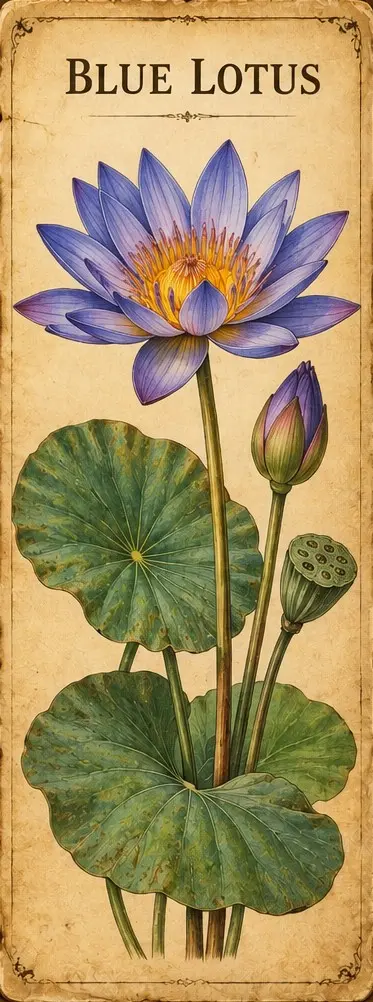
Blue Lotus
Nymphaea caerulea
A water lily that was used in rituals in ancient Egypt. It's now sold as teas, vapes and gummies for calming or euphoric effects, and has sent some users to the emergency room.
Safety at a glance
- PregnancyNothing recorded
- BreastfeedingNothing recorded
- MedicinesNothing recorded
- Who should avoid itNothing recorded
- AllergiesNothing recorded
- Toxicity1 note →
Tap a box to read the safety notes below. “Nothing recorded” means our sources don't cover it, not that it's safe.
What is Blue Lotus?
- Plant family
- Nymphaeaceae, the water lily family
- Parts used
- The flowers, sold dried, as teas, extracts and tinctures, and in vapes and gummies
- Where it grows
- Northern and central Africa
- Genus
- Nymphaea
- Species
- caerulea
Also called
Blue Egyptian Lotus, Blue Water Lily
Traditionally used for
- Calming (traditional)
- Rituals (historical)
Traditionally described as
Health topics
Where Blue Lotus appears in symptom search, and why. Being listed doesn't mean it's a proven treatment.
- Cancer Research
Lab studies only: a flower extract killed leukemia cells, but the stronger extract also harmed normal cells. Not tested against cancer in people.
Safety
Toxicity testing
Blue lotus can cause confusion, agitation, strange behavior, drowsiness and hallucinations. In one reported case, a 22-year-old man who had vaped blue lotus for several weeks had seizures and kidney and liver injury.
Serious poisoning seems to be rare, but little is known about the short- and long-term effects of these products.[1]General reference
Contamination
Blue lotus products aren't regulated by the FDA, so what's in them may not match the label. Some have contained added fragrances, and products may be mixed with other drugs such as synthetic cannabinoids.[1]General reference
In the same study, all 11 "blue lotus" oils bought on Amazon and Etsy contained synthetic fragrance chemicals, and none matched authentic blue lotus in scent or makeup. Some had other oils, such as citrus, lavender or geranium, added. Products sold as blue lotus may not contain it at all.[2]Study
Depends on how it's prepared
Safety data on blue lotus is limited. A 2023 study concluded that authentic blue lotus flower extracts (concrete or absolute) don't raise major safety concerns when diluted and used on the skin as a fragrance ingredient. This doesn't apply to teas, vapes, gummies or other products that are swallowed or inhaled.[2]Study
Safety data could not be found for 10 of the 28 main compounds in authentic blue lotus extracts, and some compounds couldn't be identified at all, so their safety is unknown.[2]Study
What does the research say?
Traditional use
These are traditional uses, not proven treatments.
In ancient Egypt, blue lotus was used in rituals, celebrations and burials. It has also been used medicinally as an aphrodisiac and for calming.[1]General reference
Laboratory & animal research
Lab and animal results show what might be worth studying in people. They don't show that the herb has these effects in humans.
Blue lotus is thought to contain two chemicals, apomorphine and nuciferine, that act on the brain. Lab tests of products sold in shops found very different amounts of these chemicals, and some had little or none.[1]General reference
Technical detail: apomorphine is a non-selective dopamine agonist (approved as an injection for Parkinson's disease "off" periods); nuciferine acts at 5-HT2, 5-HT1A and dopamine D2, D4 and D5 receptors.
Blue lotus is now added to skincare products. In a 2008 lab study, 20 compounds were isolated from its flowers, mostly flavonoids such as myricetin, quercetin and kaempferol, and nine of them acted as antioxidants in a test tube. No studies have tested blue lotus on human skin, so its skincare benefits are unproven.[3]Study
Technical detail: active compounds had IC50 values of 0.34–11.0 μg/ml; the ethyl acetate fraction was most active (IC50 0.2 μg/ml).
A 2023 study by scientists at the essential oil company doTERRA tested six authentic blue lotus flower extracts and 11 commercial products. The authentic extracts used in fragrance contained almost none of apomorphine and nuciferine, the compounds behind blue lotus's mind-altering effects.[2]Study
Technical detail: apomorphine was not detected; nuciferine was present only in traces (10–72 ppb) in the concrete and absolute.
In a 2024 lab study, blue lotus flower extract killed leukemia cells (a type called acute myeloid leukemia) grown in a dish and switched on genes involved in cell self-destruction. The weaker (50% alcohol) extract left normal kidney cells mostly unharmed, but the stronger (70% alcohol) extract also killed many of them. The alcohol used to make the extracts killed many leukemia cells on its own, which makes the results hard to judge. Doses weren't given as concentrations. Blue lotus has not been tested against cancer in animals or people.[4]Study
Technical detail: 50% and 70% hydro-ethanolic whole-flower extracts on THP-1 cells, with HEK 293 as normal-cell control; caspase-3, caspase-9 and Fas expression measured by RT-PCR; the 50% extract lowered IL-6, IL-8, IL-1β, TGF-β1 and TNF-α expression and raised IL-10; effective dose reported as about 40 µL of crude extract.
Research in people
In a 2023 report, five soldiers went to the emergency room after vaping blue lotus or drinking a drink made with it. They were drowsy and had disturbances in what they saw or sensed. All got better with supportive care, without needing sedating medicines.[5]Study
In short
Not regulated; has caused confusion, agitation, hallucinations and, in one case, seizures.
Sources
- [1] ToxTalks: Blue Lotus — Blue Ridge Poison Center at UVA HealthGeneral reference
- [2] Chemical Composition, Market Survey, and Safety Assessment of Blue Lotus (Nymphaea caerulea Savigny) Extracts — doTERRA International (authors' employer) · DOI: 10.3390/molecules28207014Peer-reviewed study
- [3] Antioxidant constituents of Nymphaea caerulea flowers · DOI: 10.1016/j.phytochem.2008.04.009Peer-reviewed study
- [4] The Apoptotic Property of Nymphaea Caerulea Flower Extract on Acute Myeloid Leukaemia Cell Line, THP-1 · DOI: 10.31557/APJCP.2024.25.1.123Peer-reviewed study
- [5] Toxicity From Blue Lotus (Nymphaea caerulea) After Ingestion or Inhalation: A Case Series · DOI: 10.1093/milmed/usab328Peer-reviewed study
This information is educational and traditional in nature, and is not a substitute for professional medical advice. Unfamiliar word? See what these words mean.