
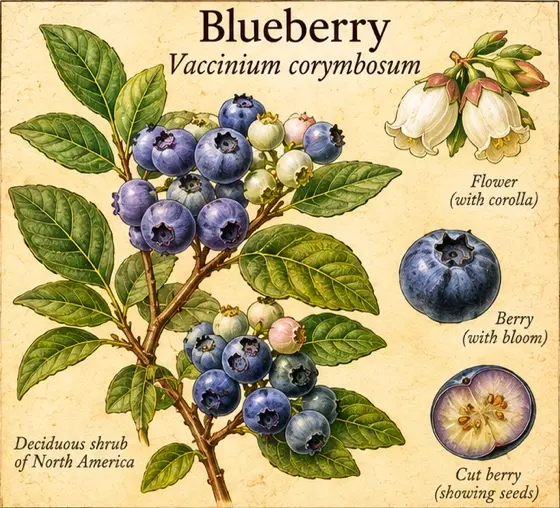
Blueberry
Vaccinium corymbosum
A North American berry rich in anthocyanins. Eating blueberries improved blood vessel function in trials, but didn't lower blood pressure or improve thinking skills.
Safety at a glance
- PregnancyNothing recorded
- BreastfeedingNothing recorded
- MedicinesNothing recorded
- Who should avoid itNothing recorded
- AllergiesNothing recorded
- ToxicityNothing recorded
Tap a box to read the safety notes below. “Nothing recorded” means our sources don't cover it, not that it's safe.
What is Blueberry?
- Plant family
- Ericaceae, the heather family
- Parts used
- The berries (fresh, frozen, freeze-dried powder or juice)
- Where it grows
- North America
- Genus
- Vaccinium
- Species
- corymbosum
Also called
Highbush Blueberry, Lowbush Blueberry, Wild Blueberry
Traditionally used for
- Food
- Blood vessel health (studied)
- Blood pressure and memory (studied
- no clear effect)
Traditionally described as
- Rich in anthocyanins
Health topics
Where Blueberry appears in symptom search, and why. Being listed doesn't mean it's a proven treatment.
- High Blood Pressure
Pooled trials found blueberries and other berries didn't lower resting blood pressure.
- Memory and Thinking
A review of trials found blueberries didn't improve thinking skills in healthy people.
- Poor Circulation
Blueberries improved blood vessel function in pooled trials of healthy people.
Natural compounds
What does the research say?
Research in people
A 2026 review of 14 trials with 632 healthy people found that eating blueberries improved how well blood vessels widen. This is a sign of healthy blood vessels. But blueberries didn't change blood pressure, thinking skills or mood.[1]Review or trial
Technical detail: flow-mediated dilation +1.11% (95% CI 0.50 to 1.72; I² = 23%); systolic BP −0.11 mmHg and diastolic −0.46 mmHg (non-significant); executive function SMD 0.21 (non-significant).
A 2026 review of 9 trials with 547 adults with high or raised blood pressure found that berry supplements, including blueberry, didn't lower resting blood pressure. Average 24-hour diastolic (lower) pressure fell slightly. The certainty of the evidence was low to very low.[2]Review or trial
Technical detail: resting systolic MD −2.35 mmHg (95% CI −4.98 to 0.29); 24-h ambulatory diastolic −1.11 mmHg (95% CI −2.04 to −0.17), driven by crossover trials.
In short
A common food; the reviews didn't assess safety.
Sources
- [1] Blueberry consumption enhances vascular function but not cognitive abilities in healthy individuals: a systematic review and meta-analysis · DOI: 10.1016/j.nutres.2026.03.007Review or clinical trial
- [2] Effects of Oral Berry Supplementation on Blood Pressure in Adults with Hypertension or Elevated Blood Pressure: A Systematic Review and Meta-Analysis of Randomized Controlled Trials · DOI: 10.3390/nu18101504Review or clinical trial
This information is educational and traditional in nature, and is not a substitute for professional medical advice. Unfamiliar word? See what these words mean.