
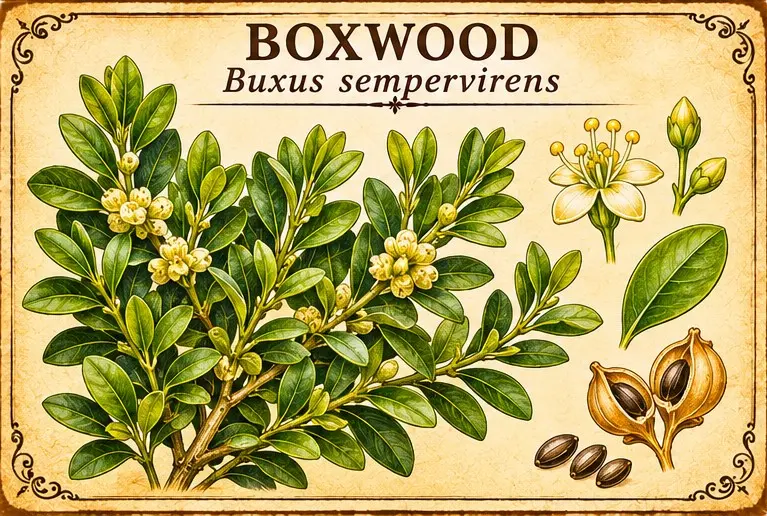
Boxwood
Buxus sempervirens
The evergreen hedge shrub, a Mediterranean folk remedy for malaria. A leaf extract slowed early HIV in a 1998 placebo-controlled trial.
Safety at a glance
- PregnancyNothing recorded
- BreastfeedingNothing recorded
- MedicinesNothing recorded
- Who should avoid itNothing recorded
- AllergiesNothing recorded
- Toxicity1 note →
Tap a box to read the safety notes below. “Nothing recorded” means our sources don't cover it, not that it's safe.
What is Boxwood?
- Plant family
- Buxaceae, the boxwood family
- Parts used
- The leaves
- Where it grows
- Europe, North Africa and western Asia
- Genus
- Buxus
- Species
- sempervirens
Also called
Common Box, European Box, Box
Traditionally used for
- Malaria
- Diabetes (traditional)
Traditionally described as
- Leaves contain triterpene alkaloids
Safety
Toxicity testing
Its alkaloids were toxic to cells in lab tests at doses not far above those that affected parasites.[1]Study
What does the research say?
Traditional use
These are traditional uses, not proven treatments.
The evergreen hedge shrub. Around the Mediterranean its leaves are a folk remedy for malaria, and in Morocco for diabetes and heart problems.[1]Study
Laboratory & animal research
Lab and animal results show what might be worth studying in people. They don't show that the herb has these effects in humans.
Research in people
In a placebo-controlled trial of 145 people with early, untreated HIV, a boxwood leaf extract (SPV30, 990 mg a day) slowed disease progression and viral load rises, with no severe side effects. It's never become a standard treatment.[3]Study
In short
Its alkaloids are toxic to cells.
Sources
- [1] Antiprotozoal activity of Buxus sempervirens and activity-guided isolation of O-tigloylcyclovirobuxeine-B as the main constituent active against Plasmodium falciparum · DOI: 10.3390/molecules19056184Peer-reviewed study
- [2] Buxus sempervirens L. Improves Lipid Profile in Diabetic Rats · DOI: 10.2174/1871529X18666180419100823Peer-reviewed study
- [3] Efficacy and safety of Buxus sempervirens L. preparations (SPV30) in HIV-infected asymptomatic patients: a multicentre, randomized, double-blind, placebo-controlled trial · DOI: 10.1016/S0944-7113(98)80052-4Peer-reviewed study
This information is educational and traditional in nature, and is not a substitute for professional medical advice. Unfamiliar word? See what these words mean.