
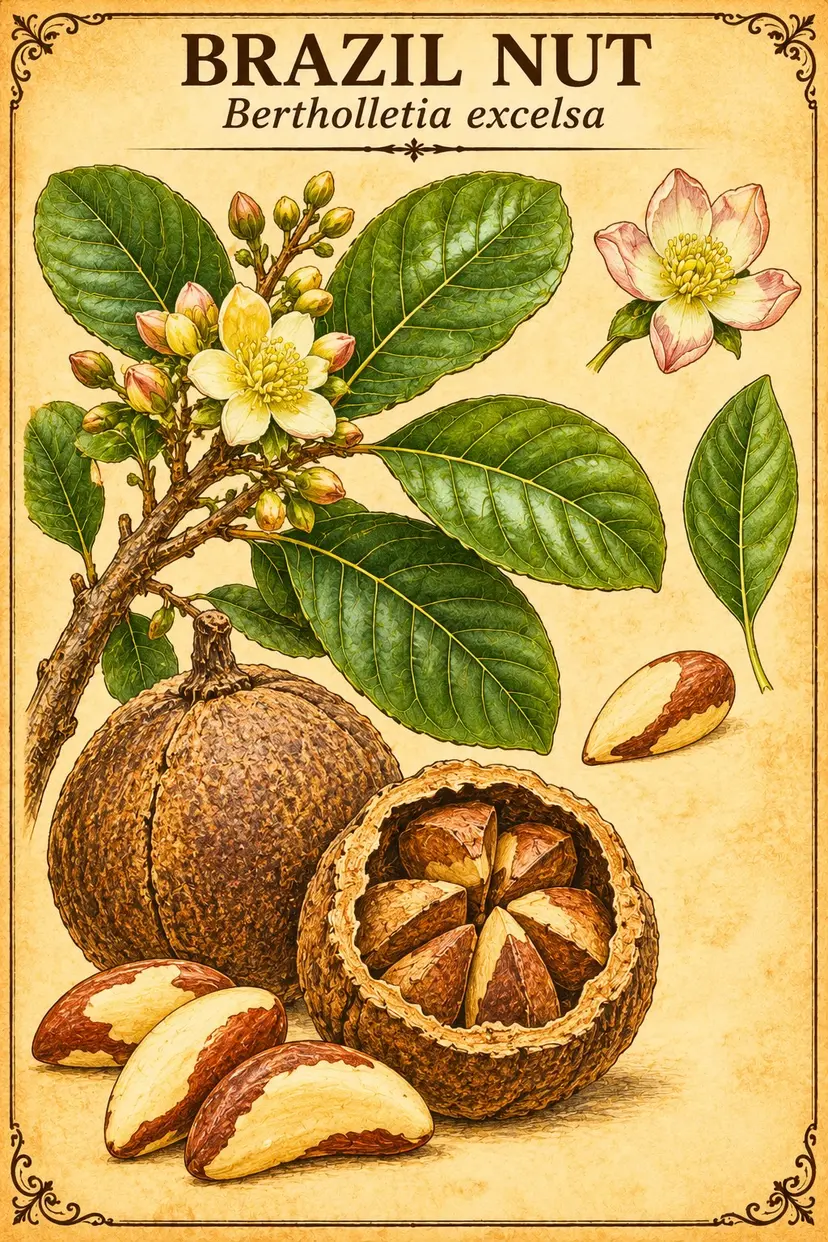
Brazil Nut
Bertholletia excelsa
The seed of a giant Amazon tree and the richest food source of selenium. Two nuts a day raised blood selenium as well as a supplement in a trial; eating many every day can mean too much.
Safety at a glance
- PregnancyNothing recorded
- BreastfeedingNothing recorded
- MedicinesNothing recorded
- Who should avoid itNothing recorded
- Allergies1 note →
- Toxicity1 note →
Tap a box to read the safety notes below. “Nothing recorded” means our sources don't cover it, not that it's safe.
What is Brazil Nut?
- Plant family
- Lecythidaceae, the Brazil nut family
- Parts used
- The seeds (nuts)
- Where it grows
- The Amazon rainforest of South America
- Genus
- Bertholletia
- Species
- excelsa
Traditionally used for
- Food
- Selenium source
Traditionally described as
- Very high in selenium; also protein and healthy fats
Health topics
Where Brazil Nut appears in symptom search, and why. Being listed doesn't mean it's a proven treatment.
- High Cholesterol
Improved cholesterol in some small trials, including in people with obesity or on dialysis.
- Memory and Thinking
Improved some thinking test scores in a small trial of older adults with mild memory problems.
Natural compounds
Safety
Allergies
Brazil nuts are tree nuts. Tree nut allergies usually last for life and are a leading cause of serious, even fatal, allergic reactions.[1]Study
Toxicity testing
Brazil nuts are very high in selenium, and too much selenium over time can cause hair loss, brittle nails, garlic breath, a metallic taste, rash, nausea and diarrhea. The safe upper limit for adults is 400 micrograms of selenium a day.[2]Health agency
How much to use
Depending on where it's grown, a single Brazil nut can supply a full day's selenium, so eating many every day can push intake too high.[3]Review or trial
What does the research say?
Traditional use
These are traditional uses, not proven treatments.
The edible seed of a giant Amazon rainforest tree. It's the richest food source of selenium, a mineral the body needs for its antioxidant defenses; depending on where it's grown, one nut can supply a day's selenium.[3]Review or trial
Research in people
In a 12-week trial of 59 adults, eating 2 Brazil nuts a day raised blood selenium as much as a selenium supplement did.[4]Study
A 2022 review of 24 trials found regular Brazil nuts raised selenium and antioxidant enzyme levels in every study that measured them. Some trials also found better cholesterol and blood sugar in healthy people and in people with obesity, but most studies were small and not randomized.[3]Review or trial
In people on kidney dialysis, Brazil nuts improved cholesterol, inflammation and thyroid markers. In older adults with mild memory problems, they improved some thinking test scores.[3]Review or trial
In short
Too much selenium over time can cause hair and nail loss. A tree nut allergen.
Sources
- [1] Tree nut allergy · DOI: 10.5114/ada.2021.108894Peer-reviewed study
- [2] Selenium: Fact Sheet for Health Professionals — NIH Office of Dietary SupplementsGovernment health agency
- [3] Effects of Regular Brazil Nut (Bertholletia excelsa H.B.K.) Consumption on Health: A Systematic Review of Clinical Trials · DOI: 10.3390/foods11182925Review or clinical trial
- [4] Brazil nuts: an effective way to improve selenium status · DOI: 10.1093/ajcn/87.2.379Peer-reviewed study
This information is educational and traditional in nature, and is not a substitute for professional medical advice. Unfamiliar word? See what these words mean.