
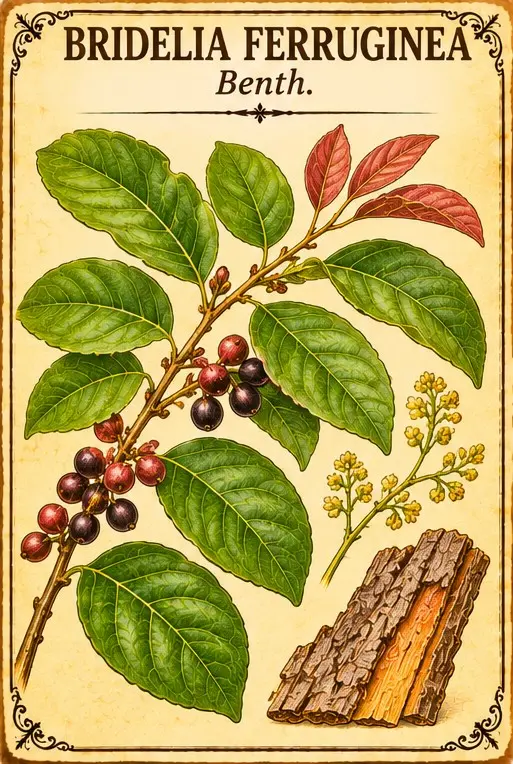
Bridelia Ferruginea
Bridelia ferruginea
A common West African shrub whose bark is used for arthritis, diarrhea, diabetes, skin diseases and as a mouthwash for thrush. Bark extracts reduced arthritis and blood sugar in rats.
Safety at a glance
- PregnancyNothing recorded
- BreastfeedingNothing recorded
- MedicinesNothing recorded
- Who should avoid itNothing recorded
- AllergiesNothing recorded
- Toxicity1 note →
Tap a box to read the safety notes below. “Nothing recorded” means our sources don't cover it, not that it's safe.
What is Bridelia Ferruginea?
- Plant family
- Phyllanthaceae, the leafflower family
- Parts used
- The stem bark, root bark, leaves and fruit
- Where it grows
- West and Central African savanna
- Genus
- Bridelia
- Species
- ferruginea
Regional names
Opam Fufuo, Iroladan
Traditionally used for
- Arthritis
- Diarrhea
- Diabetes
- Mouth infections (traditional)
Traditionally described as
- Rich in flavonoids
- tannins and caffeoylquinic acids
Health topics
Where Bridelia Ferruginea appears in symptom search, and why. Being listed doesn't mean it's a proven treatment.
- Diarrhea
A traditional remedy for diarrhea and dysentery. Not tested in people.
- High Blood Sugar
Lowered blood sugar in diabetic rats. Not tested in people.
- Joint Discomfort
Used for arthritis; reduced arthritis in rats. Not tested in people.
Safety
Toxicity testing
Bark extracts caused no deaths in animal tests even at very high doses. But in one rat study, high doses taken for 60 days lowered sperm counts.[1]Study
Depends on how it's prepared
No human medical or safety studies were found.[1]Study
What does the research say?
Traditional use
These are traditional uses, not proven treatments.
A common West African shrub. Decoctions of its bark, roots, leaves and fruit are used for arthritis, dysentery, diarrhea, constipation, diabetes, skin diseases, bladder and gut problems, and as an antidote to poisoned arrows.[1]Study
In Nigeria the bark is mixed with lime juice as a mouthwash for mouth infections such as thrush, and the leaves and bark are used for malaria. In Congo the bark is used for toothache and worms, and in Côte d'Ivoire for fever, headache and rheumatic pain.[1]Study
Laboratory & animal research
Lab and animal results show what might be worth studying in people. They don't show that the herb has these effects in humans.
In rats, a bark extract reduced swelling and arthritis about as well as indomethacin at higher doses, and eased pain and fever in rats and mice.[1]Study
In diabetic rats, a leaf extract lowered blood sugar and HbA1c about as much as glibenclamide.[1]Study
A leaf extract helped skin cells grow in lab tests at low doses, supporting its use on wounds; higher doses were toxic to the cells.[2]Study
In short
High doses lowered sperm counts in rats.
Sources
- [1] Bridelia ferruginea Benth.; An ethnomedicinal, phytochemical, pharmacological and toxicological review · DOI: 10.1016/j.heliyon.2022.e10366Peer-reviewed study
- [2] Antibacterial, antioxidant and fibroblast growth stimulation activity of crude extracts of Bridelia ferruginea leaf, a wound-healing plant of Nigeria · DOI: 10.1016/j.jep.2010.09.011Peer-reviewed study
This information is educational and traditional in nature, and is not a substitute for professional medical advice. Unfamiliar word? See what these words mean.