
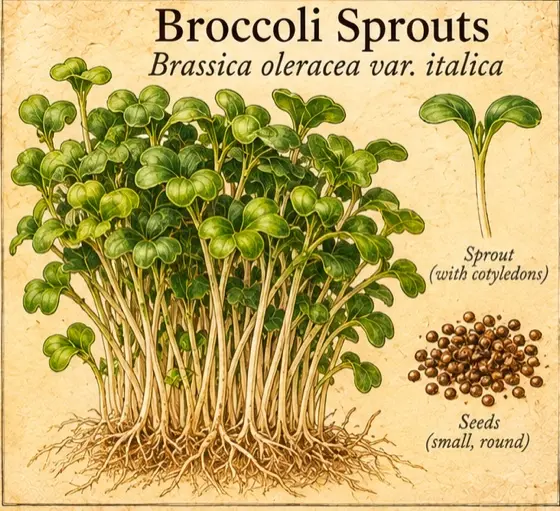
Broccoli Sprouts
Brassica oleracea var. italica
Young broccoli seedlings, a rich source of sulforaphane. Trials in autism and schizophrenia found only small or uncertain benefits, though cholesterol fell in schizophrenia trials.
Safety at a glance
- PregnancyNothing recorded
- BreastfeedingNothing recorded
- MedicinesNothing recorded
- Who should avoid itNothing recorded
- AllergiesNothing recorded
- ToxicityNothing recorded
Tap a box to read the safety notes below. “Nothing recorded” means our sources don't cover it, not that it's safe.
What is Broccoli Sprouts?
- Plant family
- Brassicaceae, the mustard and cabbage family
- Parts used
- The young sprouts, a few days old (eaten raw, or as extracts)
- Where it grows
- Cultivated worldwide
- Genus
- Brassica
- Species
- oleracea var. italica
Also called
Broccoli Microgreens
Traditionally used for
- Food
- Sulforaphane source
- Autism and schizophrenia (studied
- small effects)
Traditionally described as
- Rich in sulforaphane
Health topics
Where Broccoli Sprouts appears in symptom search, and why. Being listed doesn't mean it's a proven treatment.
- High Cholesterol
Cholesterol and triglycerides fell with sulforaphane in pooled schizophrenia trials.
Natural compounds
Safety
Side effects
In schizophrenia trials, fewer people stopped taking sulforaphane than stopped taking the placebo, suggesting it was well tolerated.[1]Review or trial
What does the research say?
Laboratory & animal research
Lab and animal results show what might be worth studying in people. They don't show that the herb has these effects in humans.
Broccoli sprouts are a source of sulforaphane, a compound studied for whether it protects cells from damage and reduces inflammation. It may work through several metabolic and immune pathways in the body.[1]Review or trial
Research in people
In a 15-week trial with 57 children aged 3 to 12 with autism, sulforaphane didn't significantly improve the main measure of autism symptoms compared with a placebo. Parents' ratings of behavior did improve more in the sulforaphane group. Placebo effects made the results hard to interpret.[2]Study
Technical detail: randomized, double-blind, placebo-controlled, then open-label; primary outcome OACIS non-significant (Cohen's d 0.21 at 7 weeks); Aberrant Behavior Checklist improved significantly at 15 weeks but Social Responsiveness Scale-2 did not; 45 children analyzed.
A 2025 review pooled 4 trials with 369 people with schizophrenia who took sulforaphane alongside their usual medicine. Overall symptoms didn't improve. Negative symptoms (such as lack of motivation) improved slightly at 12 weeks, but not by the end. Cholesterol and triglycerides fell. Fewer people dropped out in the sulforaphane groups.[1]Review or trial
Technical detail: PANSS total and positive scores unchanged; negative MD −1.06 at 12 weeks; general psychopathology MD −1.5; LDL, triglycerides and total cholesterol fell; discontinuation RR 0.68.
In short
Well tolerated in trials.
Sources
- [1] Efficacy and safety of sulforaphane in schizophrenia: a systematic review and meta-analysis of randomized controlled trials · DOI: 10.1186/s12888-025-07515-7Review or clinical trial
- [2] Randomized controlled trial of sulforaphane and metabolite discovery in children with Autism Spectrum Disorder · DOI: 10.1186/s13229-021-00447-5Peer-reviewed study
This information is educational and traditional in nature, and is not a substitute for professional medical advice. Unfamiliar word? See what these words mean.