
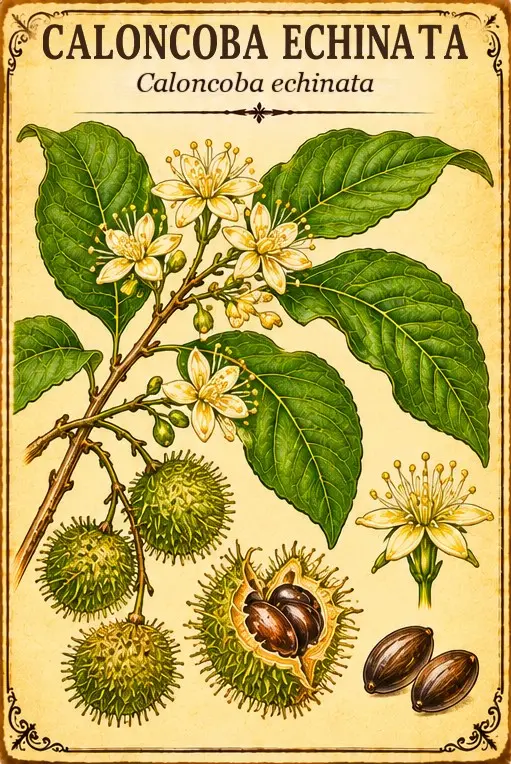
Caloncoba Echinata
Caloncoba echinata
A West African forest shrub whose seed oil is used in Sierra Leone for leprosy and skin infections. Feeding the leaves to rats damaged their liver and testes.
Safety at a glance
- PregnancyNothing recorded
- BreastfeedingNothing recorded
- MedicinesNothing recorded
- Who should avoid itNothing recorded
- AllergiesNothing recorded
- Toxicity1 note →
Tap a box to read the safety notes below. “Nothing recorded” means our sources don't cover it, not that it's safe.
What is Caloncoba Echinata?
- Plant family
- Achariaceae, the chaulmoogra family
- Parts used
- The leaves and seeds
- Where it grows
- West Africa
- Genus
- Caloncoba
- Species
- echinata
Older scientific names
Oncoba echinata
Traditionally used for
- Leprosy
- Skin infections
- Measles (traditional)
Traditionally described as
- Seed oil; leaves contain triterpenes
Safety
Toxicity testing
In rats fed the powdered leaves for 4 weeks, the leaves caused weight loss, anemia, and damage to the liver and testes.[1]Study
Depends on how it's prepared
No human medical or safety studies were found.[1]Study
What does the research say?
Traditional use
These are traditional uses, not proven treatments.
A West African forest shrub. In Sierra Leone the oil from its seeds is used for leprosy and skin infections, and a decoction of the leafy twigs and root bark for measles, chickenpox, smallpox and menstrual problems.[2]Study
The starchy, oily fruit pulp has been used in Sierra Leone as a milk substitute for infants, and it's eaten by monkeys and chimpanzees in the Gola Forest.[2]Study
Laboratory & animal research
Lab and animal results show what might be worth studying in people. They don't show that the herb has these effects in humans.
In short
The leaves were toxic to rats.
Sources
- [1] Clinicopathologic findings in rats fed on the powder of Caloncoba echinata leaves · DOI: 10.30466/vrf.2018.89652.2170Peer-reviewed study
- [2] Phytochemical Screening And Antimicrobial Sensitivity Of Extracts Of The Traditional Medicinal Plant Caloncoba Echinata In Sierra LeonePeer-reviewed study
- [3] New dammarane and malabaricane triterpenes from Caloncoba echinata · DOI: 10.1021/np0201826Peer-reviewed study
This information is educational and traditional in nature, and is not a substitute for professional medical advice. Unfamiliar word? See what these words mean.