
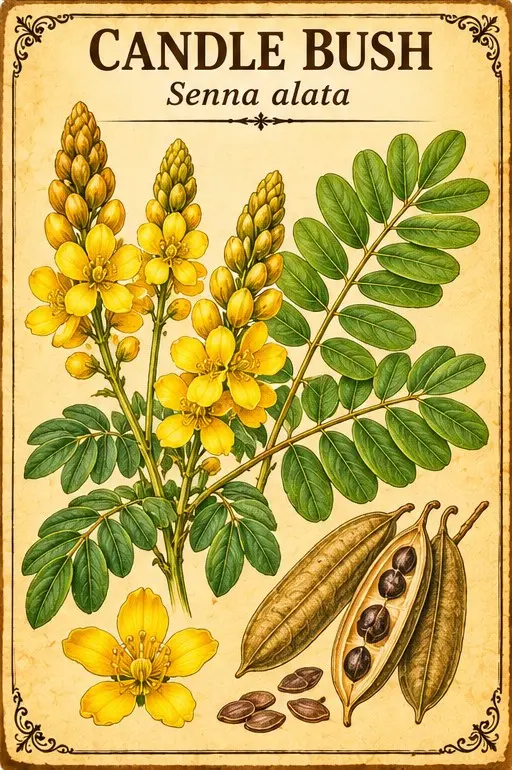
Candle Bush
Senna alata
A tropical shrub with candle-like yellow flower spikes, widely used for ringworm and as a laxative. Its tea helped bowels restart sooner after surgery in a trial.
Safety at a glance
- PregnancyNothing recorded
- BreastfeedingNothing recorded
- MedicinesNothing recorded
- Who should avoid itNothing recorded
- AllergiesNothing recorded
- ToxicityNothing recorded
Tap a box to read the safety notes below. “Nothing recorded” means our sources don't cover it, not that it's safe.
What is Candle Bush?
- Plant family
- Fabaceae, the pea and bean family
- Parts used
- The leaves, and also flowers, stems and roots
- Where it grows
- Tropical Americas; now widespread in the tropics
- Genus
- Senna
- Species
- alata
Also called
Ringworm Bush, Craw-Craw Plant, Acapulco
Older scientific names
Cassia alata
Traditionally used for
- Ringworm
- Fungal skin infections
- Constipation
Traditionally described as
- Leaves contain anthraquinones and flavonoids
Health topics
Where Candle Bush appears in symptom search, and why. Being listed doesn't mean it's a proven treatment.
- Constipation
A traditional laxative; the tea helped bowels restart sooner after surgery in a trial.
- Fungal Skin and Nail Infections (Athlete's Foot, Nail Fungus)
A leaf decoction eased a fungal skin infection in a small uncontrolled study.
Safety
Depends on how it's prepared
No side effects were reported in the small skin study. Larger safety studies haven't been done.[1]Study
What does the research say?
Traditional use
These are traditional uses, not proven treatments.
A tropical shrub named for its upright yellow flower spikes. It's widely used for ringworm and other fungal skin infections, scabies, eczema and herpes, and the leaves are used as a laxative for constipation.[2]Study
Research in people
In a trial of 90 women after cancer surgery, drinking candle bush tea got their bowels working again sooner: gas passed about 8 hours earlier and the first bowel movement about 20 hours earlier than with warm water.[3]Study
In 20 people in the Philippines with a stubborn fungal skin infection (tinea imbricata), a homemade leaf decoction applied for 4 weeks eased itching in 95% and cleared the fungus in 40%. There was no comparison group.[1]Study
In short
Larger safety studies haven't been done.
Sources
- [1] Senna (Cassia) alata (Linn.) Roxb. leaf decoction as a treatment for tinea imbricata in an indigenous tribe in Southern Philippines · DOI: 10.1111/myc.13159Peer-reviewed study
- [2] Ethnobotanical Description and Biological Activities of Senna alata · DOI: 10.1155/2020/2580259Peer-reviewed study
- [3] Effects of Cassia alata Linn on bowel function recovery following surgery for gynecological cancer: A randomized controlled trial · DOI: 10.1016/j.ctim.2019.102222Peer-reviewed study
This information is educational and traditional in nature, and is not a substitute for professional medical advice. Unfamiliar word? See what these words mean.