
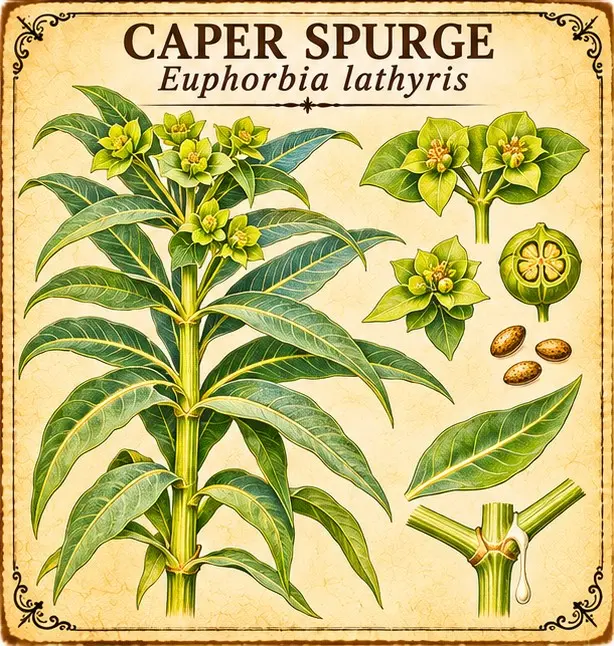
Caper Spurge
Euphorbia lathyris
A blue-green spurge whose seed is a traditional Chinese medicine. Its seed irritates the gut and its milky sap can severely damage the eyes.
Safety at a glance
- PregnancyNothing recorded
- BreastfeedingNothing recorded
- MedicinesNothing recorded
- Who should avoid itNothing recorded
- AllergiesNothing recorded
- Toxicity1 note →
Tap a box to read the safety notes below. “Nothing recorded” means our sources don't cover it, not that it's safe.
What is Caper Spurge?
- Plant family
- Euphorbiaceae, the spurge family
- Parts used
- The seeds
- Where it grows
- Southern Europe and western Asia
- Genus
- Euphorbia
- Species
- lathyris
Also called
Euphorbia Semen
Traditionally used for
- Traditional Chinese medicine (seed)
Traditionally described as
- Seeds contain lathyrane diterpenoids
Safety
Side effects
The milky sap is toxic. A gardener who got it near his eyes developed severe inflammation of both corneas and his vision worsened for weeks before he recovered. Symptoms can take a day or two to appear.[1]Study
Toxicity testing
The seed is highly irritating to the gut and toxic, and some of its compounds promote cancer when combined with other agents. Processing methods have been developed to reduce its toxicity.[2]Study
What does the research say?
Traditional use
These are traditional uses, not proven treatments.
A tall, blue-green spurge with caper-like seed pods. Its dried seed, Euphorbia semen, is a traditional Chinese medicine listed in the Chinese Pharmacopoeia.[2]Study
Laboratory & animal research
Lab and animal results show what might be worth studying in people. They don't show that the herb has these effects in humans.
Seed compounds increased urine, lowered uric acid and reduced inflammation in lab and animal studies.[2]Study
In short
Toxic seed and sap; sap can cause severe eye injury.
Sources
- [1] Exposure to Caper Spurge (Euphorbia lathyris) Sap: A Case of Ocular and Periorbital Toxicity · DOI: 10.1159/000539419Peer-reviewed study
- [2] The phytochemistry, pharmacokinetics, pharmacology and toxicity of Euphorbia semen · DOI: 10.1016/j.jep.2018.08.024Peer-reviewed study
This information is educational and traditional in nature, and is not a substitute for professional medical advice. Unfamiliar word? See what these words mean.