
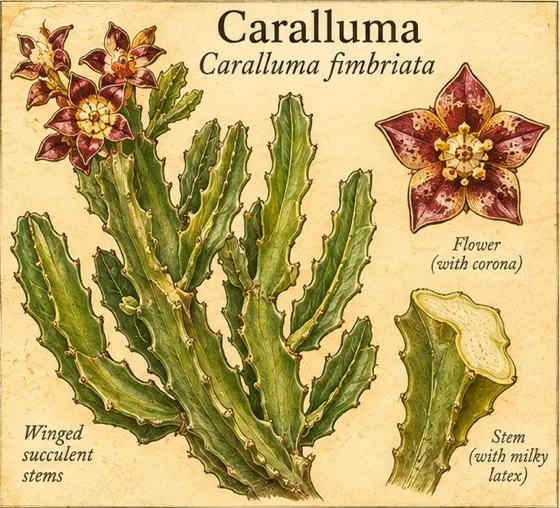
Caralluma
Caralluma fimbriata
An edible succulent from India, known as a famine food and appetite suppressant. Trials found it slightly reduced waist size and eased mild anxiety, but it didn't reduce body weight overall.
Safety at a glance
- PregnancyNothing recorded
- BreastfeedingNothing recorded
- MedicinesNothing recorded
- Who should avoid itNothing recorded
- AllergiesNothing recorded
- ToxicityNothing recorded
Tap a box to read the safety notes below. “Nothing recorded” means our sources don't cover it, not that it's safe.
What is Caralluma?
- Plant family
- Apocynaceae, the dogbane and milkweed family
- Parts used
- The fleshy stems (eaten, or as extract)
- Where it grows
- India
- Genus
- Caralluma
- Species
- fimbriata
Older scientific names
Caralluma adscendens var. fimbriata
Traditionally used for
- Appetite and weight (studied)
- Anxiety and stress (studied)
Traditionally described as
- Fleshy
- cactus-like stems
Health topics
Where Caralluma appears in symptom search, and why. Being listed doesn't mean it's a proven treatment.
Safety
Side effects
What does the research say?
Traditional use
These are traditional uses, not proven treatments.
Caralluma is an edible succulent that grows wild across India. It's known as a famine food, an appetite suppressant and a thirst quencher. North Indian folklore says it reduces appetite.[1]Review or trial
Research in people
A 2021 review of 7 trials found that caralluma extract slightly reduced waist size (by about 1.6 cm) compared with a placebo. It didn't reduce body weight, body mass index, appetite or blood test measures. The authors conclude it's unlikely to be worth recommending for weight loss.[1]Review or trial
Technical detail: waist circumference −1.59 cm (95% CI −3.07 to −0.10); waist-to-hip ratio −0.06. Trials were from Australia, Cuba, India and Spain, including one in children with Prader-Willi syndrome.
In a 16-week trial with 83 overweight adults (mostly women), people taking caralluma extract ate about 245 fewer calories a day than at the start, kept their weight steady and lost 2.7 cm from their waist. The placebo group gained weight and fat.[2]Study
Technical detail: double-blind, randomized, placebo-controlled; weight change −0.37 kg vs +1.33 kg (p = 0.03); leptin unchanged with CFE but rose with placebo.
In an 8-week trial with 97 adults with mild to moderate anxiety, caralluma extract (500 mg twice a day) reduced anxiety and stress more than a placebo. Both groups improved, which shows how strong the placebo effect was.[3]Study
Technical detail: double-blind, randomized, placebo-controlled; outcomes GAD-7, Perceived Stress Scale, PANAS and salivary cortisol.
In short
Can cause constipation, diarrhea, nausea or rashes.
Sources
- [1] The use of Caralluma fimbriata as an appetite suppressant and weight loss supplement: a systematic review and meta-analysis of clinical trials · DOI: 10.1186/s12906-021-03450-8Review or clinical trial
- [2] The effect of an orally-dosed Caralluma Fimbriata extract on appetite control and body composition in overweight adults · DOI: 10.1038/s41598-021-86108-2Peer-reviewed study
- [3] A randomised placebo controlled clinical trial on the efficacy of Caralluma fimbriata supplement for reducing anxiety and stress in healthy adults over eight weeks · DOI: 10.1016/j.jad.2018.12.062Peer-reviewed study
This information is educational and traditional in nature, and is not a substitute for professional medical advice. Unfamiliar word? See what these words mean.