
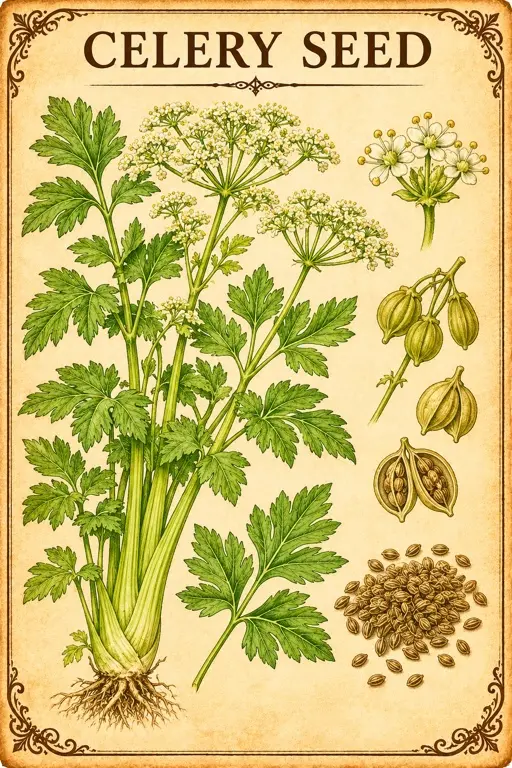
Celery Seed
Apium graveolens
The tiny, aromatic seeds of the celery plant, used as a spice and traditionally for arthritis, gout and urinary infections. Small trials suggest celery seed extract may lower blood pressure.
Safety at a glance
- PregnancyNothing recorded
- BreastfeedingNothing recorded
- MedicinesNothing recorded
- Who should avoid itNothing recorded
- Allergies1 note →
- ToxicityNothing recorded
Tap a box to read the safety notes below. “Nothing recorded” means our sources don't cover it, not that it's safe.
What is Celery Seed?
- Plant family
- Apiaceae, the carrot and parsley family
- Parts used
- The tiny dried fruits, sold as seeds (whole, ground or as extract)
- Where it grows
- Europe and the Mediterranean
- Genus
- Apium
- Species
- graveolens
Also called
Celery, Wild Celery
Regional names
Ajmod
Traditional names
Apii Fructus
Traditionally used for
- Spice
- High blood pressure (studied)
- Arthritis and gout (traditional)
Traditionally described as
- Contains 3-n-butylphthalide
- apigenin and light-sensitizing furocoumarins
Health topics
Where Celery Seed appears in symptom search, and why. Being listed doesn't mean it's a proven treatment.
- High Blood Pressure
Trials found celery seed extract lowered blood pressure, alongside usual medicine; trials were small.
- High Blood Sugar
Pooled trials found celery preparations lowered fasting blood sugar; trials were small and varied.
- Joint Discomfort
Traditionally used for arthritis and gout.
Natural compounds
Safety
Allergies
Celery is a common food allergy, especially in Europe, and can cause severe reactions. People allergic to mugwort pollen are more likely to react to celery.[1]Study
Technical detail: sensitization to the defensin allergen Api g 7 carries a high risk of severe systemic reactions and often occurs with sensitization to the mugwort allergen Art v 1.
Side effects
Celery contains compounds that make skin very sensitive to sunlight. Normal amounts in food rarely cause problems. But people who handle a lot of celery, eat celery spoiled by fungus, or use tanning beds can get painful blistering rashes on sun-exposed skin.[2]Study
Technical detail: furocoumarins and psoralens cause phytophotodermatitis on UV exposure.
What does the research say?
Traditional use
These are traditional uses, not proven treatments.
Celery has traditionally been used to treat arthritis, gout and urinary infections.
In animal studies, celery and its compound 3-n-butylphthalide (NBP) have been studied for Alzheimer's disease, Parkinson's disease, stroke and depression. Only one published human trial was found.[3]Study
Technical detail: 26 studies (19 in vivo, 4 in vitro, 2 combined, 1 clinical trial).
Research in people
A 2025 review pooled 10 trials with 511 adults. Celery preparations lowered blood pressure, fasting blood sugar and triglycerides (a type of blood fat), but didn't change cholesterol. Celery seed, or doses above 1,000 mg a day, worked better than other forms. Side effects were no more common than with placebo.
Results varied a lot between trials, and the trials were small, so longer, better trials are needed.[4]Review or trial
Technical detail: systolic BP SMD −1.0 (95% CI −1.85 to −0.14); diastolic −0.93; fasting glucose −0.80; triglycerides −1.18. No effect on total, LDL or HDL cholesterol.
In a 4-week trial, 52 people with high blood pressure took celery seed extract (1.34 g a day) or a placebo, alongside their usual medicine. With celery seed, average blood pressure fell from about 141/92 to 130/84. It didn't change with the placebo. No significant side effects were reported.[5]Study
Technical detail: randomized, triple-blind, placebo-controlled crossover; 24-hour ambulatory monitoring; systolic 141.2 → 130.0 mmHg and diastolic 92.2 → 84.2 mmHg (both p < .001). Extract standardized for 3-n-butylphthalide.
In short
Celery is a common food allergen and can cause severe reactions; it can also make skin sensitive to sunlight.
Sources
- [1] Current State of Celery Allergy: Is Discovering Api g 7 a Milestone in Diagnosing Celeriac-Allergic Patients? · DOI: 10.3390/ijms26125840Peer-reviewed study
- [2] Not as Bland as You May Think: Celery (Apium graveolens) Commonly Induces Phytophotodermatitis · DOI: 10.12788/cutis.1199Peer-reviewed study
- [3] Neurological Applications of Celery (Apium graveolens): A Scoping Review · DOI: 10.3390/molecules28155824Peer-reviewed study
- [4] Effects of celery (Apium graveolens) on blood pressure, glycemic and lipid profile in adults: a systematic review and meta-analysis of randomized controlled trials · DOI: 10.3389/fnut.2025.1597680Review or clinical trial
- [5] Effect of celery (Apium graveolens) seed extract on hypertension: A randomized, triple-blind, placebo-controlled, cross-over, clinical trial · DOI: 10.1002/ptr.7469Peer-reviewed study
This information is educational and traditional in nature, and is not a substitute for professional medical advice. Unfamiliar word? See what these words mean.