
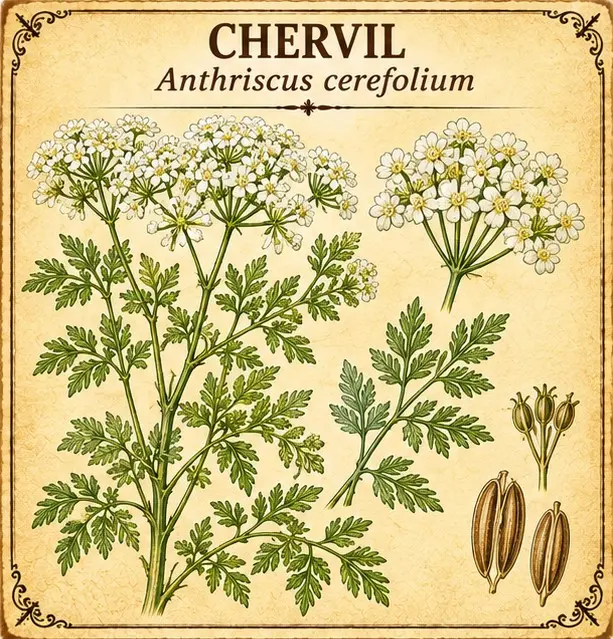
Chervil
Anthriscus cerefolium
A delicate, anise-flavored kitchen herb also called French parsley. It's been used traditionally to reduce inflammation and blood pressure.
Safety at a glance
- PregnancyNothing recorded
- BreastfeedingNothing recorded
- MedicinesNothing recorded
- Who should avoid itNothing recorded
- AllergiesNothing recorded
- ToxicityNothing recorded
Tap a box to read the safety notes below. “Nothing recorded” means our sources don't cover it, not that it's safe.
What is Chervil?
- Plant family
- Apiaceae, the carrot and parsley family
- Parts used
- The leaves
- Where it grows
- Southeastern Europe and western Asia
- Genus
- Anthriscus
- Species
- cerefolium
Also called
French Parsley
Traditionally used for
- Seasoning
- Inflammation (traditional)
Traditionally described as
- Rich in caffeoylquinic acids
Safety
Depends on how it's prepared
It's widely eaten as a herb, but no human medical or safety studies were found.[1]Study
What does the research say?
Traditional use
These are traditional uses, not proven treatments.
A delicate, parsley-like kitchen herb with a mild anise flavor, also called French parsley and used as a seasoning. In traditional medicine it's been used to reduce inflammation, lower blood pressure and increase urine.[2]Study
Laboratory & animal research
Lab and animal results show what might be worth studying in people. They don't show that the herb has these effects in humans.
In short
No human medical or safety studies were found.
Sources
- [1] Chemical profiling of Anthriscus cerefolium (L.) Hoffm., biological potential of the herbal extract, molecular modeling and KEGG pathway analysis · DOI: 10.1016/j.fitote.2024.106115Peer-reviewed study
- [2] Malonyl-Caffeoylquinic Acids and Malonyl-Flavonoid-Glucosides from Three Edible Apiaceae Plants Anthriscus Cerefolium, Anthriscus Sylvestris, and Chaerophyllum Bulbosum · DOI: 10.1021/acsomega.5c03770Peer-reviewed study
- [3] In vitro antioxidant activity of Anthriscus cerefolium L. (Hoffm.) extracts · DOI: 10.1016/s0378-8741(99)00171-3Peer-reviewed study
This information is educational and traditional in nature, and is not a substitute for professional medical advice. Unfamiliar word? See what these words mean.