
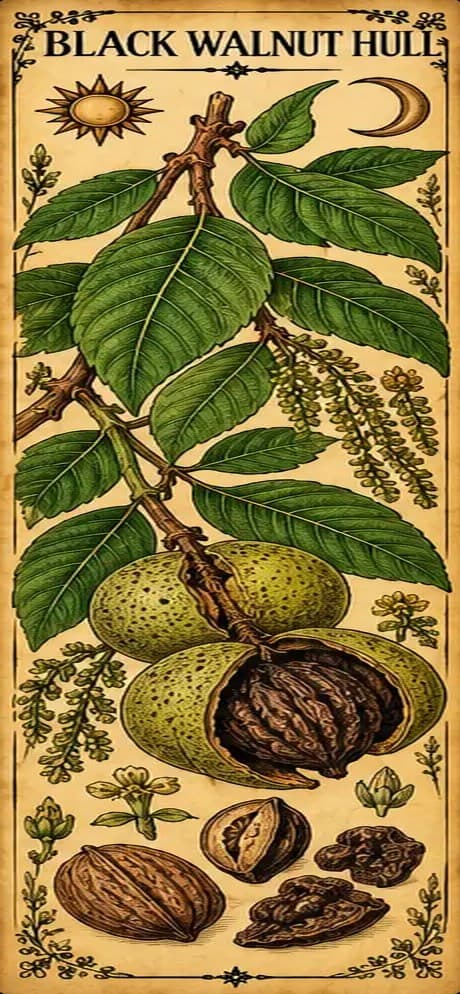
Black Walnut
Juglans nigra
A North American tree whose nut hulls contain juglone and other compounds. Black walnut hull is an ingredient in herbal gut formulas, but it hasn't been studied on its own in people.
Safety at a glance
- PregnancyNothing recorded
- BreastfeedingNothing recorded
- MedicinesNothing recorded
- Who should avoid itNothing recorded
- AllergiesNothing recorded
- ToxicityNothing recorded
Tap a box to read the safety notes below. “Nothing recorded” means our sources don't cover it, not that it's safe.
What is Black Walnut?
- Plant family
- Juglandaceae, the walnut family
- Parts used
- The nut hull (pericarp)
- Where it grows
- Native to North America; introduced into Europe in the early 1600s
- Genus
- Juglans
- Species
- nigra
Also called
Black Walnut Hull
Traditionally used for
- Gut formulas (SIBO
- parasites)
Traditionally described as
- Contains juglone
Health topics
Where Black Walnut appears in symptom search, and why. Being listed doesn't mean it's a proven treatment.
- SIBO and Intestinal Parasites
An ingredient in herbal SIBO formulas; it hasn't been tested on its own in people.
Natural compounds
How it's prepared
Common ways Black Walnut is prepared or sold. This isn't advice on how to take it; see Safety below.
- Culinary Preparation
Black walnut is prized for its edible nut.[1]Study
What does the research say?
Laboratory & animal research
Lab and animal results show what might be worth studying in people. They don't show that the herb has these effects in humans.
Researchers identified 161 plant compounds in black walnut bark, leaves and hulls. Juglone, from the hull, slowed the growth of human cancer cells in lab tests about as well as standard drugs. Juglone is found in all parts of the tree and is known for stopping other plants from growing near it.[2]Study
Research in people
Black walnut hull is an ingredient in several herbal formulas used for SIBO (bacterial overgrowth in the small intestine). In a small chart review of 13 people, these multi-herb formulas cleared SIBO in 60% to 100% of people, but the study was too small to draw conclusions, and black walnut's own effect isn't known.[3]Study
In short
It hasn't been tested on its own in people; its safety isn't known.
Sources
- [1] Thirty polymorphic nuclear microsatellite loci from black walnut · DOI: 10.1093/jhered/93.1.58Peer-reviewed study
- [2] Comprehensive Characterization of Phytochemical Composition, Membrane Permeability, and Antiproliferative Activity of Juglans nigra Polyphenols — International Journal of Molecular Sciences · DOI: 10.3390/ijms25136930Peer-reviewed study
- [3] Biofilm Disruption Enhances Antimicrobial Therapy for Small Intestinal Bacterial Overgrowth and Intestinal Methanogen Overgrowth — Cureus · DOI: 10.7759/cureus.99116Peer-reviewed study
This information is educational and traditional in nature, and is not a substitute for professional medical advice. Unfamiliar word? See what these words mean.