
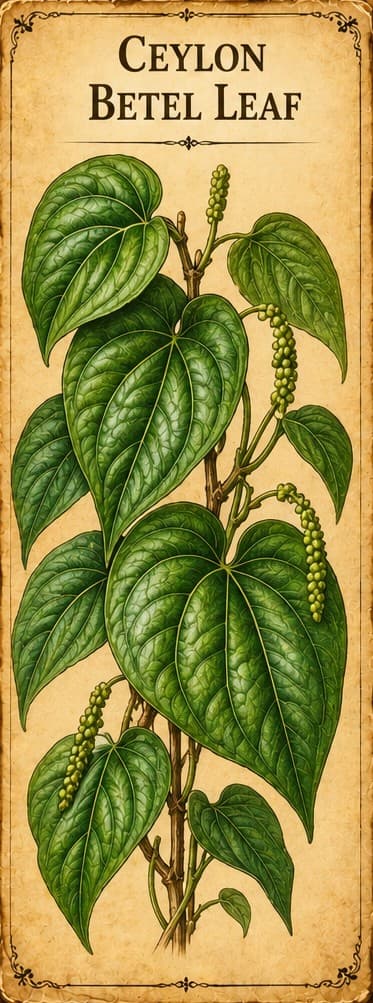
Ceylon Betel Leaf
Piper betle
The heart-shaped leaf of the betel vine, chewed across Asia and used in folk medicine for the mouth, skin and joints. Betel quid, the leaf wrapped around areca nut, causes mouth cancer.
Safety at a glance
- PregnancyNothing recorded
- BreastfeedingNothing recorded
- MedicinesNothing recorded
- Who should avoid itNothing recorded
- AllergiesNothing recorded
- Toxicity1 note →
Tap a box to read the safety notes below. “Nothing recorded” means our sources don't cover it, not that it's safe.
What is Ceylon Betel Leaf?
- Plant family
- Piperaceae, the pepper family
- Parts used
- The fresh leaves, chewed, as juice or a boiled wash, and the essential oil
- Genus
- Piper
- Species
- betle
Also called
Betel Leaf, Betel Vine
Regional names
Paan, Sirih
Traditionally used for
- Fresh breath (traditional)
- Gums and teeth (traditional)
- Skin ailments (traditional)
- Joint pain (traditional)
Traditionally described as
- Kills bacteria and fungi (in lab tests)
Safety
Toxicity testing
Betel quid, a betel leaf wrapped around areca nut and slaked lime (often with tobacco), causes cancer in people, whether or not it contains tobacco. The areca nut, which is in every betel quid, also causes cancer and a scarring of the mouth that can turn cancerous.
The leaf on its own didn't cause tumors in animal studies.[1]Health agency
Technical detail: IARC Group 1 carcinogens: betel quid with tobacco, betel quid without tobacco, and areca nut. Areca nut causes oral submucous fibrosis.
What does the research say?
Traditional use
These are traditional uses, not proven treatments.
Betel leaves are chewed in many countries, where people believe they freshen breath, strengthen gums, protect teeth and aid digestion. In folk medicine they're used:
- In Sri Lanka, as leaf juice for skin ailments
- In India and Thailand, as a mouthwash
- In Malaysia, for dental problems, headaches, arthritis and joint pain
- In Indonesia, as a vaginal wash
Laboratory & animal research
Lab and animal results show what might be worth studying in people. They don't show that the herb has these effects in humans.
In lab tests, betel leaf extracts and essential oil killed or stopped the growth of many bacteria and fungi, including drug-resistant strains, Staphylococcus aureus, E. coli and Candida (the yeast behind thrush). In mice, a leaf extract wasn't toxic even at high doses.[2]Study
Technical detail: methanol extract oral LD50 > 5000 mg/kg in ICR mice.
In animal studies, betel leaf extract given by mouth, in food or on the cheek didn't cause tumors, and in several studies it showed some anti-tumor effects.[1]Health agency
Research in people
In a small 2022 study, 60 people with mild gum inflammation used a betel leaf toothpaste and a miswak (tooth-stick) toothpaste in turn. Both reduced plaque, and the betel leaf toothpaste reduced gum bleeding more.[3]Study
In short
Betel quid made with areca nut, with or without tobacco, causes cancer.
Sources
- [1] IARC Monographs Volume 85: Betel-quid and Areca-nut Chewing and Some Areca-nut-derived Nitrosamines (Summaries & Evaluations) — International Agency for Research on Cancer (WHO)Government health agency
- [2] Piper betle (L): Recent Review of Antibacterial and Antifungal Properties, Safety Profiles, and Commercial Applications · DOI: 10.3390/molecules26082321Peer-reviewed study
- [3] Effect of a Novel Betel Leaf Dentifrice on Commonly Seen Oral Hygiene Parameters - A Randomized Clinical Crossover Study · DOI: 10.3390/dj10090166Peer-reviewed study
This information is educational and traditional in nature, and is not a substitute for professional medical advice. Unfamiliar word? See what these words mean.