
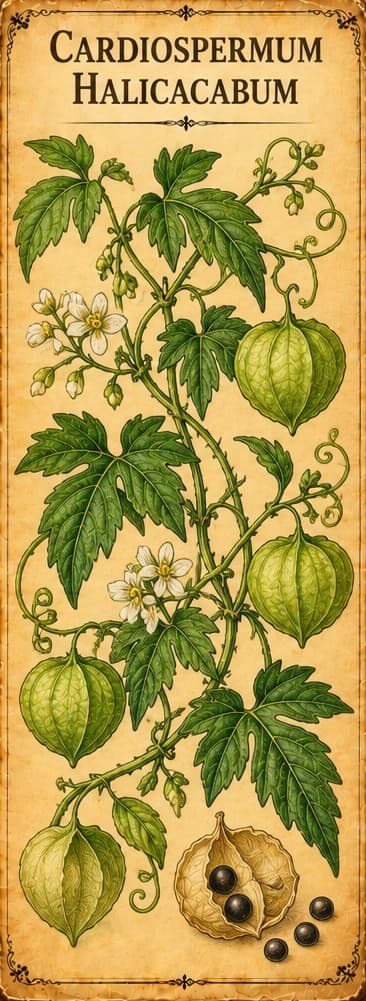
Cardiospermum Halicacabum
Cardiospermum halicacabum
Balloon vine, a climbing plant with papery, balloon-like seed pods, eaten as a leafy vegetable in India and used in traditional Indian medicine for rheumatism, pain, coughs and skin diseases.
Safety at a glance
- PregnancyNothing recorded
- BreastfeedingNothing recorded
- MedicinesNothing recorded
- Who should avoid itNothing recorded
- AllergiesNothing recorded
- ToxicityNothing recorded
Tap a box to read the safety notes below. “Nothing recorded” means our sources don't cover it, not that it's safe.
What is Cardiospermum Halicacabum?
- Plant family
- Sapindaceae, the soapberry family
- Parts used
- The leaves and whole plant; the leaves are eaten as a green vegetable in India
- Where it grows
- Found on almost every continent
- Genus
- Cardiospermum
- Species
- halicacabum
Also called
Balloon Vine, Love in a Puff
Traditionally used for
- Rheumatism (traditional)
- Pain (traditional)
- Cough (traditional)
- Skin diseases (traditional)
- Leafy vegetable
Traditionally described as
- Antioxidant (in lab studies)
- May help reduce inflammation (in lab and animal studies)
Health topics
Where Cardiospermum Halicacabum appears in symptom search, and why. Being listed doesn't mean it's a proven treatment.
- Joint Discomfort
Used in traditional Indian medicine for rheumatism. Not tested in people.
Traditions that use it
- Ayurveda
Used in traditional Indian medicine for rheumatism, belly pain, back pain, coughs, skin diseases and fever.
How it's prepared
Common ways Cardiospermum Halicacabum is prepared or sold. This isn't advice on how to take it; see Safety below.
- Culinary Preparation
Balloon vine is a well-known leafy green vegetable in India.[1]Study
What does the research say?
Traditional use
These are traditional uses, not proven treatments.
Balloon vine is a well-known leafy green vegetable in India. In traditional Indian medicine it's used for:
- Rheumatism and lower back pain
- Belly pain
- Swelling of the testicles and fluid build-up (dropsy)
- Skin diseases
- Coughs
- Nervous complaints and fever
Laboratory & animal research
Lab and animal results show what might be worth studying in people. They don't show that the herb has these effects in humans.
In lab and animal studies, balloon vine extracts have shown antioxidant activity, may help reduce inflammation, and have protected nerve cells from damage.[2]Study
In short
Not studied in people.
Sources
- [1] Ethnomedical, phytochemical and pharmacological insights on an Indian medicinal plant: The balloon vine (Cardiospermum halicacabum Linn.) · DOI: 10.1016/j.jep.2022.115143Peer-reviewed study
- [2] Cardiospermum halicacabum: A Scoping Review on its Phytoactives, Neuroprotective, Anti-Inflammatory, and Antioxidant Potential · DOI: 10.2174/0118715249382675251026140404Peer-reviewed study
This information is educational and traditional in nature, and is not a substitute for professional medical advice. Unfamiliar word? See what these words mean.