
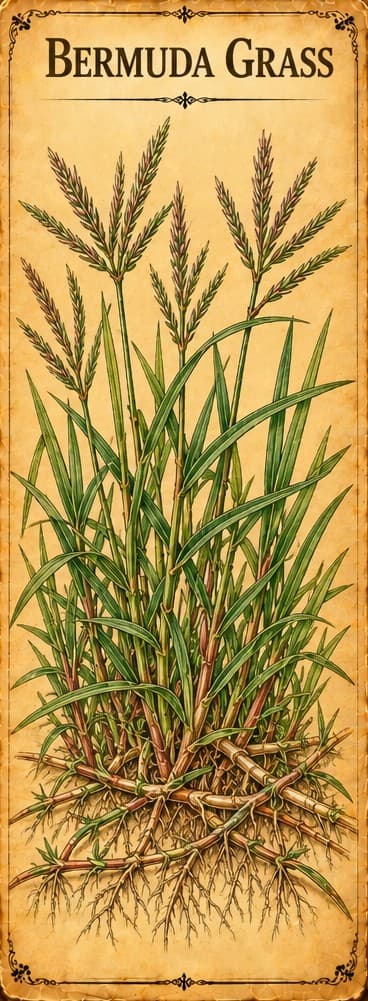
Bermuda Grass
Cynodon dactylon
A common lawn grass, known as durva in India, traditionally used for women's hormonal problems. Research on its juice (durva swaras) so far is in rats and mice. Its pollen is a common allergy trigger.
Safety at a glance
- PregnancyNothing recorded
- BreastfeedingNothing recorded
- MedicinesNothing recorded
- Who should avoid itNothing recorded
- Allergies1 note →
- ToxicityNothing recorded
Tap a box to read the safety notes below. “Nothing recorded” means our sources don't cover it, not that it's safe.
What is Bermuda Grass?
- Plant family
- Poaceae, the grass family
- Parts used
- The whole plant, often as fresh juice (durva swaras)
- Genus
- Cynodon
- Species
- dactylon
Traditional names
Durva, Durva Swaras
Traditionally used for
- Women's hormonal problems (traditional)
- Durva swaras (juice)
Traditionally described as
- May protect the liver (in animal studies)
How it's prepared
Common ways Bermuda Grass is prepared or sold. This isn't advice on how to take it; see Safety below.
Safety
Allergies
Bermuda grass pollen is a common airborne allergen.[2]Study
What does the research say?
Traditional use
These are traditional uses, not proven treatments.
Bermuda grass has traditionally been used for women's hormonal problems. In India it's known as durva, and a juice preparation called durva swaras has been studied as a herbal medicine.[1]Study
Laboratory & animal research
Lab and animal results show what might be worth studying in people. They don't show that the herb has these effects in humans.
In a 160-day study of rats with a condition like menopause, durva swaras was tested as an alternative to hormone therapy. Rats given higher doses had less body fat than rats given estrogen. These results haven't been tested in people.[3]Study
In mice, durva swaras taken beforehand protected the liver from damage caused by a paracetamol (acetaminophen) overdose.[4]Study
In rats with a condition like polycystic ovary syndrome (PCOS), a Bermuda grass extract improved their reproductive cycles.[1]Study
In short
Its pollen is a common cause of hay fever and other allergies.
Sources
- [1] Therapeutic Effects of Cynodon dactylon against Polycystic Ovary Syndrome Induced by Letrozole in Adult Rats: Ovarian and Uterine Aspects · DOI: 10.22074/ijfs.2024.2020015.1608Peer-reviewed study
- [2] Major Pollen Allergen Components and CCD Detection in Bermuda Grass Sensitized Patients in Guangzhou, China · DOI: 10.2147/JAA.S277704Peer-reviewed study
- [3] Pharmacological properties of durva swaras (Cynodon dactylon L. Pers.) in an ovariectomised rat model mimicking chronic menopausal syndrome · DOI: 10.1016/j.biopha.2021.111976Peer-reviewed study
- [4] Pharmacological benefits of durva swaras (Cynodon dactylon L. Pers.) administration in APAP-induced liver injury model of mice · DOI: 10.4103/ijp.ijp_133_24Peer-reviewed study
This information is educational and traditional in nature, and is not a substitute for professional medical advice. Unfamiliar word? See what these words mean.