
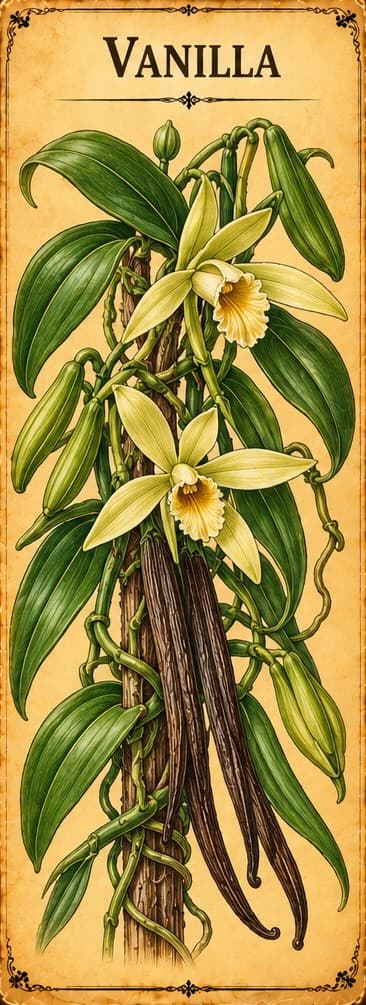
Vanilla
Vanilla planifolia
The cured pods of a Mexican climbing orchid, the source of vanilla flavor. Known as tlilxochitl to the Aztecs, it was one of the first Mexican plants with medicinal uses recorded after the Spanish arrived.
Safety at a glance
- Pregnancy1 note →
- BreastfeedingNothing recorded
- MedicinesNothing recorded
- Who should avoid itNothing recorded
- AllergiesNothing recorded
- ToxicityNothing recorded
Tap a box to read the safety notes below. “Nothing recorded” means our sources don't cover it, not that it's safe.
What is Vanilla?
- Plant family
- Orchidaceae, the orchid family
- Parts used
- The cured seed pods (vanilla beans) and the flowers
- Where it grows
- Mexico
- Genus
- Vanilla
- Species
- planifolia
Also called
Vanilla Bean
Regional names
Vainilla
Traditional names
Tlilxochitl, Xanat
Traditionally used for
- Flavoring
- Fatigue (traditional)
- Stomach problems (traditional)
- Nervous complaints (traditional)
Traditionally described as
How it's prepared
Common ways Vanilla is prepared or sold. This isn't advice on how to take it; see Safety below.
- Extract
In the US, vanilla extract is legally defined as the flavor compounds of vanilla beans dissolved in alcohol and water, with at least 35% alcohol.[1]Health agency
Safety
Pregnancy
In Mexican traditional medicine, vanilla has been used to bring on menstruation and to speed up childbirth. Its effects in pregnancy haven't been studied.[2]Study
What does the research say?
Traditional use
These are traditional uses, not proven treatments.
Vanilla, called tlilxochitl, was the first native Mexican orchid whose medicinal uses were written down after the Spanish arrived, in a 1552 herbal by Martín de la Cruz. In Mexican traditional medicine, the pods and flowers have been used:
- To flavor chocolate and drinks
- For tiredness and nervous complaints
- For stomach and gut problems, and pain and inflammation
- To lower fever and increase urination
- To bring on menstruation and speed up childbirth
Research in people
In a 2022 Spanish trial, 142 newborns having a tongue-tie snipped smelled a drop of vanilla or lavender oil on gauze, along with usual comfort measures such as sugar water and swaddling. Pain scores, crying time and heart rate changes were similar with both scents, so neither could be shown to work better. No side effects were seen.[3]Study
In short
Traditionally used to bring on menstruation and speed childbirth; not studied as a medicine.
Sources
- [1] 21 CFR 169.175 — Vanilla extract — US Food and Drug Administration (Code of Federal Regulations)Government health agency
- [2] Medicinal Orchids of Mexico: A Review · DOI: 10.3390/ph17070907Peer-reviewed study
- [3] Comparison of the analgesic effect of inhaled lavender vs vanilla essential oil for neonatal frenotomy: a randomized clinical trial (NCT04867824) · DOI: 10.1007/s00431-022-04608-3Peer-reviewed study
This information is educational and traditional in nature, and is not a substitute for professional medical advice. Unfamiliar word? See what these words mean.