
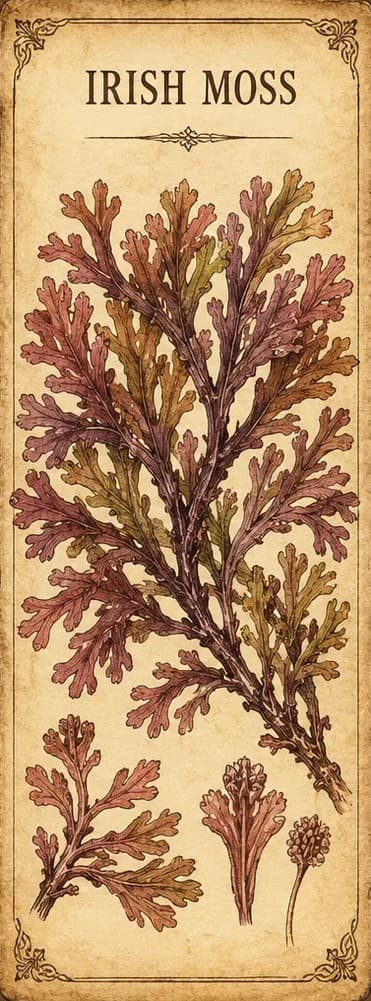
Irish Moss
Chondrus crispus
Sea moss, a red seaweed used as food and medicine, though no medicinal benefit has been proven. It's a source of carrageenan, a food thickener.
Safety at a glance
- PregnancyNothing recorded
- Breastfeeding1 note →
- MedicinesNothing recorded
- Who should avoid itNothing recorded
- AllergiesNothing recorded
- ToxicityNothing recorded
Tap a box to read the safety notes below. “Nothing recorded” means our sources don't cover it, not that it's safe.
What is Irish Moss?
- Plant family
- Gigartinaceae, a family of red seaweeds
- Parts used
- The whole seaweed, often made into a gel
- Where it grows
- Rocky shores of the northern Atlantic Ocean, between the high and low tide lines
- Genus
- Chondrus
- Species
- crispus
Also called
Sea Moss, Chondrus crispus, Carrageen Moss
Traditionally used for
- Food and thickener
Traditionally described as
How it's prepared
Common ways Irish Moss is prepared or sold. This isn't advice on how to take it; see Safety below.
- Culinary Preparation
Carrageenan, the gel taken from red seaweeds such as Irish moss, is used as a food additive.[1]Health agency
Safety
Breastfeeding
Too much iodine from seaweed eaten by breastfeeding mothers has suppressed the thyroid in their babies. Avoid sea moss while breastfeeding unless its iodine and heavy metal levels are shown to be low enough to be safe.[2]Health agency
Contamination
Sea moss can contain toxic heavy metals, such as arsenic, lead, cadmium and mercury, from the water it grew in. It also contains iodine, and the amount can be high.[2]Health agency
What does the research say?
Traditional use
These are traditional uses, not proven treatments.
Irish moss, also sold as sea moss, is a red seaweed used as food and medicine, though no medicinal benefit has been proven. It contains carrageenan (a gel used as a food thickener), other carbohydrates and many minerals, including iodine.[2]Health agency
Laboratory & animal research
Lab and animal results show what might be worth studying in people. They don't show that the herb has these effects in humans.
Europe's food safety agency reviewed carrageenan, the gel taken from red seaweeds. It isn't absorbed whole by the body, and animal studies at high doses found no harm, no cancer risk and no damage to genes. Because some data were missing, the agency kept its safe daily limit only as temporary while more research is done.[1]Health agency
Technical detail: temporary group acceptable daily intake 75 mg/kg body weight per day for E 407 and E 407a; NOAEL up to 7,500 mg/kg bw per day in chronic rat studies.
In 2013, scientists read Irish moss's full genetic code, finding about 9,600 genes. It's a small seaweed, up to 20 cm long, that grows on rocky North Atlantic shores. The study found the genes it uses to build carrageenan in its cell walls, and an unusually large set of genes for handling halogens, a group of elements in seawater that includes chlorine, bromine and iodine. This is basic biology research and says nothing about health effects.[3]Study
Technical detail: 105-Mbp genome; ι- and κ-carrageenan in the gametophyte and λ-carrageenan in the sporophyte; galactose-6-sulfurylases and haloperoxidases.
In short
Can contain heavy metals and a lot of iodine. Avoid while breastfeeding unless tested.
Sources
- [1] Re-evaluation of carrageenan (E 407) and processed Eucheuma seaweed (E 407a) as food additives — European Food Safety Authority · DOI: 10.2903/j.efsa.2018.5238Government health agency
- [2] Sea Moss. Drugs and Lactation Database (LactMed®) — National Institute of Child Health and Human Development (NIH)Government health agency
- [3] Genome structure and metabolic features in the red seaweed Chondrus crispus shed light on evolution of the Archaeplastida · DOI: 10.1073/pnas.1221259110Peer-reviewed study
This information is educational and traditional in nature, and is not a substitute for professional medical advice. Unfamiliar word? See what these words mean.