
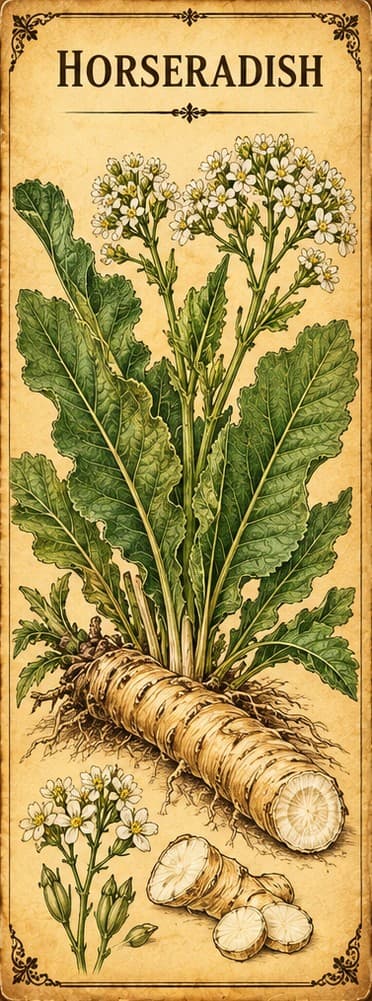
Horseradish
Armoracia rusticana
A hot, sharp root used as a condiment and traditionally for airway and bladder infections. A trial found a nasturtium and horseradish medicine reduced repeat bladder infections.
Safety at a glance
- PregnancyNothing recorded
- BreastfeedingNothing recorded
- MedicinesNothing recorded
- Who should avoid itNothing recorded
- AllergiesNothing recorded
- ToxicityNothing recorded
Tap a box to read the safety notes below. “Nothing recorded” means our sources don't cover it, not that it's safe.
What is Horseradish?
- Plant family
- Brassicaceae, the mustard and cabbage family
- Parts used
- The root, as a condiment and in herbal medicines
- Genus
- Armoracia
- Species
- rusticana
Also called
Armoracia rusticana, Horseradish Root
Traditionally used for
- Condiment
- Bladder infections (studied
- with nasturtium)
- Sinus and chest infections (traditional)
Traditionally described as
Health topics
Where Horseradish appears in symptom search, and why. Being listed doesn't mean it's a proven treatment.
- Bladder and Urinary Tract Infections (UTIs)
A trial paid for by the maker found a nasturtium and horseradish medicine reduced repeat bladder infections in women.
How it's prepared
Common ways Horseradish is prepared or sold. This isn't advice on how to take it; see Safety below.
- Culinary Preparation
Horseradish has a long tradition as a condiment and in preserving food in many parts of the world.[1]Study
What does the research say?
Traditional use
These are traditional uses, not proven treatments.
Horseradish root is used as a hot, sharp-smelling condiment. In traditional medicine it's used for bacterial infections of the airways and bladder, such as sinusitis, bronchitis and bladder infections.[2]Study
Laboratory & animal research
Lab and animal results show what might be worth studying in people. They don't show that the herb has these effects in humans.
Horseradish root is rich in glucosinolates, sulphur compounds that break down into the sharp-tasting mustard oils. In lab tests, a water extract of the root reduced an inflammation signal in immune cells. This hasn't been tested in people.[2]Study
Technical detail: inhibited LPS-induced TNF-α release at 37 µg/mL and above; glucosinolates include sinigrin.
Research in people
In a 2026 German trial, 217 women with repeated bladder infections took a medicine combining nasturtium herb and horseradish root, or a dummy pill, for 6 months. About 36% of the herbal group had another infection, compared with 48% of the dummy-pill group. Side effects were similar in both groups. The trial was paid for by the medicine's maker, and it tested the combination, not horseradish alone.[3]Review or trial
Technical detail: recurrence hazard ratio 0.64 (95% CI 0.42 to 0.97); product Angocin Anti-Infekt N; EudraCT 2013-004653-25.
Sources
- [1] Horseradish (Armoracia rusticana), a neglected medical and condiment species with a relevant glucosinolate profile: a review · DOI: 10.1007/s10722-013-0010-4Peer-reviewed study
- [2] Evaluation of an Aqueous Extract from Horseradish Root (Armoracia rusticana Radix) against Lipopolysaccharide-Induced Cellular Inflammation Reaction · DOI: 10.1155/2017/1950692Peer-reviewed study
- [3] Clinical evaluation of the efficacy and safety of nasturtium herb and horseradish root versus placebo in the continuous prophylaxis of recurrent uncomplicated cystitis: a double-blind randomised clinical trial · DOI: 10.1186/s12906-026-05328-zReview or clinical trial
This information is educational and traditional in nature, and is not a substitute for professional medical advice. Unfamiliar word? See what these words mean.