
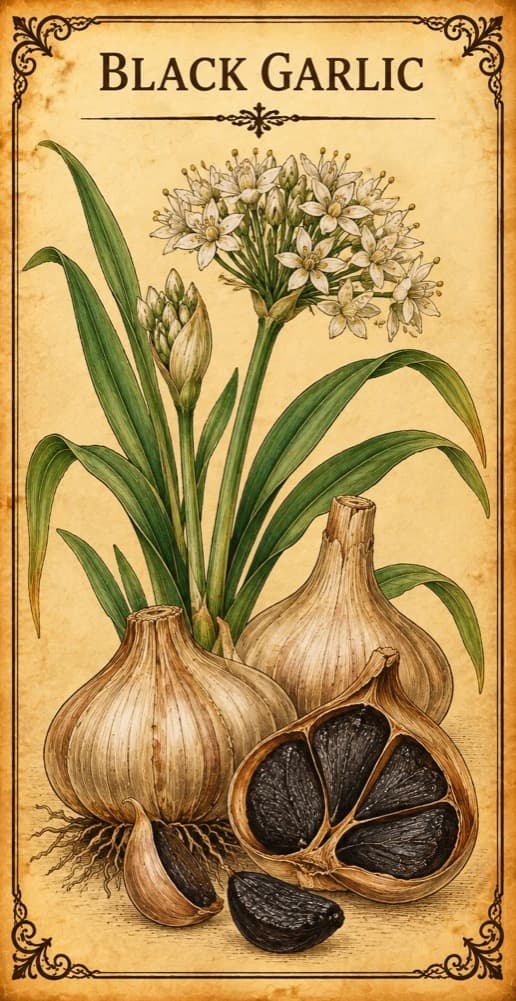
Black Garlic
Allium sativum
Garlic bulbs aged with gentle heat for weeks until the cloves turn black, soft and sweet, long eaten in Korea, Japan and Thailand. A few small trials suggest it may slightly improve some blood fat and blood pressure measures.
Safety at a glance
- PregnancyNothing recorded
- BreastfeedingNothing recorded
- MedicinesNothing recorded
- Who should avoid itNothing recorded
- AllergiesNothing recorded
- ToxicityNothing recorded
Tap a box to read the safety notes below. “Nothing recorded” means our sources don't cover it, not that it's safe.
What is Black Garlic?
- Plant family
- Amaryllidaceae, the amaryllis and onion family
- Parts used
- Whole garlic bulbs (the cloves), aged with gentle heat and humidity until they turn black
- Genus
- Allium
- Species
- sativum
Also called
Aged Black Garlic
Traditionally used for
- Food
- Health food
- Cholesterol (small trials)
- High blood pressure (small trials)
Traditionally described as
- Antioxidant (in lab studies)
- May slightly lower blood pressure
Health topics
Where Black Garlic appears in symptom search, and why. Being listed doesn't mean it's a proven treatment.
- High Blood Pressure
Two small trials of a black garlic extract found slightly lower blood pressure, mainly the bottom number. Staff of the company that makes the extract worked on both.
- High Cholesterol
A few small trials of black garlic have looked at cholesterol. One found it raised HDL ("good") cholesterol but didn't lower LDL ("bad") or total cholesterol; others found no change compared with placebo.
Natural compounds
How it's prepared
Common ways Black Garlic is prepared or sold. This isn't advice on how to take it; see Safety below.
- Culinary Preparation
Black garlic is thought to have been eaten in Korea, Japan and Thailand since ancient times.[1]Study
Safety
Side effects
In a 12-week trial of 6 g of aged black garlic a day, no side effects were reported.[2]Review or trial
In a 12-week trial of a black garlic extract, 2 people taking it and 1 taking a placebo had mild stomach discomfort. One person stopped taking the extract because of heartburn and acid reflux.[3]Review or trial
Depends on how it's prepared
Heating garlic to make black garlic forms a compound called HMF, and the amount rises the longer it's aged. Researchers say it's still unclear whether HMF poses a health risk. Lab studies suggest it can damage genes only weakly, and only at high amounts.[4]Study
Technical detail: 5-hydroxymethylfurfural; "weak genotoxic and mutagenic potential only at high concentration."
Black garlic is made from ordinary garlic, but the black garlic studies here didn't look at garlic's known safety warnings. Garlic supplements may raise the risk of bleeding. If you take a blood thinner, aspirin or other medicines, talk to your health care provider first, and see the safety section on the Garlic page.[5]Health agency
What does the research say?
Traditional use
These are traditional uses, not proven treatments.
Nobody knows exactly where black garlic came from. It's thought to have been eaten in Korea, Japan and Thailand since ancient times. In recent years it has become a fast-growing health food.[1]Study
Laboratory & animal research
Lab and animal results show what might be worth studying in people. They don't show that the herb has these effects in humans.
Black garlic is made by keeping whole garlic bulbs warm (60–90 °C) and humid for 15 to 90 days, with nothing added. Lab analyses show this turns the cloves black, chewy and sweet, and changes what's in them.
- Much less allicin, the compound behind fresh garlic's sharp smell
- More S-allyl cysteine (SAC), a more stable sulfur compound
- More sugars and more plant antioxidants (polyphenols)
The amounts vary a lot with how it's made, because there's no standard method.[4]Study
Technical detail: browning comes from the Maillard reaction, which forms melanoidins and 5-hydroxymethylfurfural (HMF). Allicin 3.45 g/kg in fresh garlic vs 0.16–0.93 g/kg; SAC 19.61 vs 28.78–124.67 µg/g; polyphenols 13.91 vs 25.81–58.33 mg GAE/g.
In lab tests and animal studies, black garlic and its extracts acted as antioxidants and lowered inflammation signals. They also slowed or killed some cancer cells, lowered blood sugar in diabetic rats, and reduced weight and blood fats in rats fed a high-fat diet. Researchers don't yet know which of its compounds are responsible.[4]Study
Technical detail: DPPH and ABTS IC50 166.3 and 108.1 µg/mL; extract at 120 mg/kg protected mice from LPS-induced septic shock; 1% or 3% extract in the diet of diabetic rats; 0.2–1.5% black garlic in the diet of high-fat-fed rats.
Research in people
In a Korean trial, 60 adults with mildly high cholesterol took 6 g of aged black garlic or a placebo every day for 12 weeks, and 55 finished. Compared with placebo, black garlic didn't change total cholesterol, LDL ("bad") cholesterol or triglycerides. It did raise HDL ("good") cholesterol and lowered apolipoprotein B, a blood protein linked to heart disease risk. No side effects were reported.[2]Review or trial
Technical detail: double-blind, randomized, placebo-controlled; analyzed 28 black garlic vs 27 placebo; LDL-C/apoB ratio increased.
In a Spanish study, 62 adults aged 40 to 64 ate 4 cloves (12 g) of black garlic a day for 12 weeks. Half had high cholesterol and half didn't. There was no placebo group, so each person's results were compared before and after.
- Some blood markers linked to healthy blood vessels improved in both groups, while two others went up.
- In people without high cholesterol, total, LDL and HDL cholesterol all went up.
- Blood pressure and weight didn't change, and safety blood tests stayed normal.
The authors say longer studies are needed.[6]Study
Technical detail: ApoA1 rose by about 11 mg/dL in both groups; MCP-1 fell 13.9% (hypercholesterolemic) and 7.2% (non-hypercholesterolemic); VCAM-1 fell 12.5% in the hypercholesterolemic group; atherogenic index fell from 3.86 to 3.54 in the non-hypercholesterolemic group; NCT05082350.
In a Spanish trial, 67 adults with moderately high LDL cholesterol took a tablet of 250 mg aged black garlic extract or a placebo each day. Each person took both, for 6 weeks each, with a 3-week break between. On black garlic, diastolic blood pressure (the bottom number) was about 3.6 mm Hg lower than on placebo. The drop was seen in men but not in women. Cholesterol didn't change compared with placebo. Two authors worked for the company that makes the extract.[7]Review or trial
Technical detail: randomized, crossover, double-blind; 1.25 mg S-allyl-L-cysteine per tablet; DBP −3.62 mm Hg (95% CI −6.2 to −0.99) vs placebo; men −5.85 mm Hg (−10.5 to −1.3); SBP −1.51 mm Hg (−9.1 to 6.1), not significant; NCT04010565.
In a Spanish trial, 81 adults with mild (grade 1) high blood pressure who already took blood pressure medicine added a 250 mg aged black garlic extract tablet or a placebo each day for 12 weeks; 77 finished. Blood pressure fell slightly more with black garlic: about 1.8 mm Hg for the top number and 1.5 mm Hg for the bottom number. The company that makes the extract funded the study and employed some of the authors.[3]Review or trial
Technical detail: randomized, triple-blind, placebo-controlled; 0.25 mg S-allyl-cysteine a day; SBP −1.8 mm Hg (95% CI 0.7 to 4.1), DBP −1.5 mm Hg (0.3 to 3.0); nitric oxide +10.3 µM; uric acid −0.3 mg/dL; ACE activity −9.3 U/L.
In another Spanish trial, 75 adults with mild (grade 1) high blood pressure finished 12 weeks of a daily 250 mg aged black garlic extract or a placebo. Black garlic didn't change total, LDL or HDL cholesterol or triglycerides. More detailed blood fat tests hinted at small changes, but the authors say these need confirming in larger trials. The extract's maker funded the study.[8]Review or trial
Technical detail: randomized, triple-blind, placebo-controlled; NMR lipoprotein subclass analysis (exploratory); NCT04915053.
In short
Its safety hasn't been studied in detail, and the trials so far are small and short.
Sources
- [1] Black Garlic and Its Bioactive Compounds on Human Health Diseases: A Review — Molecules · DOI: 10.3390/molecules26165028Peer-reviewed study
- [2] Reduction of blood lipid parameters by a 12-wk supplementation of aged black garlic: a randomized controlled trial — Nutrition · DOI: 10.1016/j.nut.2014.02.014Review or clinical trial
- [3] Antihypertensive Effects of an Optimized Aged Garlic Extract in Subjects with Grade I Hypertension and Antihypertensive Drug Therapy: A Randomized, Triple-Blind Controlled Trial — Nutrients · DOI: 10.3390/nu15173691Review or clinical trial
- [4] Black Garlic: Evolution of the Chemical Composition and Broad Biological Activities — Journal of Agricultural and Food Chemistry · DOI: 10.1021/acs.jafc.5c09705Peer-reviewed study
- [5] Garlic: Usefulness and Safety — National Center for Complementary and Integrative Health (NIH)Government health agency
- [6] Effect of Black Garlic Consumption on Endothelial Function and Lipid Profile: A Before-and-After Study in Hypercholesterolemic and Non-Hypercholesterolemic Subjects — Nutrients · DOI: 10.3390/nu15143138Peer-reviewed study
- [7] Effects of an Optimized Aged Garlic Extract on Cardiovascular Disease Risk Factors in Moderate Hypercholesterolemic Subjects: A Randomized, Crossover, Double-Blind, Sustained and Controlled Study — Nutrients · DOI: 10.3390/nu14030405Review or clinical trial
- [8] Effects of aged black garlic (ABG10+) on lipoprotein subclass composition in Grade I hypertension: a randomized, triple-blind controlled trial with sex-stratified sequential allocation — Frontiers in Nutrition · DOI: 10.3389/fnut.2026.1869617Review or clinical trial
This information is educational and traditional in nature, and is not a substitute for professional medical advice. Unfamiliar word? See what these words mean.