
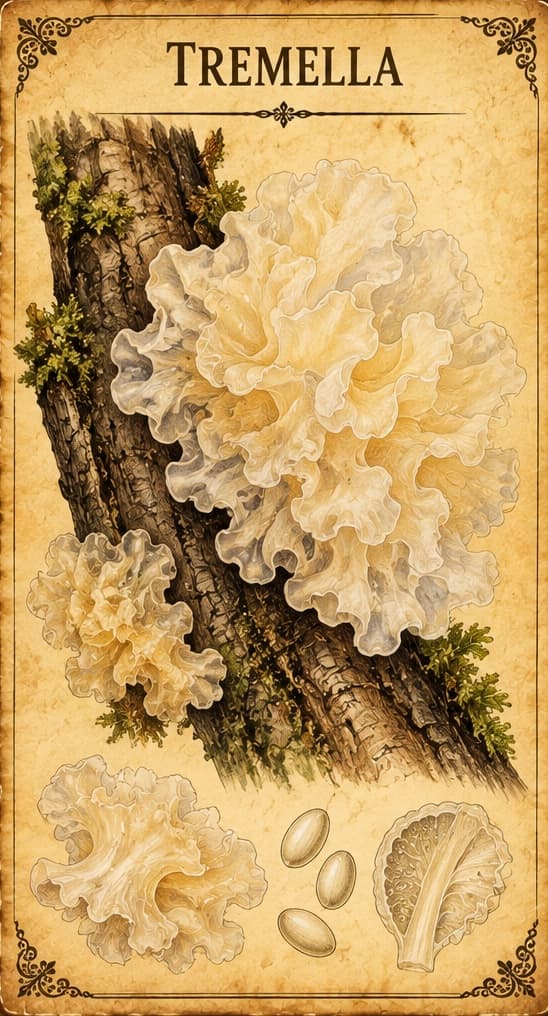
Tremella
Tremella fuciformis
Snow fungus, an edible white, frilly fungus eaten and used in Chinese medicine for centuries. Most research is in the lab; one small trial suggests it may help with memory complaints.
Safety at a glance
- PregnancyNothing recorded
- BreastfeedingNothing recorded
- MedicinesNothing recorded
- Who should avoid itNothing recorded
- AllergiesNothing recorded
- ToxicityNothing recorded
Tap a box to read the safety notes below. “Nothing recorded” means our sources don't cover it, not that it's safe.
What is Tremella?
- Plant family
- Tremellaceae, a family of jelly fungi
- Parts used
- The whole fruiting body (the edible white, frilly part of the fungus)
- Genus
- Tremella
- Species
- fuciformis
Also called
Snow Fungus, Snow Mushroom, Silver Fungus, White Fungus
Traditionally used for
- Food
- Stomach and lungs (traditional)
- Weakness (traditional)
- Memory (one small trial)
Traditionally described as
- Antioxidant (in lab studies)
Health topics
Where Tremella appears in symptom search, and why. Being listed doesn't mean it's a proven treatment.
- Fatigue
Valued in Chinese medicine for weakness. Not tested in trials.
- Memory and Thinking
In one small 8-week trial, adults with memory complaints who took tremella did better on memory tests than with a placebo.
How it's prepared
Common ways Tremella is prepared or sold. This isn't advice on how to take it; see Safety below.
- Culinary Preparation
It has been eaten in Asian countries for centuries.[1]Study
Safety
Side effects
In an 8-week trial of tremella supplements, side effects were about as common as with a placebo.[2]Review or trial
Contamination
Spoiled snow fungus can contain bongkrekic acid, a toxin made by bacteria that can cause severe food poisoning. Don't eat tremella that may have spoiled.[3]Study
Technical detail: bongkrekic acid is a potent respiratory toxin produced by Pseudomonas cocovenenans; also found in spoiled fermented rice- and wheat-based foods and black fungus.
What does the research say?
Traditional use
These are traditional uses, not proven treatments.
Tremella is an edible fungus with clusters of flat, wavy, frilly lobes. It has been eaten and used as medicine in Asian countries for centuries. It was first recorded in the Shennong Herbal Classic, an early Chinese medical text. In Chinese medicine it's valued for nourishing the stomach and lungs and for weakness.[1]Study
Laboratory & animal research
Lab and animal results show what might be worth studying in people. They don't show that the herb has these effects in humans.
Most research is on tremella's sugar-based compounds (polysaccharides). In lab and animal studies, they acted as antioxidants, affected the immune system, lowered blood sugar and blood fats, and supported healthy gut bacteria. The review's authors note that nearly all of this research is in the lab or in animals.[1]Study
In lab and animal studies, tremella extracts have been looked at for skin aging, protection from sun damage, wound healing and keeping the skin barrier healthy. A 2023 dermatology review says clinical studies in people are needed before we know whether it helps the skin.[4]Study
Research in people
In a Korean trial, 75 adults who felt their memory was slipping took 600 mg or 1,200 mg of tremella or a placebo every day for 8 weeks. People taking tremella reported fewer memory complaints and did better on short-term memory and planning tests. Side effects were about as common as with placebo. It was a small, short trial.[2]Review or trial
Technical detail: randomized, double-blind, placebo-controlled; subjective cognitive impairment; adverse events 40.4% (1,200 mg), 35.1% (600 mg), 41.4% (placebo); exploratory MRI gray-matter changes.
In short
Spoiled snow fungus can contain a bacterial toxin that causes severe food poisoning.
Sources
- [1] Recent advances in polysaccharides from Tremella fuciformis: isolation, structures, bioactivities and application — Frontiers in Nutrition · DOI: 10.3389/fnut.2025.1663327Peer-reviewed study
- [2] Efficacy and Safety of Tremella fuciformis in Individuals with Subjective Cognitive Impairment: A Randomized Controlled Trial — Journal of Medicinal Food · DOI: 10.1089/jmf.2017.4063Review or clinical trial
- [3] Development of a High-Throughput Indirect Competitive Chemiluminescence Enzyme-Linked Immunoassay for the Rapid Detection of Bongkrekic Acid in Tremella Fungus and Rice Noodles — Foods · DOI: 10.3390/foods15101749Peer-reviewed study
- [4] The potential cutaneous benefits of Tremella fuciformis — Archives of Dermatological Research · DOI: 10.1007/s00403-023-02550-4Peer-reviewed study
This information is educational and traditional in nature, and is not a substitute for professional medical advice. Unfamiliar word? See what these words mean.