
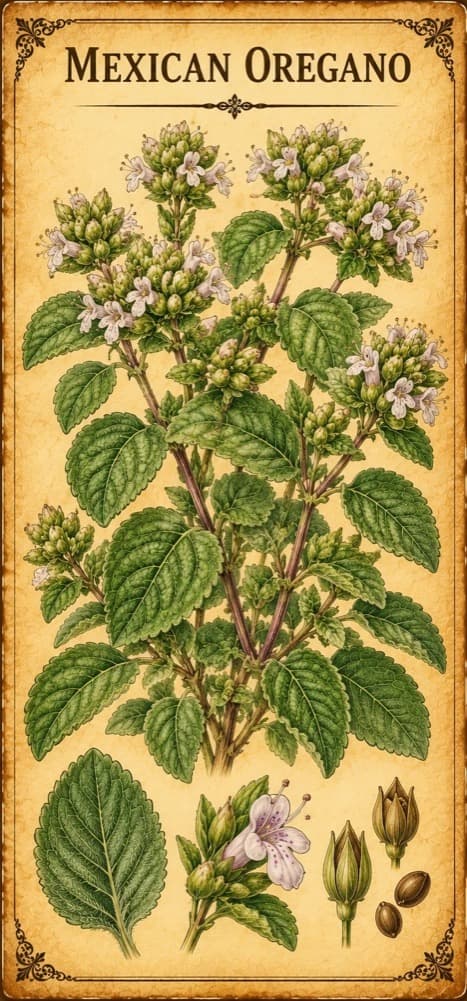
Mexican Oregano
Poliomintha longiflora
A Mexican plant known as oregano. It's a different plant from common oregano, but its oil contains the same compounds, carvacrol and thymol. Its oil has only been studied in the lab, not in animals or people.
Safety at a glance
- PregnancyNothing recorded
- BreastfeedingNothing recorded
- MedicinesNothing recorded
- Who should avoid itNothing recorded
- AllergiesNothing recorded
- ToxicityNothing recorded
Tap a box to read the safety notes below. “Nothing recorded” means our sources don't cover it, not that it's safe.
What is Mexican Oregano?
- Plant family
- Lamiaceae, the mint family
- Parts used
- The essential oil, studied in the lab
- Genus
- Poliomintha
- Species
- longiflora
Traditionally used for
- Flavoring
Traditionally described as
- Antioxidant (in lab studies)
- Kills some germs (in lab studies)
Natural compounds
What does the research say?
Laboratory & animal research
Lab and animal results show what might be worth studying in people. They don't show that the herb has these effects in humans.
In lab tests, Mexican oregano essential oil was split into parts by distillation. The parts richest in carvacrol and thymol acted as strong antioxidants. They also stopped the growth of Listeria and Salmonella bacteria and of Candida, a yeast. The lighter parts without these compounds had little effect. This was lab work only: it hasn't been tested in animals or people. The authors say more research is needed to understand how it works.[1]Study
Technical detail: vacuum distillation fractions F1–F4 plus undistilled residue; F1 and F2 lacked thymol and carvacrol and showed no antimicrobial activity; lowest MIC 6.4 µg/mL (residue, Listeria monocytogenes); C. albicans MIC 78–84 µg/mL; ABTS up to about 177,016 µmol TE/g (F4).
In short
Not tested in animals or people.
Sources
- [1] Chemical Composition and Biological Activities of Oregano Essential Oil and Its Fractions Obtained by Vacuum Distillation — Molecules · DOI: 10.3390/molecules24101904Peer-reviewed study
This information is educational and traditional in nature, and is not a substitute for professional medical advice. Unfamiliar word? See what these words mean.