
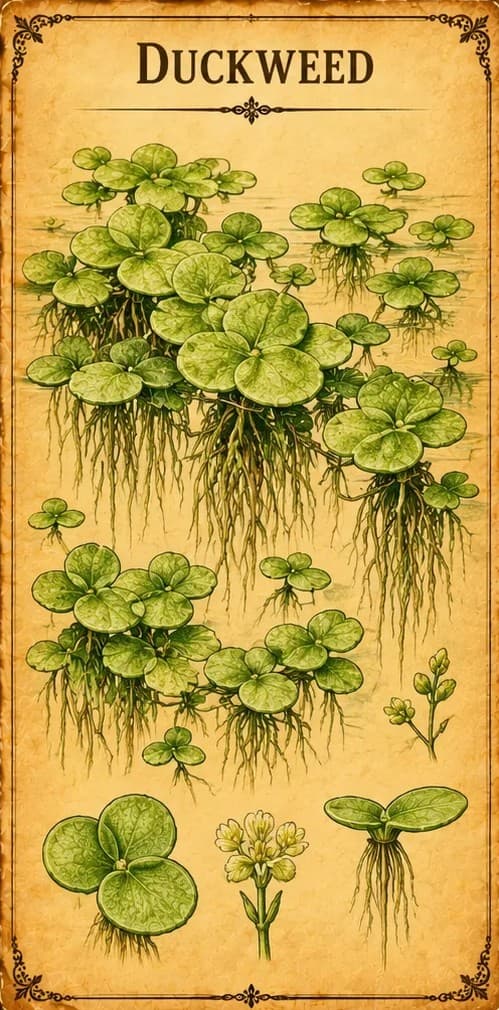
Duckweed
Lemna minor
A tiny floating water plant, high in protein, eaten in parts of Asia and studied as a new food. It soaks up whatever is in its water.
Safety at a glance
- PregnancyNothing recorded
- BreastfeedingNothing recorded
- MedicinesNothing recorded
- Who should avoid itNothing recorded
- AllergiesNothing recorded
- Toxicity1 note →
Tap a box to read the safety notes below. “Nothing recorded” means our sources don't cover it, not that it's safe.
What is Duckweed?
- Plant family
- Araceae, the arum family, which includes duckweeds
- Parts used
- The whole plant
- Genus
- Lemna
- Species
- minor
Also called
Common Duckweed, Lesser Duckweed, Water Lentil, Water Lentils
Traditionally used for
- Food and protein source
- Animal and fish feed
Traditionally described as
- High in protein
- Fast-growing
How it's prepared
Common ways Duckweed is prepared or sold. This isn't advice on how to take it; see Safety below.
- Culinary Preparation
Duckweed has historically been eaten in southwest Asia.[1]Study
Safety
Side effects
In 2023, Europe's food safety agency judged a protein concentrate made from common duckweed and a close relative to be safe as a food ingredient, and for adults as a supplement.[2]Health agency
Duckweed contains oxalates, phytates and tannins, natural compounds that can reduce how well some nutrients are absorbed, at levels similar to common vegetables. Drying in the sun and boiling help control germs.[3]Study
Toxicity testing
In 2022, Europe's food safety agency couldn't confirm that whole duckweed is safe to eat as a vegetable, because it can contain much more manganese than other leafy vegetables. How much it contains depends on how it's grown and fertilized. The agency judged the risk of allergic reactions to be low.[4]Health agency
Contamination
Duckweed soaks up heavy metals and other substances from the water it grows in; it's even used to clean polluted water. Only eat duckweed grown in clean, monitored water, not plants collected from ponds or ditches.[3]Study
What does the research say?
Traditional use
These are traditional uses, not proven treatments.
Duckweed has historically been eaten in southwest Asia. Related duckweeds (Wolffia species) are already sold as food in the US, EU, Israel, Thailand and Japan. Common duckweed is widely used as feed for fish and farm animals.[1]Study
Laboratory & animal research
Lab and animal results show what might be worth studying in people. They don't show that the herb has these effects in humans.
Duckweed is one of the fastest-growing plants on Earth and can double in 4 to 5 days. Common duckweed can be up to 39% protein by dry weight, with all the essential amino acids, and it also provides vitamins and minerals. It is low in fat.[3]Study
In lab tests on three kinds of human cells, extracts of seven duckweed species, including common duckweed, didn't harm the cells or slow their growth.[5]Study
Research in people
In a trial of 12 healthy adults, drinking 20 g of duckweed (Lemna) protein raised amino acids in the blood less than the same amount of whey protein from milk, about 60% as much overall. Results varied widely from person to person.[6]Study
Technical detail: relative AUC 60.4% for total amino acids and 66.3% for essential amino acids vs whey; double-blind crossover.
In short
Only eat duckweed grown in clean water; it absorbs heavy metals. May be high in manganese.
Sources
- [1] Lemna minor: Unlocking the Value of This Duckweed for the Food and Feed Industry · DOI: 10.3390/foods13101435Peer-reviewed study
- [2] Safety of water lentil protein concentrate from a mixture of Lemna gibba and Lemna minor as a novel food pursuant to Regulation (EU) 2015/2283 — European Food Safety Authority, Panel on Nutrition, Novel Foods and Food Allergens (NDA) · DOI: 10.2903/j.efsa.2023.7903Government health agency
- [3] Duckweed (Wolffia globosa, Wolffia arrhiza, and Lemna minor) as novel therapeutic food for acute malnutrition and famine alleviation in low- and middle-income countries and humanitarian crisis settings · DOI: 10.3389/fnut.2026.1835959Peer-reviewed study
- [4] Safety of Lemna minor and Lemna gibba whole plant material as a novel food pursuant to Regulation (EU) 2015/2283 — European Food Safety Authority, Panel on Nutrition, Novel Foods and Food Allergens (NDA) · DOI: 10.2903/j.efsa.2022.7598Government health agency
- [5] Duckweed for Human Nutrition: No Cytotoxic and No Anti-Proliferative Effects on Human Cell Lines · DOI: 10.1007/s11130-019-00725-xPeer-reviewed study
- [6] A controlled human intervention trial to study protein quality by amino acid uptake kinetics with the novel Lemna protein concentrate as case study · DOI: 10.1080/09637486.2021.1960958Peer-reviewed study
This information is educational and traditional in nature, and is not a substitute for professional medical advice. Unfamiliar word? See what these words mean.