
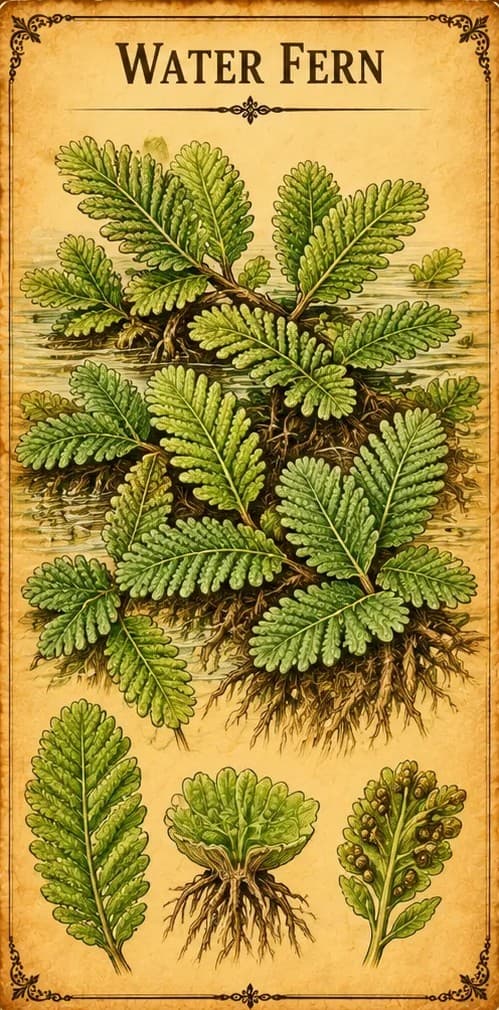
Water Fern
Azolla spp.
A small floating fern used for centuries as a natural fertilizer in Asian rice paddies. Extracts have been tested only in rats.
Safety at a glance
- PregnancyNothing recorded
- BreastfeedingNothing recorded
- MedicinesNothing recorded
- Who should avoid itNothing recorded
- AllergiesNothing recorded
- Toxicity1 note →
Tap a box to read the safety notes below. “Nothing recorded” means our sources don't cover it, not that it's safe.
What is Water Fern?
- Plant family
- Salviniaceae, the floating fern family
- Parts used
- The whole plant
- Where it grows
- Native to the Americas, Africa, Asia and Australia; no species is native to Europe
- Genus
- Azolla
- Species
- spp.
Also called
Azolla, Mosquito Fern, Azolla pinnata, Azolla filiculoides
Traditionally used for
- Rice paddy fertilizer (traditional)
- Animal feed
- Liver and kidney protection (rat studies only)
Traditionally described as
- Antioxidant (in animal studies)
- High in protein
Safety
Toxicity testing
The bacteria living inside azolla are a type that can make toxins in other species. A 2024 study of 48 azolla samples found no genes for the main cyanobacterial toxins, and no BMAA, a nerve toxin. The authors concluded azolla could be a safe food.[1]Study
Contamination
Azolla absorbs heavy metals from water and is used to clean polluted water.[2]Study
What does the research say?
Traditional use
These are traditional uses, not proven treatments.
Azolla has been grown in rice paddies for centuries as a natural fertilizer. In Vietnam its use dates back to the 11th century, and by the 17th century it was widespread in China; it later spread to India and the Philippines. A floating mat of azolla blocks light to weeds and cuts water loss. It's also fed to farm animals and fish because it's rich in protein.[2]Study
Laboratory & animal research
Lab and animal results show what might be worth studying in people. They don't show that the herb has these effects in humans.
Azolla lives with a type of bacteria (cyanobacteria) inside its leaves that takes nitrogen from the air, which is why it works as a fertilizer. Several azolla species have become invasive outside their native range, forming dense mats that disrupt waterways.[2]Study
In rats given lead for 60 days, an extract of Azolla pinnata given by mouth reduced liver damage and lowered signs of inflammation and cell damage. This hasn't been tested in people.[3]Study
Technical detail: 10 mg/kg ethanolic extract; compounds identified included quercetin, rutin, vitexin and hyperoside.
In rats given the antibiotic gentamicin, which can harm the kidneys, an Azolla pinnata extract helped protect kidney function and tissue, mainly by boosting the body's antioxidant defenses. This hasn't been tested in people.[4]Study
Technical detail: hydroalcoholic extract 10 or 20 mg/kg/day orally for 7 days.
In short
Absorbs heavy metals from water. Not tested in people.
Sources
- [1] Azolla as a Safe Food: Suppression of Cyanotoxin-Related Genes and Cyanotoxin Production in Its Symbiont, Nostoc azollae · DOI: 10.3390/plants13192707Peer-reviewed study
- [2] Role of Azolla in sustainable agriculture and climate resilience: a comprehensive review · DOI: 10.3389/fpls.2025.1661720Peer-reviewed study
- [3] Antioxidant, Anti-Inflammatory, and Anti-Apoptotic Effects of Azolla pinnata Ethanolic Extract against Lead-Induced Hepatotoxicity in Rats · DOI: 10.3390/antiox9101014Peer-reviewed study
- [4] Reno-Protective Properties of Azolla pinnata Extract Against Gentamicin-Induced Kidney Damage Are Attributed to Its Antioxidant Effects · DOI: 10.61882/ibj.5194Peer-reviewed study
This information is educational and traditional in nature, and is not a substitute for professional medical advice. Unfamiliar word? See what these words mean.