
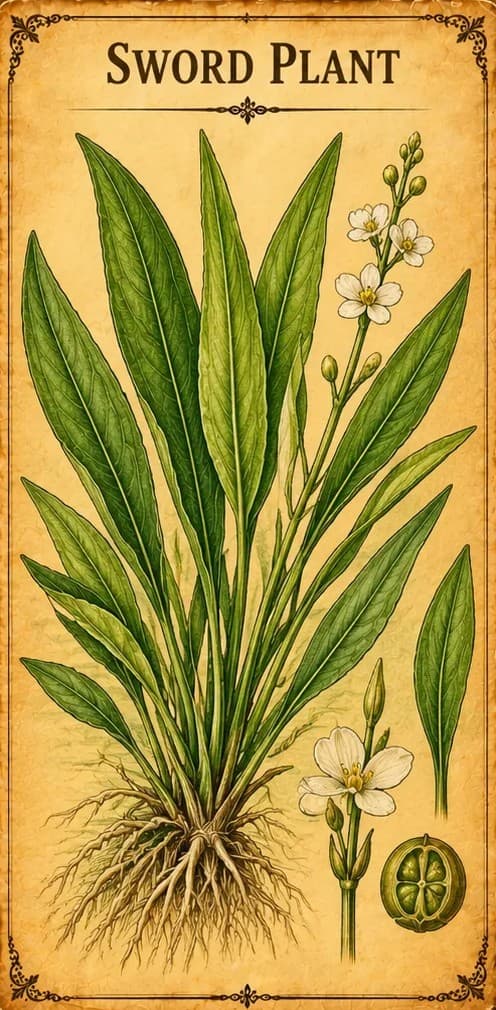
Sword Plant
Echinodorus grandiflorus
A Brazilian water plant (chapéu-de-couro) whose leaves are a folk remedy for high blood pressure, swelling and fluid retention. Studied only in animals.
Safety at a glance
- Pregnancy1 note →
- BreastfeedingNothing recorded
- MedicinesNothing recorded
- Who should avoid itNothing recorded
- AllergiesNothing recorded
- ToxicityNothing recorded
Tap a box to read the safety notes below. “Nothing recorded” means our sources don't cover it, not that it's safe.
What is Sword Plant?
- Plant family
- Alismataceae, the water plantain family
- Parts used
- The leaves
- Where it grows
- A semi-aquatic plant native to Brazil, where it is widespread
- Genus
- Echinodorus
- Species
- grandiflorus
Also called
Aquarius grandiflorus, Chapéu-de-couro, Chapeu de Couro, Leather Hat, Echinodorus
Traditionally used for
- High blood pressure (traditional)
- Inflammation (traditional)
- Water pill (traditional)
Traditionally described as
- Lowers blood pressure (in animals)
- Increases urination (in animals)
Health topics
Where Sword Plant appears in symptom search, and why. Being listed doesn't mean it's a proven treatment.
- High Blood Pressure
Used for high blood pressure in Brazilian folk medicine. Leaf extracts lowered blood pressure in rats; not tested in people.
Safety
Pregnancy
In pregnant rats given high doses of a leaf extract, the mothers developed anemia and mild liver and kidney damage, though the pregnancies and unborn young weren't affected.[1]Study
Technical detail: 250–1,000 mg/kg/day by mouth; anemia, raised AST and cholesterol at 1,000 mg/kg; liver and kidney changes at 500 and 1,000 mg/kg.
What does the research say?
Traditional use
These are traditional uses, not proven treatments.
Laboratory & animal research
Lab and animal results show what might be worth studying in people. They don't show that the herb has these effects in humans.
In rats with high blood pressure, a leaf extract lowered blood pressure, partly by relaxing blood vessels. Given by mouth over a longer period, it worked about as well as standard blood pressure medicines. This hasn't been tested in people.[4]Study
Technical detail: ethanolic extract; mean arterial pressure fell up to 23% (intraperitoneal) and 51% (intravenous); effects involved nitric oxide, muscarinic and PAF receptors.
In lab tests on rabbit blood vessels, a water extract of the leaves made the vessels widen, mainly by releasing nitric oxide, a natural compound that relaxes blood vessel walls.[2]Study
In rats, a leaf extract taken for 7 days increased urine output about as much as the water pill hydrochlorothiazide, without the same loss of bicarbonate. It also lowered blood pressure in rats with high blood pressure. This hasn't been tested in people.[3]Study
In mice, leaf extracts reduced swelling in a standard inflammation test. Flavonoids and diterpenes (two groups of plant compounds) seemed to be responsible.[5]Study
Technical detail: carrageenan paw edema; 50% and 70% ethanol extracts at 1000 mg/kg orally; trans-aconitic acid active at 270 mg/kg.
In short
High doses harmed pregnant rats. Not tested in people.
Sources
- [1] Reproductive toxicity of Echinodorus grandiflorus in pregnant rats · DOI: 10.2131/jts.35.911Peer-reviewed study
- [2] Pharmacological mechanisms involved in the vasodilator effects of extracts from Echinodorus grandiflorus · DOI: 10.1016/j.jep.2006.10.030Peer-reviewed study
- [3] Involvement of bradykinin B2 and muscarinic receptors in the prolonged diuretic and antihypertensive properties of Echinodorus grandiflorus (Cham. & Schltdl.) Micheli · DOI: 10.1016/j.phymed.2015.10.020Peer-reviewed study
- [4] Antihypertensive effects of crude extracts from leaves of Echinodorus grandiflorus · DOI: 10.1111/j.1472-8206.2008.00565.xPeer-reviewed study
- [5] Antiedematogenic activity and phytochemical composition of preparations from Echinodorus grandiflorus leaves · DOI: 10.1016/j.phymed.2010.05.008Peer-reviewed study
This information is educational and traditional in nature, and is not a substitute for professional medical advice. Unfamiliar word? See what these words mean.