
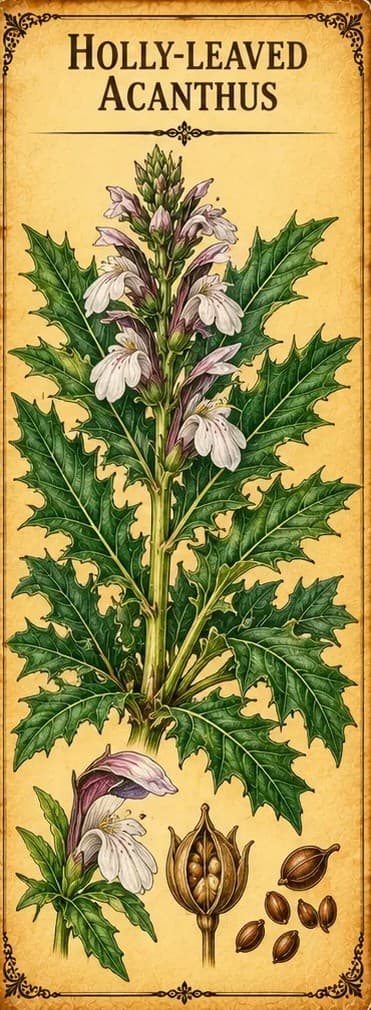
Holly-leaved Acanthus
Acanthus ilicifolius
A mangrove plant used in folk medicine for wounds and skin, breathing and digestive problems. Research so far is in animals.
Safety at a glance
- PregnancyNothing recorded
- BreastfeedingNothing recorded
- MedicinesNothing recorded
- Who should avoid itNothing recorded
- AllergiesNothing recorded
- ToxicityNothing recorded
Tap a box to read the safety notes below. “Nothing recorded” means our sources don't cover it, not that it's safe.
What is Holly-leaved Acanthus?
- Plant family
- Acanthaceae, the acanthus family
- Parts used
- The leaves
- Where it grows
- Mangroves, including the Sundarbans
- Genus
- Acanthus
- Species
- ilicifolius
Also called
Holly Mangrove, Acanthus ilicifolius
Traditionally used for
- Wound healing (traditional)
- Skin conditions (traditional)
- Breathing and digestive problems (traditional)
Traditionally described as
- Reduces swelling (in animals)
- Protects the liver (in animals)
What does the research say?
Traditional use
These are traditional uses, not proven treatments.
Acanthus species are used in traditional medicine mainly for breathing, nervous system, reproductive, digestive and urinary problems and for skin conditions. Holly-leaved acanthus is one of the three most-used species.[1]Study
It grows widely in the Sundarbans mangroves, where it's popularly used to heal wounds.[2]Study
Laboratory & animal research
Lab and animal results show what might be worth studying in people. They don't show that the herb has these effects in humans.
In rats, a leaf extract reduced paw swelling in a standard inflammation test and blocked enzymes involved in inflammation (COX-1, COX-2 and 5-LOX). In human immune cells in the lab, it lowered inflammation signals. This hasn't been tested in people.[2]Study
In rats, a leaf extract given by mouth protected the liver from a toxic chemical (carbon tetrachloride) about as well as curcumin. It also acted as an antioxidant in lab tests.[3]Study
Technical detail: alcoholic leaf extract 250 and 500 mg/kg; curcumin 100 mg/kg as comparison.
In mice, an extract slowed tumor growth, made mice with an implanted cancer live 75% longer, and delayed skin growths caused by cancer-causing chemicals. It has not been tested against cancer in people.[4]Study
Technical detail: 250 and 500 mg/kg; Ehrlich ascites carcinoma; DMBA/croton oil skin papilloma.
In short
No safety studies in people.
Sources
- [1] A review of the ethnomedicinal uses, chemistry, and pharmacological properties of the genus Acanthus (Acanthaceae) · DOI: 10.1016/j.jep.2022.115271Peer-reviewed study
- [2] Anti-inflammatory activity of Acanthus ilicifolius · DOI: 10.1016/j.jep.2008.07.024Peer-reviewed study
- [3] Antioxidant and hepatoprotective effect of Acanthus ilicifolius · DOI: 10.1016/s0367-326x(00)00300-2Peer-reviewed study
- [4] Tumour reducing and anticarcinogenic activity of Acanthus ilicifolius in mice · DOI: 10.1016/s0378-8741(01)00347-6Peer-reviewed study
This information is educational and traditional in nature, and is not a substitute for professional medical advice. Unfamiliar word? See what these words mean.