
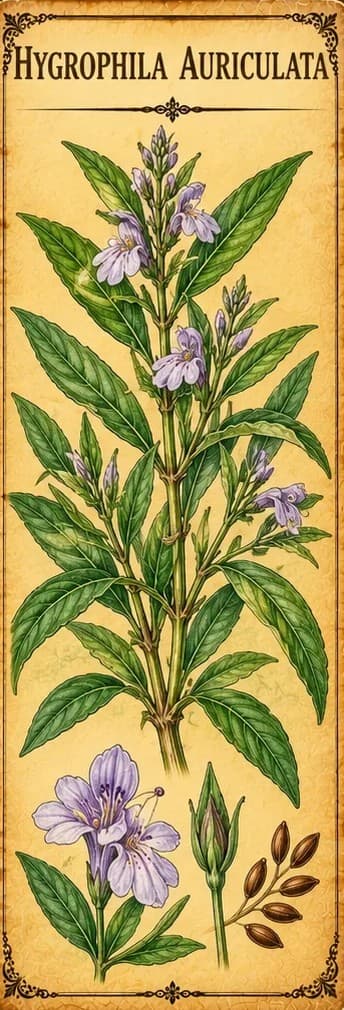
Hygrophila Auriculata
Hygrophila auriculata
An herb used in Ayurveda for the liver, kidney stones, swelling and as an aphrodisiac. Studied only in animals.
Safety at a glance
- PregnancyNothing recorded
- BreastfeedingNothing recorded
- MedicinesNothing recorded
- Who should avoid itNothing recorded
- AllergiesNothing recorded
- ToxicityNothing recorded
Tap a box to read the safety notes below. “Nothing recorded” means our sources don't cover it, not that it's safe.
What is Hygrophila Auriculata?
- Plant family
- Acanthaceae, the acanthus family
- Parts used
- The seeds, roots and aerial parts
- Genus
- Hygrophila
- Species
- auriculata
Older scientific names
Hygrophila spinosa, Asteracantha longifolia
Traditionally used for
- Liver problems (traditional)
- Kidney stones (traditional)
- Aphrodisiac (traditional)
Traditionally described as
- Protects the liver and kidneys (in animals)
- Lowers blood sugar (in animals)
Health topics
Where Hygrophila Auriculata appears in symptom search, and why. Being listed doesn't mean it's a proven treatment.
- Kidney Stones
Traditionally used for kidney stones; not tested in people.
Traditions that use it
- Ayurveda
Used in Ayurveda as a Rasayana (rejuvenating) remedy.
What does the research say?
Traditional use
These are traditional uses, not proven treatments.
Traditional writings describe using the plant for jaundice, swelling, digestive problems, diarrhea, gallstones and kidney stones, urinary and genital problems, vaginal discharge, rheumatism, anemia, body pain, constipation and skin disease, and as an aphrodisiac.[1]Study
The seeds are used in Indian systems of medicine for liver problems.[2]Study
In Indian medicine the seeds are also used to boost male sex drive and sperm production.[3]Study
Laboratory & animal research
Lab and animal results show what might be worth studying in people. They don't show that the herb has these effects in humans.
In rats, a seed extract protected the liver from damage caused by an overdose of acetaminophen (paracetamol) or another toxic chemical. This hasn't been tested in people.[2]Study
In diabetic rats, an extract of the above-ground parts given for 3 weeks lowered blood sugar and reduced cell damage in the liver and kidneys. This hasn't been tested in people.[4]Study
Technical detail: 100 and 250 mg/kg; streptozotocin-induced diabetes; glibenclamide comparison.
In rats given the cancer drug cisplatin, which can harm the kidneys, an extract of the above-ground parts protected kidney function and tissue.[5]Study
In male rats, an alkaloid-rich seed fraction more than doubled testosterone levels and improved sperm production and sexual behavior. This hasn't been tested in people.[3]Study
Technical detail: 50 mg/kg; serum testosterone up 115%.
In short
No safety studies in people.
Sources
- [1] Ethnomedicinal, phytochemical and pharmacological updates on Hygrophila auriculata (Schum.) Hiene: an overview · DOI: 10.1016/j.joim.2018.07.002Peer-reviewed study
- [2] Hepatoprotective activity of Apium graveolens and Hygrophila auriculata against paracetamol and thioacetamide intoxication in rats · DOI: 10.1016/0378-8741(95)01291-5Peer-reviewed study
- [3] Aphrodisiac and spermatogenic potential of alkaloidal fraction of Hygrophila spinosa T. Ander in rats · DOI: 10.1016/j.jep.2016.10.080Peer-reviewed study
- [4] Action of Hygrophila auriculata against streptozotocin-induced oxidative stress · DOI: 10.1016/j.jep.2005.09.030Peer-reviewed study
- [5] Protective effect of Hygrophila spinosa against cisplatin induced nephrotoxicity in rats · DOI: 10.4103/0253-7613.111909Peer-reviewed study
This information is educational and traditional in nature, and is not a substitute for professional medical advice. Unfamiliar word? See what these words mean.