
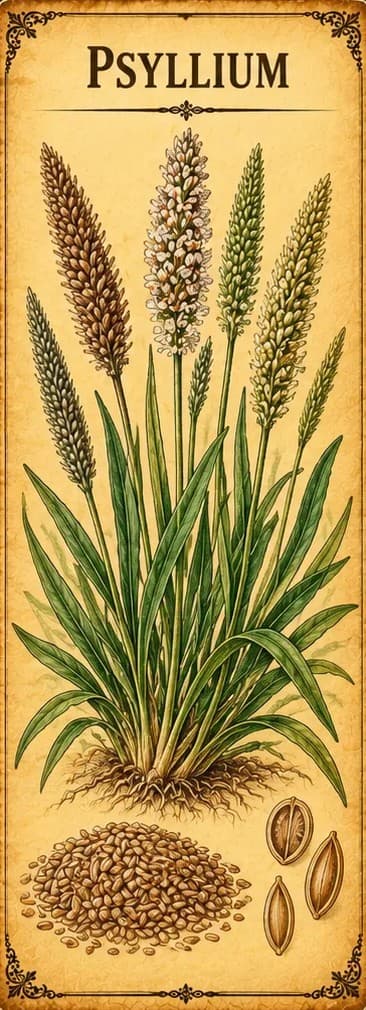
Psyllium
Plantago ovata
Ispaghula husk, a fiber that swells into a gel and works as a mild laxative. Recognized in Europe for constipation, and shown in trials to lower LDL cholesterol.
Safety at a glance
- Pregnancy1 note →
- BreastfeedingNothing recorded
- Medicines1 note →
- Who should avoid it2 notes →
- Allergies1 note →
- ToxicityNothing recorded
Tap a box to read the safety notes below. “Nothing recorded” means our sources don't cover it, not that it's safe.
Psyllium may interact with some medicines. If you take any medicine, read Interactions with medicines below and talk to your doctor or pharmacist before using it.
What is Psyllium?
- Plant family
- Plantaginaceae, the plantain family
- Parts used
- The seed husks (seed coats)
- Genus
- Plantago
- Species
- ovata
Also called
Ispaghula, Ispaghula Husk, Psyllium Husk
Traditionally used for
- Constipation
- Softening the stool
- High cholesterol (with diet)
- Irritable bowel syndrome with constipation
Traditionally described as
- Bulk-forming fiber
Health topics
Where Psyllium appears in symptom search, and why. Being listed doesn't mean it's a proven treatment.
- Constipation
Recognized in Europe, based on scientific evidence, for ongoing constipation and to soften the stool.
- High Cholesterol
A 2018 review of 28 trials found about 10 g a day lowered LDL cholesterol.
- Irritable Bowel Syndrome (IBS)
Recognized in Europe as added fiber for people with irritable bowel syndrome who are constipated.
How it's prepared
Common ways Psyllium is prepared or sold. This isn't advice on how to take it; see Safety below.
- Powder
The seed husks are used whole or powdered, and taken by mouth mixed with or followed by plenty of water, milk or juice.[1]Health agency
Safety
Interactions with medicines
Psyllium can delay the absorption of other medicines, such as minerals, vitamin B12, heart medicines like digoxin, warfarin, carbamazepine and lithium. Take it at least 30 to 60 minutes before or after other medicines. People with diabetes or taking thyroid hormone should use it only under medical supervision, because their dose may need changing. With opioids or other medicines that slow the gut, use it only under medical supervision.[1]Health agency
Who should avoid it
Don't use psyllium if you have:
- Trouble swallowing or throat problems
- A narrowing or blockage of the gut, or a gut that has stopped working
- A sudden change in bowel habit lasting more than 2 weeks
- Rectal bleeding that hasn't been diagnosed, or no bowel movement after using a laxative
Stop and get medical advice if you get stomach pain. See a doctor if constipation lasts more than 3 days.[1]Health agency
Not recommended for children under 6 for constipation, or under 12 for adding fiber. Older or frail people need medical supervision.[1]Health agency
Allergies
Psyllium contains strong allergens. Allergic reactions, including a runny nose, eye irritation, wheezing, rashes and itching, and sometimes anaphylaxis, can happen. People who handle the powder often, such as caregivers, can become allergic by breathing it in.[1]Health agency
Side effects
Always take psyllium with plenty of liquid, about 30 ml of water for every gram. Taken with too little liquid, it can block the throat or gut and cause choking, chest pain, vomiting, or trouble swallowing or breathing.[1]Health agency
Gas may occur and usually goes away as treatment continues. Bloating can also occur.[1]Health agency
Pregnancy
Psyllium may be used during pregnancy and breastfeeding if needed and if changing your diet hasn't helped. Bulk laxatives like psyllium should be tried before other laxatives.[1]Health agency
What does the research say?
Laboratory & animal research
Lab and animal results show what might be worth studying in people. They don't show that the herb has these effects in humans.
Psyllium husk is a dietary fiber. Mixed with water it forms a gel that works as a mild laxative: it bulks up and softens the stool as it moves through the gut. The effect starts 12 to 24 hours after taking it.[2]Health agency
Research in people
Based on scientific evidence, the European Medicines Agency recognizes psyllium husk for:
- Ongoing constipation
- Softening the stool when passing it is painful, such as with anal fissures, hemorrhoids or after surgery on the anus or rectum
- Adding fiber when that's advisable, such as for people with irritable bowel syndrome who are constipated, or alongside diet for high cholesterol
A 2018 review of 28 trials with 1,924 people found that about 10 g of psyllium a day lowered LDL ("bad") cholesterol, in people with or without high cholesterol.[3]Review or trial
Technical detail: LDL cholesterol MD −0.33 mmol/L (95% CI −0.38 to −0.27); non-HDL cholesterol and apolipoprotein B also reduced.
In short
Always take with plenty of water. Take other medicines 30 to 60 minutes apart.
Sources
- [1] Community herbal monograph on Plantago ovata Forssk., seminis tegumentum — European Medicines Agency, Committee on Herbal Medicinal Products (HMPC)Government health agency
- [2] Ispaghula husk: summary for the public (EMA/HMPC/313600/2013) — European Medicines Agency, Committee on Herbal Medicinal Products (HMPC)Government health agency
- [3] Effect of psyllium (Plantago ovata) fiber on LDL cholesterol and alternative lipid targets, non-HDL cholesterol and apolipoprotein B: a systematic review and meta-analysis of randomized controlled trials · DOI: 10.1093/ajcn/nqy115Review or clinical trial
This information is educational and traditional in nature, and is not a substitute for professional medical advice. Unfamiliar word? See what these words mean.