
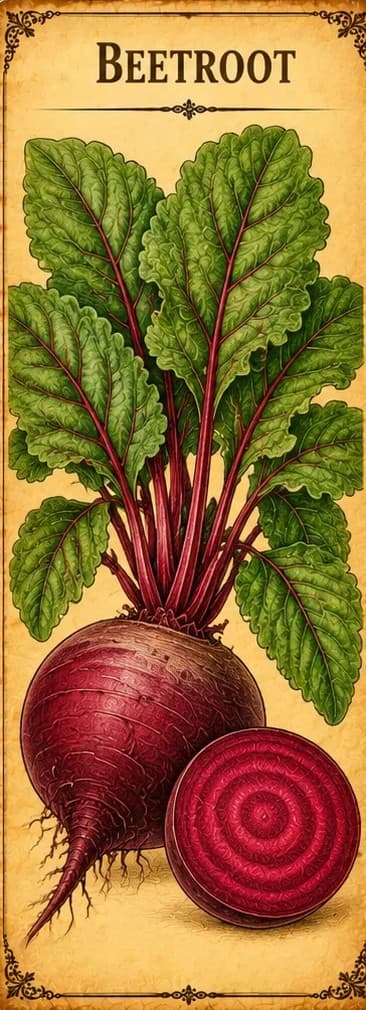
Beetroot
Beta vulgaris
A root vegetable whose juice is rich in nitrate. In short trials, beetroot juice lowered the top number of blood pressure by about 4 points.
Safety at a glance
- PregnancyNothing recorded
- BreastfeedingNothing recorded
- MedicinesNothing recorded
- Who should avoid itNothing recorded
- AllergiesNothing recorded
- Toxicity1 note →
Tap a box to read the safety notes below. “Nothing recorded” means our sources don't cover it, not that it's safe.
What is Beetroot?
- Plant family
- Amaranthaceae, the amaranth family
- Parts used
- The root, usually as juice
- Genus
- Beta
- Species
- vulgaris
Also called
Beet, Beetroot Juice
Traditionally used for
- Blood pressure (short-term trials)
- Sports performance
Traditionally described as
- High in nitrate
Health topics
Where Beetroot appears in symptom search, and why. Being listed doesn't mean it's a proven treatment.
- High Blood Pressure
A 2013 review of 16 short trials found beetroot juice lowered the top number by about 4 points.
How it's prepared
Common ways Beetroot is prepared or sold. This isn't advice on how to take it; see Safety below.
- Culinary Preparation
Beetroot is usually taken as juice, which is high in nitrate.[1]Review or trial
Safety
Toxicity testing
Drinking beetroot juice can easily push nitrate intake above the acceptable daily amount. Nitrate can lead to the formation of N-nitroso compounds in the body, which are known to cause cancer. Much less research has been done on these risks than on the benefits.[1]Review or trial
What does the research say?
Laboratory & animal research
Lab and animal results show what might be worth studying in people. They don't show that the herb has these effects in humans.
Beetroot juice is high in nitrate, which the body turns into nitric oxide. Nitric oxide relaxes blood vessels, which lowers blood pressure and increases the flow of oxygen and nutrients to organs and muscles.[1]Review or trial
Research in people
A 2013 review of 16 small trials with 254 people found that nitrate or beetroot juice lowered systolic blood pressure (the top number) by about 4 points compared with a placebo. The effect on the bottom number was smaller and not certain. The trials lasted from 2 hours to 15 days, so longer studies are needed.[2]Review or trial
Technical detail: SBP −4.4 mmHg (95% CI −5.9 to −2.8); DBP −1.1 mmHg (95% CI −2.2 to 0.1).
Beetroot juice has become popular with athletes, because the extra oxygen delivery may help muscle efficiency, endurance and sports performance.[1]Review or trial
In short
Large amounts of juice can push nitrate intake above the acceptable daily limit.
Sources
- [1] The benefits and risks of beetroot juice consumption: a systematic review · DOI: 10.1080/10408398.2020.1746629Review or clinical trial
- [2] Inorganic nitrate and beetroot juice supplementation reduces blood pressure in adults: a systematic review and meta-analysis · DOI: 10.3945/jn.112.170233Review or clinical trial
This information is educational and traditional in nature, and is not a substitute for professional medical advice. Unfamiliar word? See what these words mean.