
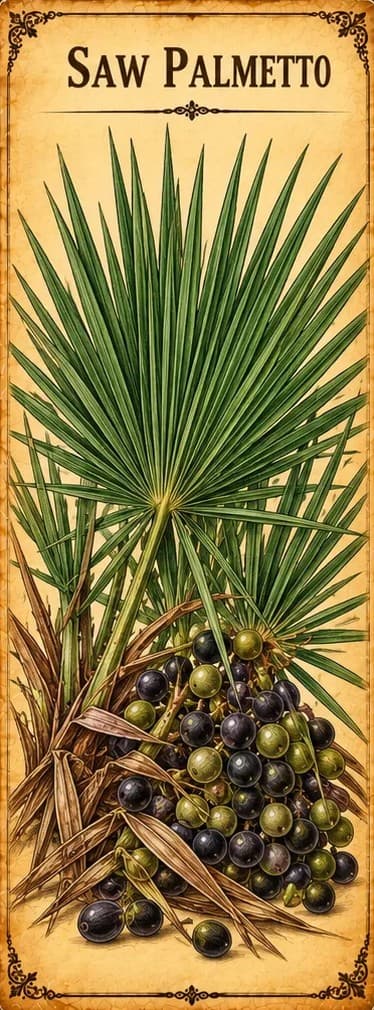
Saw Palmetto
Serenoa repens
A small palm whose berries are promoted for urinary symptoms of an enlarged prostate. A 2023 Cochrane review found little or no benefit over placebo.
Safety at a glance
- Pregnancy1 note →
- BreastfeedingNothing recorded
- Medicines1 note →
- Who should avoid it1 note →
- AllergiesNothing recorded
- ToxicityNothing recorded
Tap a box to read the safety notes below. “Nothing recorded” means our sources don't cover it, not that it's safe.
Saw Palmetto may interact with some medicines. If you take any medicine, read Interactions with medicines below and talk to your doctor or pharmacist before using it.
What is Saw Palmetto?
- Plant family
- Arecaceae, the palm family
- Parts used
- The berries (fruit)
- Where it grows
- The West Indies and the southeast coast of North America
- Genus
- Serenoa
- Species
- repens
Also called
Dwarf Palm
Older scientific names
Sabal serrulatum
Traditionally used for
- Enlarged prostate symptoms (little or no benefit in trials)
- Hair loss (not enough evidence)
Traditionally described as
- Berry extracts rich in fatty acids
Health topics
Where Saw Palmetto appears in symptom search, and why. Being listed doesn't mean it's a proven treatment.
- Enlarged Prostate (BPH)
Recognized in Europe for enlarged-prostate symptoms, but a 2023 Cochrane review found little or no benefit over placebo.
- Hair Loss
Studied for male-pattern hair loss, but the evidence is too limited to draw conclusions.
How it's prepared
Common ways Saw Palmetto is prepared or sold. This isn't advice on how to take it; see Safety below.
- Extract
Soft extracts of the berries, made with hexane or alcohol, are taken by mouth in capsules or tablets.[1]Health agency
Safety
Interactions with medicines
A few cases of a suspected interaction with the blood thinner warfarin have been reported, with a higher INR (blood clotting test).[1]Health agency
Who should avoid it
See a doctor if symptoms get worse, or if you have fever, spasms, blood in the urine, painful urination or can't pass urine.[1]Health agency
Side effects
Saw palmetto is well tolerated and has been used safely in studies for up to 3 years. Side effects are mild and uncommon, such as stomach upset, dizziness and headache. It doesn't seem to affect PSA blood test results.[2]Health agency
Other reported side effects include nausea, stomach pain (especially on an empty stomach), rash, raised liver enzymes, allergic reactions and, uncommonly, breast enlargement in men that goes away.[1]Health agency
Pregnancy
Saw palmetto may be unsafe during pregnancy or breastfeeding.[2]Health agency
What does the research say?
Traditional use
These are traditional uses, not proven treatments.
Saw palmetto is a small palm whose berries have been used for health. Today it's promoted for urinary symptoms of an enlarged prostate (benign prostatic hyperplasia, or BPH), male-pattern baldness and long-term prostate inflammation.[2]Health agency
Research in people
The European Medicines Agency recognizes a hexane extract of saw palmetto, based on scientific evidence, for the symptoms of an enlarged prostate. An alcohol extract is recognized as a traditional remedy for urinary symptoms of an enlarged prostate, after a doctor has ruled out serious conditions.[1]Health agency
A 2023 Cochrane review of 27 trials with 4,656 men found that saw palmetto alone makes little or no difference to urinary symptoms or quality of life compared with a placebo (high-certainty evidence). Ten of the studies were funded by drug companies.[3]Review or trial
Technical detail: IPSS MD −0.90 (95% CI −1.74 to −0.07) at 3–6 months, 9 low-risk-of-bias studies, 1,681 participants; adverse events RR 1.01 (95% CI 0.77 to 1.31).
Two NIH-funded trials, one using up to three times the usual dose, found saw palmetto didn't improve prostate symptoms, and hexane extracts worked no better than other kinds. A 2022 review found no clear benefit for long-term prostate inflammation and pelvic pain. Studies on hair loss are too few to draw conclusions.[2]Health agency
In short
Well tolerated. A few suspected interactions with warfarin. See a doctor about urinary symptoms.
Sources
- [1] European Union herbal monograph on Serenoa repens (W. Bartram) Small, fructus — European Medicines Agency, Committee on Herbal Medicinal Products (HMPC)Government health agency
- [2] Saw Palmetto: Usefulness and Safety — National Center for Complementary and Integrative Health (NIH)Government health agency
- [3] Serenoa repens for the treatment of lower urinary tract symptoms due to benign prostatic enlargement · DOI: 10.1002/14651858.CD001423.pub4Review or clinical trial
This information is educational and traditional in nature, and is not a substitute for professional medical advice. Unfamiliar word? See what these words mean.