
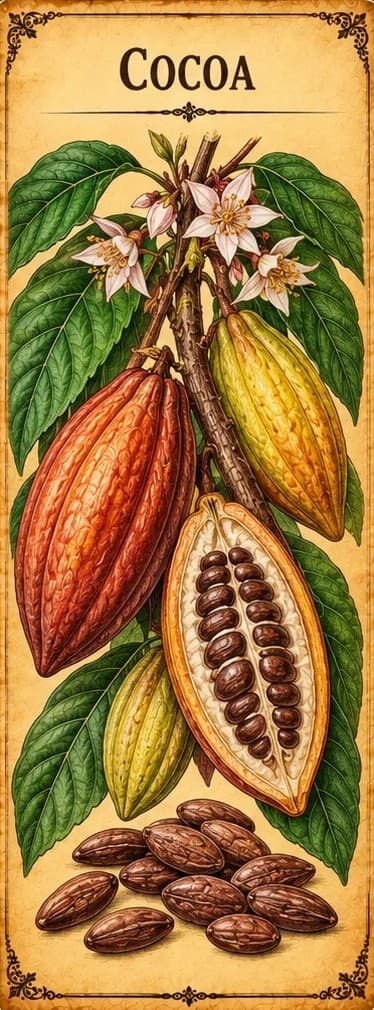
Cocoa
Theobroma cacao
The bean behind chocolate. Flavanol-rich cocoa lowered blood pressure slightly in a Cochrane review, and a large trial found fewer heart-related deaths.
Safety at a glance
- PregnancyNothing recorded
- BreastfeedingNothing recorded
- MedicinesNothing recorded
- Who should avoid itNothing recorded
- AllergiesNothing recorded
- ToxicityNothing recorded
Tap a box to read the safety notes below. “Nothing recorded” means our sources don't cover it, not that it's safe.
What is Cocoa?
- Plant family
- Malvaceae, the mallow family
- Parts used
- The beans (seeds), as cocoa and chocolate
- Genus
- Theobroma
- Species
- cacao
Also called
Cacao, Chocolate
Traditionally used for
- Blood pressure (small effect)
- Heart health (under study)
Traditionally described as
- Rich in flavanols
Health topics
Where Cocoa appears in symptom search, and why. Being listed doesn't mean it's a proven treatment.
- High Blood Pressure
A 2017 Cochrane review found flavanol-rich cocoa lowered blood pressure by about 2 points.
How it's prepared
Common ways Cocoa is prepared or sold. This isn't advice on how to take it; see Safety below.
- Capsule
Cocoa extract supplements standardized for flavanols are also sold.[1]Review or trial
- Culinary Preparation
Trials used flavanol-rich chocolate and cocoa drinks and powders, from about 1 to 105 grams of cocoa product a day.[2]Review or trial
Safety
Side effects
Cocoa products were well tolerated in trials. About 1% of people had stomach complaints or nausea.[2]Review or trial
The COSMOS trial found no safety concerns with a cocoa extract supplement taken for several years.[1]Review or trial
What does the research say?
Laboratory & animal research
Lab and animal results show what might be worth studying in people. They don't show that the herb has these effects in humans.
Cocoa contains flavanols, which help the blood vessel lining make nitric oxide. Nitric oxide relaxes blood vessels, which may lower blood pressure.[2]Review or trial
Research in people
A 2017 Cochrane review of 35 trials with 1,804 mostly healthy people found that flavanol-rich cocoa products lowered blood pressure a little (by about 2 points) over 2 to 18 weeks, compared with low-flavanol products. Results varied between trials, and the effect seemed bigger in trials where people knew what they were taking.[2]Review or trial
Technical detail: SBP −1.76 mmHg (95% CI −3.09 to −0.43); DBP −1.76 mmHg (95% CI −2.57 to −0.94); flavanol doses 30–1,218 mg/day.
In the COSMOS trial of 21,442 older US adults, a cocoa extract supplement taken for a median of 3.6 years didn't significantly lower total heart attacks, strokes and other cardiovascular events, but deaths from cardiovascular disease were 27% lower than with a placebo. More research is needed.[1]Review or trial
Technical detail: 500 mg flavanols/day; total CVD events HR 0.90 (95% CI 0.78 to 1.02); CVD death HR 0.73 (95% CI 0.54 to 0.98).
In short
Well tolerated in trials; occasional stomach upset.
Sources
- [1] Effect of cocoa flavanol supplementation for the prevention of cardiovascular disease events: the COcoa Supplement and Multivitamin Outcomes Study (COSMOS) randomized clinical trial · DOI: 10.1093/ajcn/nqac055Review or clinical trial
- [2] Effect of cocoa on blood pressure · DOI: 10.1002/14651858.CD008893.pub3Review or clinical trial
This information is educational and traditional in nature, and is not a substitute for professional medical advice. Unfamiliar word? See what these words mean.