
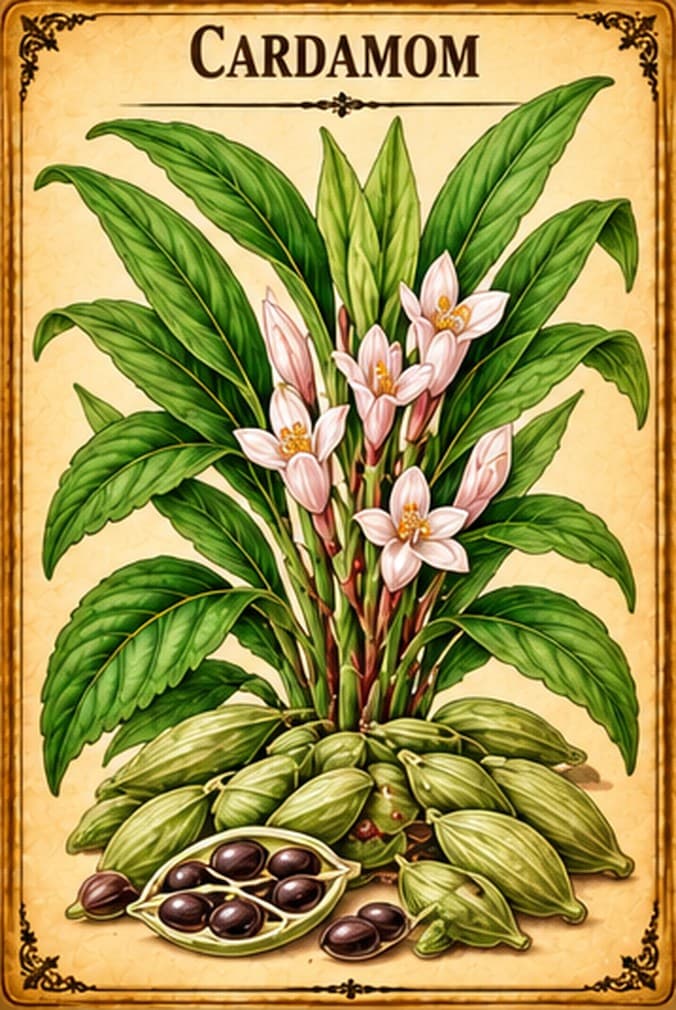
Cardamom
Elettaria cardamomum
A spice from the ginger family. Reviews of small trials found it lowered some blood fats, inflammation markers and blood pressure slightly.
Safety at a glance
- PregnancyNothing recorded
- BreastfeedingNothing recorded
- MedicinesNothing recorded
- Who should avoid itNothing recorded
- AllergiesNothing recorded
- ToxicityNothing recorded
Tap a box to read the safety notes below. “Nothing recorded” means our sources don't cover it, not that it's safe.
What is Cardamom?
- Plant family
- Zingiberaceae, the ginger family
- Parts used
- The seed pods and seeds
- Where it grows
- India, Indonesia and other parts of tropical and subtropical Asia
- Genus
- Elettaria
- Species
- cardamomum
Also called
Green Cardamom
Traditionally used for
- Spice
- Cholesterol
- Blood pressure
Traditionally described as
- Seed pods and seeds
Health topics
Where Cardamom appears in symptom search, and why. Being listed doesn't mean it's a proven treatment.
- High Blood Pressure
A 2023 review of 8 trials found a slight drop in blood pressure; few studies.
- High Blood Sugar
In a small trial in type 2 diabetes, 3 g a day for 10 weeks lowered HbA1c.
- High Cholesterol
A 2024 review of 12 trials found it lowered total cholesterol and triglycerides, but not LDL.
Natural compounds
How it's prepared
Common ways Cardamom is prepared or sold. This isn't advice on how to take it; see Safety below.
- Capsule
In trials, people took about 3 g of green cardamom a day, for example as two 500 mg capsules three times a day.[1]Study
- Culinary Preparation
Cardamom is used as a spice to flavor food.[1]Study
What does the research say?
Laboratory & animal research
Lab and animal results show what might be worth studying in people. They don't show that the herb has these effects in humans.
Cardamom is rich in phenolic compounds and volatile and fixed oils. In rats, cardamom lowered cholesterol and blood pressure, and two of its oil compounds, 1,8-cineole and alpha-terpineol, also lowered blood pressure. In the lab, cardamom extracts slowed enzymes that break down starch into sugar.[1]Study
Research in people
A 2021 review gathered small trials in which people took 3 g of cardamom a day:
- In people with mild high blood pressure, 12 weeks lowered blood pressure from about 154/92 to 135/80.
- In women with prediabetes, 8 weeks didn't significantly change blood pressure, possibly because the study was short and small.
- In people with type 2 diabetes, 10 weeks lowered HbA1c (a measure of average blood sugar), insulin and triglycerides compared with a placebo.
- In people with fatty liver disease, 3 months reduced inflammation markers and the degree of fatty liver.
The authors say larger randomized trials are still needed.[1]Study
A 2024 review of 12 trials with 989 adults found cardamom lowered total cholesterol, triglycerides and two markers of inflammation. It didn't change HDL ("good") or LDL ("bad") cholesterol. The authors say larger, better-designed trials are needed.[2]Review or trial
Technical detail: total cholesterol WMD −8.56 mg/dL (95% CI −14.90 to −2.22); triglycerides WMD −14.09 mg/dL (95% CI −24.01 to −4.17); hs-CRP WMD −1.01; IL-6 WMD −1.81 pg/mL.
A 2023 review of 8 trials found cardamom lowered markers of inflammation and slightly lowered blood pressure. Because there were few studies, the authors say the results should be interpreted with caution.[3]Review or trial
Technical detail: diastolic BP WMD −0.90 mmHg (95% CI −1.07 to −0.73); hs-CRP SMD −0.60; IL-6 WMD −1.25.
In short
No safety studies found.
Sources
- [1] The effect of Elettaria cardamomum (cardamom) on the metabolic syndrome: Narrative review · DOI: 10.22038/ijbms.2021.54417.12228Peer-reviewed study
- [2] Cardamom consumption may improve cardiovascular metabolic biomarkers in adults: A systematic review and meta-analysis of randomized controlled trials · DOI: 10.1016/j.nutres.2024.03.002Review or clinical trial
- [3] Effect of cardamom consumption on inflammation and blood pressure in adults: A systematic review and meta-analysis of randomized clinical trials · DOI: 10.1002/fsn3.3738Review or clinical trial
This information is educational and traditional in nature, and is not a substitute for professional medical advice. Unfamiliar word? See what these words mean.