
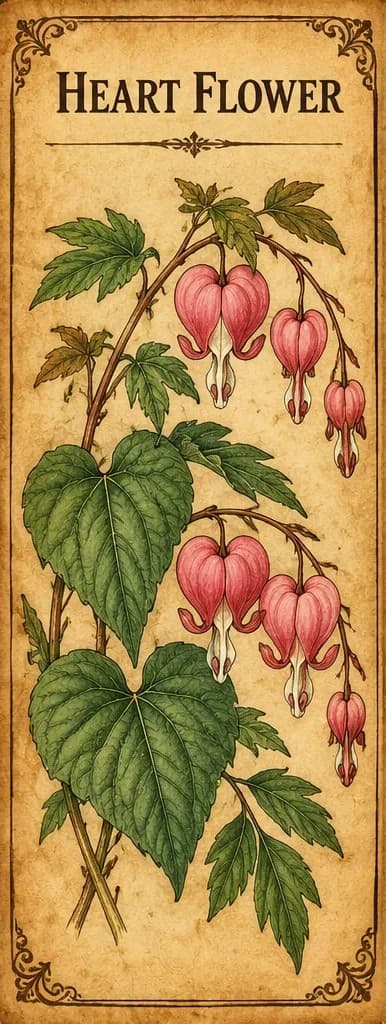
Heart Flower
Lamprocapnos spectabilis
Better known as bleeding heart, a garden plant with heart-shaped pink flowers. Compounds from it have only been studied in the lab, and eating it has caused poisoning.
Safety at a glance
- PregnancyNothing recorded
- BreastfeedingNothing recorded
- MedicinesNothing recorded
- Who should avoid itNothing recorded
- AllergiesNothing recorded
- Toxicity1 note →
Tap a box to read the safety notes below. “Nothing recorded” means our sources don't cover it, not that it's safe.
What is Heart Flower?
- Plant family
- Papaveraceae, the poppy family
- Parts used
- The root and the above-ground plant have been studied in the lab
- Where it grows
- Northern China, Korea and Siberia; grown in gardens in North America, Europe and Asia
- Genus
- Lamprocapnos
- Species
- spectabilis
Also called
Bleeding Heart
Older scientific names
Dicentra spectabilis
Traditionally used for
- Garden ornamental
Traditionally described as
- Kills some cancer cells (in lab studies)
Natural compounds
Safety
Toxicity testing
Don't eat bleeding heart. Doctors in Korea reported a case of anticholinergic poisoning after someone ate the plant. That kind of poisoning can cause confusion, a fast heartbeat, dry mouth and widened pupils.[1]Study
What does the research say?
Laboratory & animal research
Lab and animal results show what might be worth studying in people. They don't show that the herb has these effects in humans.
Bleeding heart contains two compounds, menisdaurilide and aquilegiolide, in large amounts. In lab tests, both made human tumor cells self-destruct.[2]Study
Technical detail: butenolides; apoptosis induced at 10 µM.
In lab tests, extracts of the root and the above-ground plant killed melanoma (skin cancer) cells. The above-ground extract also reduced the number of human melanoma cells growing in zebrafish larvae. The authors say this is a basis for further research.[3]Study
Technical detail: isoquinoline alkaloids measured by HPLC-DAD and LC-MS/MS; A375, G-361 and SK-MEL-3 cell lines; zebrafish xenograft model.
In short
Don't eat it: a case of poisoning after eating the plant has been reported.
Sources
- [1] Anticholinergic syndrome following ingestion of Lamprocapnos spectabilis (Bleeding Heart) · DOI: 10.3109/15563650.2015.1066506Peer-reviewed study
- [2] Discovery of the apoptosis-inducing activity and high accumulation of the butenolides, menisdaurilide and aquilegiolide in Dicentra spectabilis · DOI: 10.1055/s-2007-990264Peer-reviewed study
- [3] Determination of Some Isoquinoline Alkaloids in Extracts Obtained from Selected Plants of the Ranunculaceae, Papaveraceae and Fumarioideae Families by Liquid Chromatography and In Vitro and In Vivo Investigations of Their Cytotoxic Activity · DOI: 10.3390/molecules28083503Peer-reviewed study
This information is educational and traditional in nature, and is not a substitute for professional medical advice. Unfamiliar word? See what these words mean.