
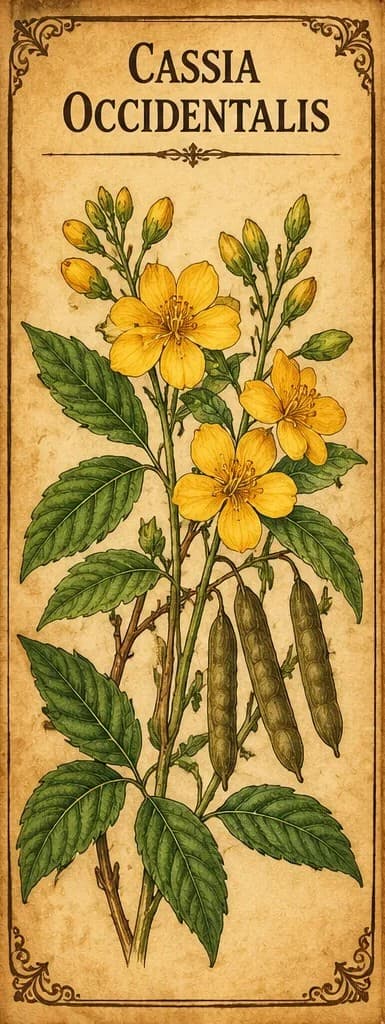
Cassia Occidentalis
Senna occidentalis
A tropical weed, also called coffee senna, used in Ayurveda and other traditional medicine. Its seeds have caused deadly poisoning in children in India, and the leaves have caused fatal liver failure.
Safety at a glance
- PregnancyNothing recorded
- BreastfeedingNothing recorded
- MedicinesNothing recorded
- Who should avoid itNothing recorded
- AllergiesNothing recorded
- Toxicity3 notes →
Tap a box to read the safety notes below. “Nothing recorded” means our sources don't cover it, not that it's safe.
What is Cassia Occidentalis?
- Plant family
- Fabaceae, the pea and bean family
- Parts used
- The leaves, roots and seeds
- Where it grows
- The tropical Americas; now a common weed throughout the tropics
- Genus
- Senna
- Species
- occidentalis
Also called
Coffee Senna
Older scientific names
Senna occidentalis
Traditionally used for
- Fever
- Arthritis
Traditionally described as
- Antibacterial (in lab studies)
- Lowers blood sugar (in animal studies)
Traditions that use it
- Ayurveda
Described as an Ayurvedic plant used in several traditional medicine systems.
Natural compounds
Safety
Side effects
This isn't the senna used as a laxative, which comes from different Senna species.[1]Study
Toxicity testing
Don't eat the seeds or beans. In northern India, children who ate them developed a severe illness affecting the liver, muscles and brain. Up to 76% of such cases have died, most within 48 hours.[1]Study
In three children from North India who ate the seeds, the illness began with drowsiness, jaundice (yellow skin and eyes) and confusion. It can be mistaken for a viral brain infection, so tell doctors if a child may have eaten the seeds.[2]Study
A 75-year-old woman who took the leaves for 2 weeks for knee arthritis developed vomiting, diarrhea, jaundice and seizures, and died of liver failure within 5 days. The authors say this poisoning is unpredictable and its danger is greatly underestimated.[1]Study
What does the research say?
Traditional use
These are traditional uses, not proven treatments.
Cassia occidentalis is a weed used in Ayurveda and several other traditional medicine systems for many illnesses. In India, an older woman took the leaves for knee arthritis (see Safety for what happened).[3]Study
Laboratory & animal research
Lab and animal results show what might be worth studying in people. They don't show that the herb has these effects in humans.
In lab and animal studies, extracts killed some bacteria and fungi, lowered blood sugar, may help reduce inflammation and protected the liver. Many compounds have been found in the plant, including emodin, aloe-emodin and other anthraquinones.[3]Study
Technical detail: reported antibacterial, antifungal, antidiabetic, anti-inflammatory, anticancer, antimutagenic and hepatoprotective activity.
The seeds contain five anthraquinones that were also found in the blood and urine of poisoned children and rats. In lab tests, they damaged liver cells; rhein was the most harmful.[4]Study
Technical detail: physcion, emodin, rhein, aloe-emodin and chrysophanol; rat primary hepatocytes and HepG2 cells.
In short
The seeds and leaves can cause fatal liver, muscle and brain damage, especially in children.
Sources
- [1] Senna occidentalis Poisoning: An Uncommon Cause of Liver Failure · DOI: 10.14309/crj.0000000000000035Peer-reviewed study
- [2] Hepatomyoencephalopathy Secondary to Cassia occidentalis Poisoning: Report of Three Cases from North India · DOI: 10.4103/ijccm.IJCCM_85_18Peer-reviewed study
- [3] Cassia occidentalis L.: a review on its ethnobotany, phytochemical and pharmacological profile · DOI: 10.1016/j.fitote.2009.09.008Peer-reviewed study
- [4] Activity-guided chemo toxic profiling of Cassia occidentalis (CO) seeds: detection of toxic compounds in body fluids of CO-exposed patients and experimental rats · DOI: 10.1021/acs.chemrestox.5b00056Peer-reviewed study
This information is educational and traditional in nature, and is not a substitute for professional medical advice. Unfamiliar word? See what these words mean.