
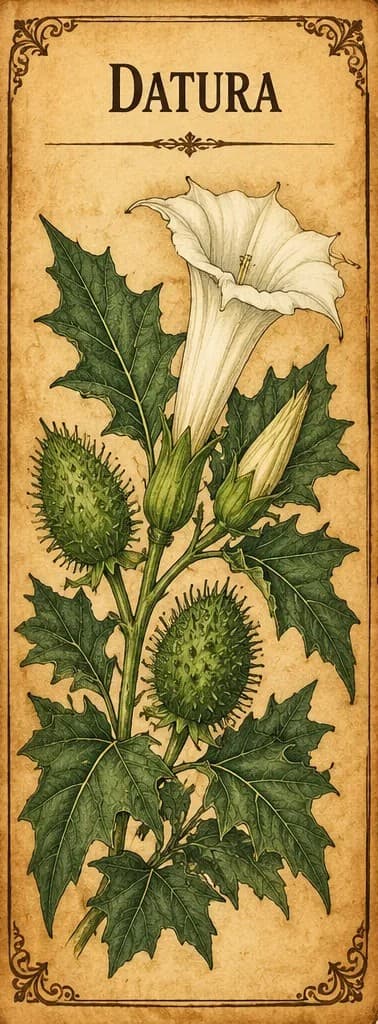
Datura
Datura stramonium
Also called jimsonweed or thorn apple, a highly poisonous plant once used in Ayurveda for asthma, pain and wounds. All parts, especially the seeds, can cause hallucinations, seizures and death.
Safety at a glance
- Pregnancy1 note →
- BreastfeedingNothing recorded
- MedicinesNothing recorded
- Who should avoid it1 note →
- AllergiesNothing recorded
- Toxicity1 note →
Tap a box to read the safety notes below. “Nothing recorded” means our sources don't cover it, not that it's safe.
What is Datura?
- Plant family
- Solanaceae, the nightshade family
- Parts used
- The leaves, seeds and bark (all parts are poisonous)
- Where it grows
- The Americas; now a widespread weed in warm and temperate regions
- Genus
- Datura
- Species
- stramonium
Also called
Jimsonweed, Thorn Apple, Devil's Trumpet
Traditionally used for
- Asthma
- Rheumatism
- Wounds and ulcers
- Toothache
Traditionally described as
- Poisonous
- Hallucinogenic
Traditions that use it
- Ayurveda
Used for wounds, ulcers, rheumatism, fever, inflammation, asthma and toothache; leaves were smoked in a pipe for allergies.
Natural compounds
Safety
Who should avoid it
Don't use datura if you have glaucoma, an enlarged prostate, a fast or irregular heartbeat, a blocked or paralyzed bowel, a narrowed stomach outlet (pyloric stenosis) or fluid on the lungs.[1]Study
Side effects
People who take datura recreationally for its hallucinogenic effects have been seriously poisoned.[1]Study
Pregnancy
The review warns that exposure before birth may cause lasting harm to the baby. Don't use it while pregnant.[1]Study
Toxicity testing
Every part of datura is poisonous, and the seeds are the most poisonous. Drying or boiling doesn't destroy the poison. Poisoning can cause dry mouth and skin, widened pupils, blurred vision, a fast heartbeat, fever, confusion, hallucinations, seizures, coma and death. Get emergency help if someone may have eaten it.[1]Study
Contamination
Datura seeds can get mixed into grain and bean harvests. In Uganda in 2019, contaminated food aid poisoned 293 people and 5 died. Symptoms included confusion, dizziness, diarrhea, vomiting, seizures and hallucinations, starting 2 to 12 hours after eating.[2]Study
What does the research say?
Traditional use
These are traditional uses, not proven treatments.
In Ayurveda, datura has been used for:
- wounds, ulcers, burns and swellings (the bark, applied to the skin)
- rheumatism and sciatica pain (as an ointment)
- asthma and sinus problems (the leaf, taken by mouth, or smoked)
- fever, inflammation and toothache
The seeds have also been smoked for their hallucinogenic effect, and the plant is used in religious rituals.[1]Study
Laboratory & animal research
Lab and animal results show what might be worth studying in people. They don't show that the herb has these effects in humans.
In lab tests, seed extracts showed antioxidant activity and killed breast cancer cells. Leaf extracts killed some bacteria and repelled or killed mosquito larvae.[1]Study
Technical detail: methanolic seed extract DPPH IC50 94.87 µg/mL; MCF-7 IC50 113.05 µg/mL; larvicidal against Aedes aegypti, Anopheles stephensi and Culex quinquefasciatus.
Research in people
The 2021 review mentions a study in which people with mild asthma inhaled smoke from datura cigarettes and their airways opened slightly. It gives no details of how many people took part, and no controlled trials in people were found.[1]Study
In short
Every part is poisonous, and drying or boiling doesn't make it safe.
Sources
- [1] Phytochemistry, Pharmacology, and Toxicology of Datura Species—A Review · DOI: 10.3390/antiox10081291Peer-reviewed study
- [2] Large outbreak of Jimsonweed (Datura stramonium) poisoning due to consumption of contaminated humanitarian relief food: Uganda, March-April 2019 · DOI: 10.1186/s12889-022-12854-1Peer-reviewed study
This information is educational and traditional in nature, and is not a substitute for professional medical advice. Unfamiliar word? See what these words mean.