
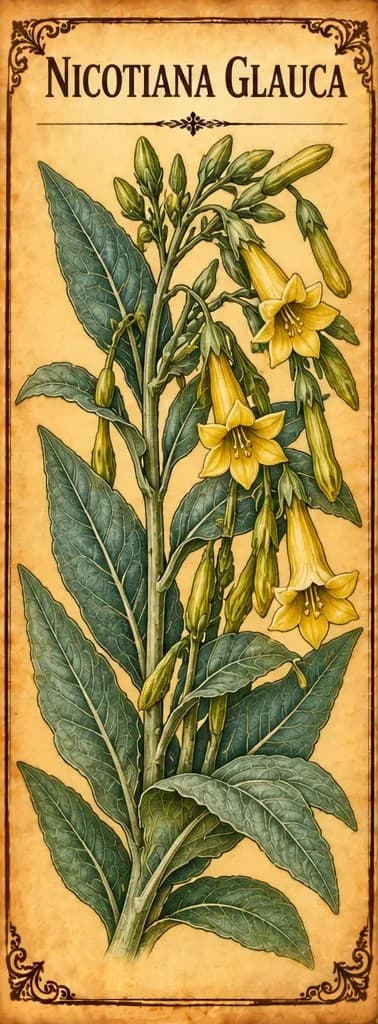
Nicotiana Glauca
Nicotiana glauca
Tree tobacco, a yellow-flowered shrub from South America that now grows wild in dry regions worldwide. Its leaves contain anabasine, a nicotine-like poison; eating them has stopped people breathing.
Safety at a glance
- PregnancyNothing recorded
- BreastfeedingNothing recorded
- MedicinesNothing recorded
- Who should avoid itNothing recorded
- AllergiesNothing recorded
- Toxicity2 notes →
Tap a box to read the safety notes below. “Nothing recorded” means our sources don't cover it, not that it's safe.
What is Nicotiana Glauca?
- Plant family
- Solanaceae, the nightshade family
- Parts used
- The leaves (poisonous)
- Where it grows
- Argentina and Bolivia; now a weed in dry regions in 66 countries
- Genus
- Nicotiana
- Species
- glauca
Also called
Tree Tobacco
Traditionally used for
- None recommended
Traditionally described as
- Poisonous
- Antioxidant (in lab studies)
Natural compounds
Safety
Toxicity testing
Don't eat any part of this plant. A 65-year-old woman boiled and ate a few leaves of a new plant "with yellow flowers". Within about an hour she vomited, felt weak, and then stopped breathing and couldn't move. She needed a breathing machine for 3 days before recovering fully.[1]Study
Its poison, anabasine, first causes a fast heartbeat, small pupils and trembling. Larger amounts can stop breathing, cause paralysis and collapse the heart and circulation. Poisoning can also happen through the skin.[1]Study
What does the research say?
Laboratory & animal research
Lab and animal results show what might be worth studying in people. They don't show that the herb has these effects in humans.
In short
Eating even a few leaves can cause paralysis and stop breathing.
Sources
- [1] Ingestion of A Common Plant's Leaves Leads to Acute Respiratory Arrest and Paralysis: A Case Report · DOI: 10.5811/cpcem.2020.5.46703Peer-reviewed study
- [2] Persistent foliar anabasine and unusually broad geographic distribution make Nicotiana glauca a distinctive toxicological concern · DOI: 10.1016/j.toxicon.2026.109325Peer-reviewed study
- [3] Nicotiana glauca leaf extract exhibits synergistic antioxidant and anticancer activities revealed by phytochemical profiling and molecular docking · DOI: 10.1038/s41598-026-67585-9Peer-reviewed study
This information is educational and traditional in nature, and is not a substitute for professional medical advice. Unfamiliar word? See what these words mean.