
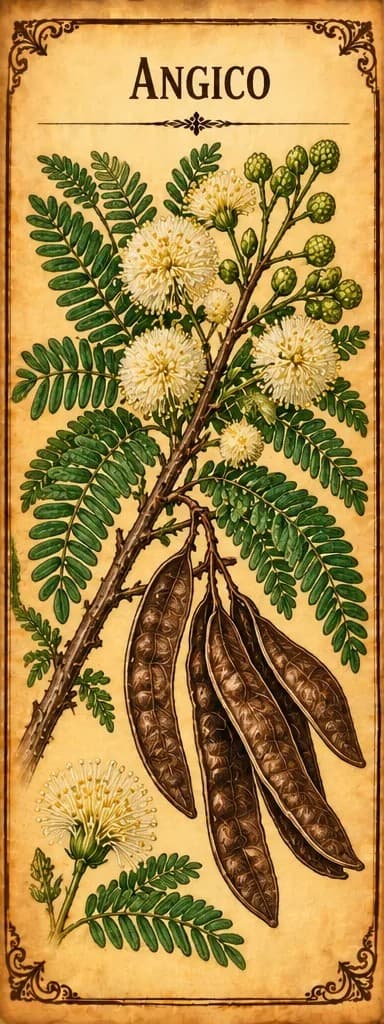
Angico
Anadenanthera colubrina
A South American tree whose bark is widely used in Brazil for lung and breathing problems, inflammation and infections. Its seeds, called vilca or cebil, contain hallucinogens and are used as a ritual snuff in the Andes.
Safety at a glance
- PregnancyNothing recorded
- BreastfeedingNothing recorded
- MedicinesNothing recorded
- Who should avoid itNothing recorded
- AllergiesNothing recorded
- Toxicity1 note →
Tap a box to read the safety notes below. “Nothing recorded” means our sources don't cover it, not that it's safe.
What is Angico?
- Plant family
- Fabaceae, the pea and bean family
- Parts used
- The bark, leaves, gum and seeds
- Where it grows
- Dry forests and savannas of Brazil, Argentina, Paraguay and Bolivia, and the Andes of Peru
- Genus
- Anadenanthera
- Species
- colubrina
Also called
Red Angico
Regional names
Cebil, Vilca
Traditionally used for
- Lung problems
- Coughs
- Inflammation
- Infections
- Wounds
- Ritual snuff (seeds)
Traditionally described as
- May help reduce inflammation (in animal studies)
- Antioxidant (in lab studies)
Natural compounds
Safety
Toxicity testing
The seeds contain strong hallucinogens (bufotenine, DMT and 5-MeO-DMT) that can harm the heart and nerves.[1]Study
What does the research say?
Traditional use
These are traditional uses, not proven treatments.
Guaraní, Tupí and Wichí communities have long used angico in healing and ritual. It's used for breathing problems, inflammation and infections. In the Caatinga of northeastern Brazil, it's widely used for lung diseases.[1]Study
The seeds, called vilca or cebil, were used as a ritual snuff by pre-Hispanic peoples of the southern Andes. Market research in Argentina, Bolivia and Peru found the seeds are still sold and used to restore health.[2]Study
Laboratory & animal research
Lab and animal results show what might be worth studying in people. They don't show that the herb has these effects in humans.
In rats with damaged lungs (emphysema), a bark extract reduced lung inflammation and damage. It didn't damage the rats' genes or blood cells.[3]Study
Technical detail: hydroethanolic stem-bark extract; elastase-induced emphysema; reduced TNF-α, IL-1β, IL-6, myeloperoxidase and malondialdehyde; micronucleus test negative.
In lab tests, a bark extract from northern Peru was rich in polyphenols, showed strong antioxidant activity and may help reduce inflammation.[4]Study
Technical detail: DPPH 747.6 mg Trolox equivalents/g; FRAP 435.9 mg FeSO4 equivalents/g; inhibited heat-induced ovalbumin denaturation.
In animal studies, bark and leaf extracts may help reduce inflammation and pain, killed some microbes, eased diarrhea and helped wounds heal. The gum also helped wounds heal and appears to be low in toxicity.[1]Study
In short
The seeds contain strong hallucinogens that can harm the heart and nerves.
Sources
- [1] Beyond a Psychotropic Plant: Exploring the Ethnomedicinal Value of Anadenanthera colubrina var. cebil · DOI: 10.2174/0113895575418590260116110240Peer-reviewed study
- [2] Contemporary Uses of Vilca (Anadenanthera colubrina var cebil): A Major Ritual Plant in the Andes · DOI: 10.3390/plants13172398Peer-reviewed study
- [3] Anti-inflammatory effect of Anadenanthera colubrina var. cebil (Griseb.) Altschul in experimental elastase-induced pulmonary emphysema in rats · DOI: 10.1016/j.jep.2024.118216Peer-reviewed study
- [4] In vitro antioxidant and anti-inflammatory activities and total polyphenol and flavonoid contents of Anadenanthera colubrina from northern Peru · DOI: 10.17843/rpmesp.2026.431.15207Peer-reviewed study
This information is educational and traditional in nature, and is not a substitute for professional medical advice. Unfamiliar word? See what these words mean.